

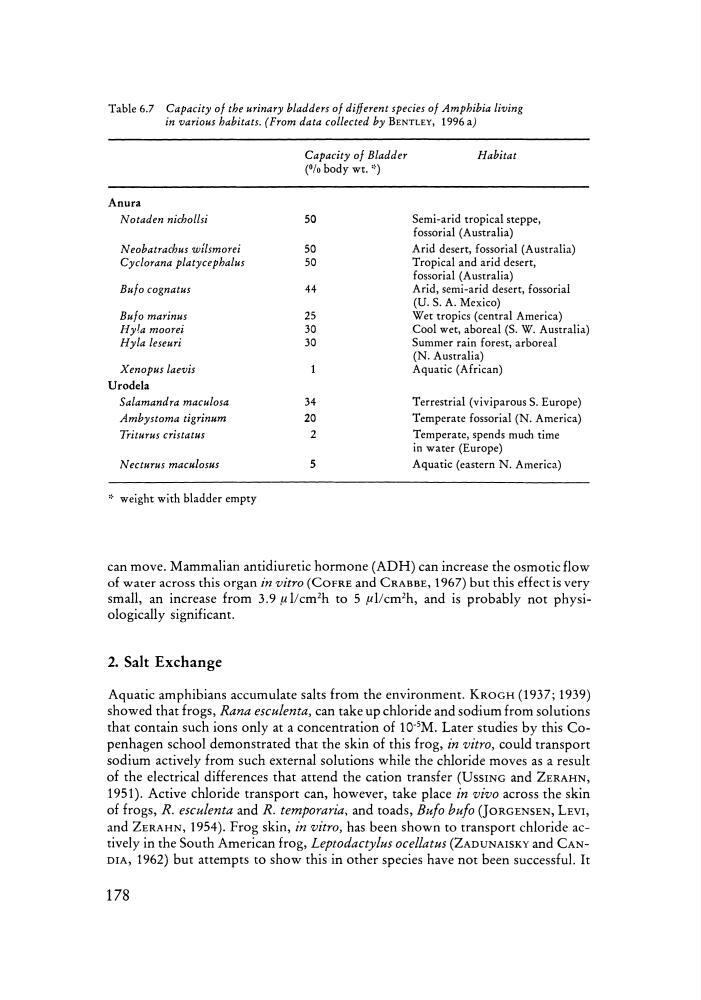
Table 6.7 Capacity of the urinary bladders of different species of Amphibia living
in various habitats. (From data collected by BENTLEY, 1996a)
Anura
Notaden nichollsi
N eobatrachus tullsmorei
Cyclorana platycephalus
Bufo cognatus
Bu]o marinus
Hyla moorei
Hyla leseuri
Xenopus laeois
Urodela
Salamandra maculosa
Ambystoma tigrinum
Triturus crlstatus
Neeturus maculosus
':. weight with bladder empty
Capacity of Bladder
(0/0 body wt . ,:-)
50
50
50
44
25
30
30
34
20
2
5
Habitat
Semi-arid tropical steppe,
fossorial (Australia)
Arid desert, fossorial (Australia)
Tropical and arid desert,
fossorial (Australia)
Arid, semi-arid desert, fossorial
(U . S. A. Mexico)
Wet tropics (central America)
Cool wet, aboreal (5. W. Australia)
Summer rain forest, arboreal
(N . Australia)
Aquatic (African)
Terrestrial (viviparous S. Europe)
Temperate fossorial (N. America)
Temperate, spends much time
in water (Europe)
Aquatic (eastern N . America)
can move. Mammalian antidiuretic hormone (ADH) can increase the osmotic flow
of water across this organ in vitro (CaFRE and CRABBE, 1967) but this effect is very
small, an increase from 3.9 .u 11crn-h to 5 .u11crrr'h, and is probably not physiologically significant.
2. Salt Exchange
Aquatic amphibians accumulate salts from the environment. KROGH (1937; 1939)
showed that frogs, Rana esculenta, can take up chloride and sodium from solutions
that contain such ions only at a concentration of 1a·sM . Later studies by this Copenhagen school demonstrated that the skin of this frog, in vitro, could transport
sodium actively from such external solutions while the chloride moves as a result
of the electrical differences that attend the cation transfer (USSING and ZERAHN,
1951). Active chloride transport can, however, take place in vivo across the skin
of frogs, R. esculenta and R . temporaria, and toads, Bufo bufo (JORGENSEN, LEVI,
and ZERAHN, 1954). Frog skin, in vitro, has been shown to transport chloride actively in the South American frog, Leptodactylus ocellatus (ZADUNAISKY and CANDIA, 1962) but attempts to show this in other species have not been successful. It
178
in various habitats. (From data collected by BENTLEY, 1996a)
Anura
Notaden nichollsi
N eobatrachus tullsmorei
Cyclorana platycephalus
Bufo cognatus
Bu]o marinus
Hyla moorei
Hyla leseuri
Xenopus laeois
Urodela
Salamandra maculosa
Ambystoma tigrinum
Triturus crlstatus
Neeturus maculosus
':. weight with bladder empty
Capacity of Bladder
(0/0 body wt . ,:-)
50
50
50
44
25
30
30
34
20
2
5
Habitat
Semi-arid tropical steppe,
fossorial (Australia)
Arid desert, fossorial (Australia)
Tropical and arid desert,
fossorial (Australia)
Arid, semi-arid desert, fossorial
(U . S. A. Mexico)
Wet tropics (central America)
Cool wet, aboreal (5. W. Australia)
Summer rain forest, arboreal
(N . Australia)
Aquatic (African)
Terrestrial (viviparous S. Europe)
Temperate fossorial (N. America)
Temperate, spends much time
in water (Europe)
Aquatic (eastern N . America)
can move. Mammalian antidiuretic hormone (ADH) can increase the osmotic flow
of water across this organ in vitro (CaFRE and CRABBE, 1967) but this effect is very
small, an increase from 3.9 .u 11crn-h to 5 .u11crrr'h, and is probably not physiologically significant.
2. Salt Exchange
Aquatic amphibians accumulate salts from the environment. KROGH (1937; 1939)
showed that frogs, Rana esculenta, can take up chloride and sodium from solutions
that contain such ions only at a concentration of 1a·sM . Later studies by this Copenhagen school demonstrated that the skin of this frog, in vitro, could transport
sodium actively from such external solutions while the chloride moves as a result
of the electrical differences that attend the cation transfer (USSING and ZERAHN,
1951). Active chloride transport can, however, take place in vivo across the skin
of frogs, R. esculenta and R . temporaria, and toads, Bufo bufo (JORGENSEN, LEVI,
and ZERAHN, 1954). Frog skin, in vitro, has been shown to transport chloride actively in the South American frog, Leptodactylus ocellatus (ZADUNAISKY and CANDIA, 1962) but attempts to show this in other species have not been successful. It
178