

/
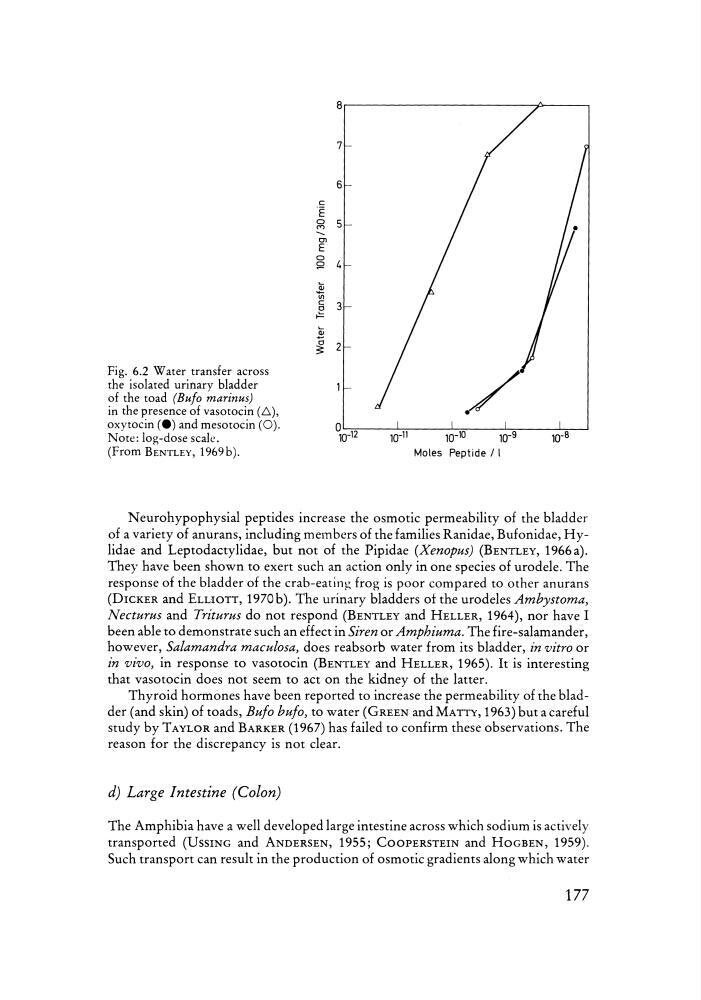
Fig. 6.2 Water transfer across
the isolated urinary bladder
of the toad (Bufo marinus)
in the presence of vasotocin (6),
oxytocin (e) and rnesotocin (0).
Note : log-dose scale.
(From BENTLEY, 1969b).
8
7
6
c
E
0
5
(T')
<,
01
E
0
4
s;1
~
~
Vl
c 3
0
.=
~
0 2
~
Neurohypophysial peptides increase the osmotic permeability of the bladder
of a variety of anurans, including members of the families Ranidae, Bufonidae, Hylidae and Leptodactylidae, but not of the Pipidae (Xenopus) (BENTLEY, 1966 a).
They have been shown to exert such an action only in one species of urodele. The
response of the bladder of the crab-eating frog is poor compared to other anurans
(DICKER and ELLIOTT, 1970 b). The urinary bladders of the urodeles Ambystoma,
Necturus and Triturus do not respond (BENTLEY and HELLER, 1964), nor have I
been able to demonstrate such an effect in Siren or Amphiuma. The fire-salamander,
however, Salamandra maculosa, does reabsorb water from its bladder, in vitro or
in vivo, in response to vasotocin (BENTLEY and HELLER, 1965). It is interesting
that vasotocin does not seem to act on the kidney of the latter.
Thyroid hormones have been reported to increase the permeability of the bladder (and skin) of toads, Bufo bufo, to water (GREENand MATTY, 1963) but a careful
study by TAYLOR and BARKER (1967) has failed to confirm these observations. The
reason for the discrepancy is not clear.
d) Large Intestine (Colon)
The Amphibia have a well developed large intestine across which sodium is actively
transported (U SSING and ANDERSEN, 1955; COOPERSTEIN and HOGBEN, 1959) .
Such transport can result in the production of osmotic gradients along which water
177
Fig. 6.2 Water transfer across
the isolated urinary bladder
of the toad (Bufo marinus)
in the presence of vasotocin (6),
oxytocin (e) and rnesotocin (0).
Note : log-dose scale.
(From BENTLEY, 1969b).
8
7
6
c
E
0
5
(T')
<,
01
E
0
4
s;1
~
~
Vl
c 3
0
.=
~
0 2
~
Neurohypophysial peptides increase the osmotic permeability of the bladder
of a variety of anurans, including members of the families Ranidae, Bufonidae, Hylidae and Leptodactylidae, but not of the Pipidae (Xenopus) (BENTLEY, 1966 a).
They have been shown to exert such an action only in one species of urodele. The
response of the bladder of the crab-eating frog is poor compared to other anurans
(DICKER and ELLIOTT, 1970 b). The urinary bladders of the urodeles Ambystoma,
Necturus and Triturus do not respond (BENTLEY and HELLER, 1964), nor have I
been able to demonstrate such an effect in Siren or Amphiuma. The fire-salamander,
however, Salamandra maculosa, does reabsorb water from its bladder, in vitro or
in vivo, in response to vasotocin (BENTLEY and HELLER, 1965). It is interesting
that vasotocin does not seem to act on the kidney of the latter.
Thyroid hormones have been reported to increase the permeability of the bladder (and skin) of toads, Bufo bufo, to water (GREENand MATTY, 1963) but a careful
study by TAYLOR and BARKER (1967) has failed to confirm these observations. The
reason for the discrepancy is not clear.
d) Large Intestine (Colon)
The Amphibia have a well developed large intestine across which sodium is actively
transported (U SSING and ANDERSEN, 1955; COOPERSTEIN and HOGBEN, 1959) .
Such transport can result in the production of osmotic gradients along which water
177