

mo st other tetrapods. N evertheless, this may var y; two Au stralian tree frogs (family H ylidae), Hyla m oorei and H. caerulea, have water contents equiva lent, respectively, to 71% and 79% of their body weights (MAIN and BENTLEY, 1964). The
osmotic concentrations of the body fluid s of amphibians are also usuall y less than
those of other tetrapods, about 250 rn-osmole/ I; there is also less sodium pres ent
in the plasma, about 115 m-equiv/l . This may also var y a great deal depending on
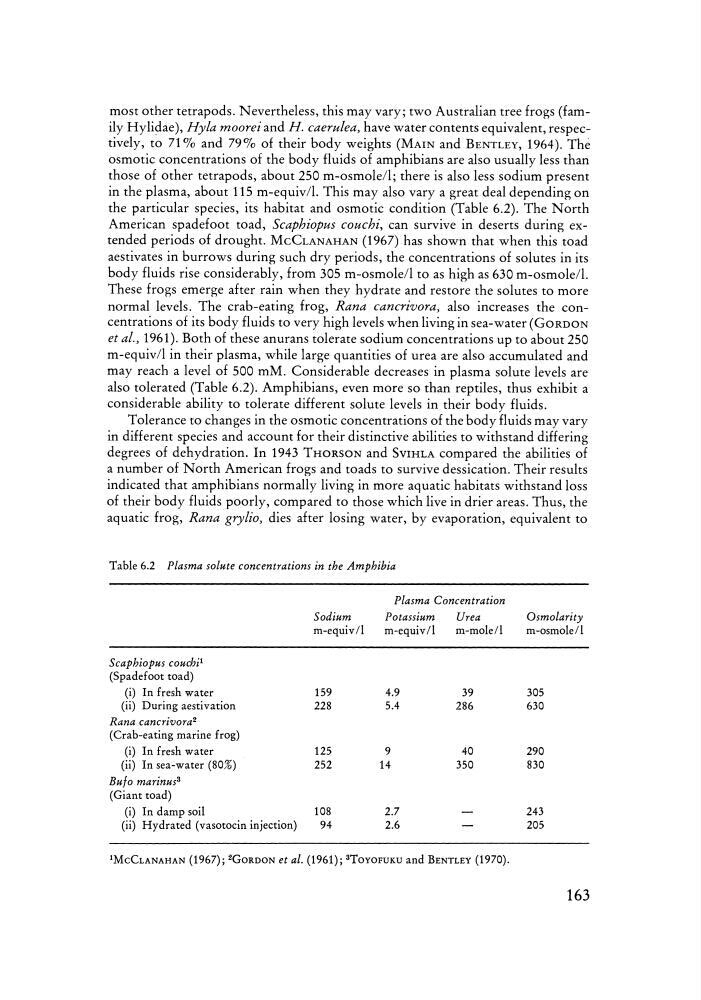
the particular species, its habitat and osmotic condition (Table 6.2). The North
American spadefoot toad , Scaphiopus couchi, can survive in deserts during extended periods of drought. MCCLANAHAN (1967) has shown that when this toad
aestivate s in burrows during such dr y periods, the concentrations of solutes in its
bod y fluids rise con siderably, from 305 m-osrnole/ I to as high as 630 m-osmole/l .
These frogs emerge after rain when they hydrate and restore the solutes to more
no rmal levels. The crab-eating frog, Rana cancriv ora, also increases the concentrations of its body fluids to very high levels when living in sea-water (GORDON
et al., 1961). Bot h of these anura ns tolerate sodium concentratio ns up to abo ut 250
m-equiv/l in their plasma, wh ile large quant ities of urea are also accumu lated and
may reach a level of 500 mM. Con siderabl e decreases in plasma solute levels are
also to lerate d (T able 6.2). Amphibians, even more so than reptiles, th us exhibit a
consi dera ble ability to tolerate different solute levels in their body fluids .
Tolerance to chan ges in the osmotic concentrations of the bod y fluids ma y vary
in different species and account for their distinctive abilities to withstand differing
degrees of deh yd ration. In 1943 THORSON and SVIHLA compared the abilitie s of
a number of North Am erican frogs and toads to survive dessication. Their results
indicated that amphibians normally living in more aquatic habitats withstand loss
of their body fluids poorly, compared to those w hich live in drier areas. Thus, the
aquatic frog , Rana grylio, dies after losing wat er, by evapo ration, equivalent to
Table 6.2 Plasma solute concentrations in the Amphibia
Sodium
rn-equiv /]
Plasma Concentration
Potassium
Urea
m -equivI I
m-mole /I
Osmolarity
m-osmoleI I
Scaphiopus couchi 1
(Spadefoot toad)
(i) I n fresh water
159
4.9
39
305
(ii) D uring aestivation
228
504
286
630
Rana cancrivorai
(Crab-eating marine frog)
(i) In fres h wate r
125
9
40
290
(ii) In sea-water (80%)
252
14
350
830
Hulo marinuss
(Giant toad)
(i) In damp soil
108
2.7
243
(ii) H ydrated (vasotocin inject ion)
94
2.6
205
lM c C LANAHAN (1967); 2G ORDON et at. (1961); 3ToYOFUKU and BENTLEY (1970).
163
osmotic concentrations of the body fluid s of amphibians are also usuall y less than
those of other tetrapods, about 250 rn-osmole/ I; there is also less sodium pres ent
in the plasma, about 115 m-equiv/l . This may also var y a great deal depending on
the particular species, its habitat and osmotic condition (Table 6.2). The North
American spadefoot toad , Scaphiopus couchi, can survive in deserts during extended periods of drought. MCCLANAHAN (1967) has shown that when this toad
aestivate s in burrows during such dr y periods, the concentrations of solutes in its
bod y fluids rise con siderably, from 305 m-osrnole/ I to as high as 630 m-osmole/l .
These frogs emerge after rain when they hydrate and restore the solutes to more
no rmal levels. The crab-eating frog, Rana cancriv ora, also increases the concentrations of its body fluids to very high levels when living in sea-water (GORDON
et al., 1961). Bot h of these anura ns tolerate sodium concentratio ns up to abo ut 250
m-equiv/l in their plasma, wh ile large quant ities of urea are also accumu lated and
may reach a level of 500 mM. Con siderabl e decreases in plasma solute levels are
also to lerate d (T able 6.2). Amphibians, even more so than reptiles, th us exhibit a
consi dera ble ability to tolerate different solute levels in their body fluids .
Tolerance to chan ges in the osmotic concentrations of the bod y fluids ma y vary
in different species and account for their distinctive abilities to withstand differing
degrees of deh yd ration. In 1943 THORSON and SVIHLA compared the abilitie s of
a number of North Am erican frogs and toads to survive dessication. Their results
indicated that amphibians normally living in more aquatic habitats withstand loss
of their body fluids poorly, compared to those w hich live in drier areas. Thus, the
aquatic frog , Rana grylio, dies after losing wat er, by evapo ration, equivalent to
Table 6.2 Plasma solute concentrations in the Amphibia
Sodium
rn-equiv /]
Plasma Concentration
Potassium
Urea
m -equivI I
m-mole /I
Osmolarity
m-osmoleI I
Scaphiopus couchi 1
(Spadefoot toad)
(i) I n fresh water
159
4.9
39
305
(ii) D uring aestivation
228
504
286
630
Rana cancrivorai
(Crab-eating marine frog)
(i) In fres h wate r
125
9
40
290
(ii) In sea-water (80%)
252
14
350
830
Hulo marinuss
(Giant toad)
(i) In damp soil
108
2.7
243
(ii) H ydrated (vasotocin inject ion)
94
2.6
205
lM c C LANAHAN (1967); 2G ORDON et at. (1961); 3ToYOFUKU and BENTLEY (1970).
163