

lungs and depend solely on their skin for this purpose). As a result the skin is also
more permeable to water. It has been suggested that th e cro ssopterygian ancestors
of the Amphibia underwent a reduction of their cutaneous scales in order to facilitate aeriform respiration (SZARSKI, 1962). A relatively impermeable skin was not
phyletically restored until the emergence of the reptiles. The other major factor
influencing the osmotic life of amphibians is the necessity to lay their eggs in water
and for the larvae to undergo an aquatic period of development before th ey meta -
morphose into a form which can live on land. Reptiles have adopted an amniotic
and cleidoic egg which is normally laid on land, and so have achieved a considerable
further measure of osmotic independence. There are many other differences in th e
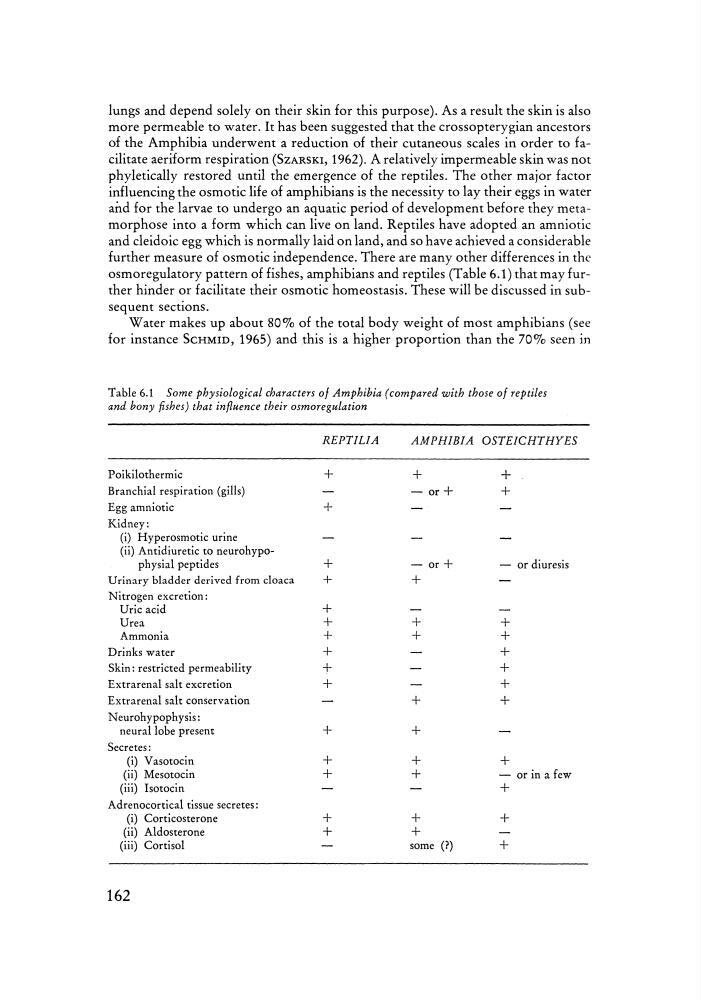
osmoregulatory pattern of fishes, amphibians and reptiles (Table 6.1) that may further hinder or facilitate their osmotic homeostasis. These will be discussed in subsequent sections.
Water makes up about 80% of the total body weight of most amphibians (see
for instance SCHMID, 1965) andthis is a higher proportion than the 70% seen in
Table 6.1 Some physiological characters 0/Amphibia (compared w ith tho se 0/ reptile s
and bony fishes) that influence their osmoregulation
REPTILIA
AMPHIBIA OSTEICHTHYES
Po ikilothermic
Branchial respiration (gills)
Egg amniotic
Kidney:
(i) Hyperosmoric urine
(ii) Antidiuretic to neu rohypoph ysial peptides
Urinary bladder derived from cloaca
Nitrogen excretion :
Uric acid
Urea
Ammonia
Drinks water
Skin: restricted permeability
Extrarenal salt excretion
Extrarenal salt conservation
Neurohypophysis:
neural lobe present
Secretes:
(i) Vasotocin
(ii) Mesotocin
(iii) Isotocin
Adrenocortical tissue secretes:
(i) Corticosterone
(ii) Aldosterone
(iii) Cortisol
162
+
+
+
+
+
+
+
+
+
+
+
+
+
+
+
+
- or+
- or +
+
+
+
+
+
+
+
+
+
some (?)
+
+
- or diuresis
+
+
+
+
+
+
+
- or in a few
+
+
+
more permeable to water. It has been suggested that th e cro ssopterygian ancestors
of the Amphibia underwent a reduction of their cutaneous scales in order to facilitate aeriform respiration (SZARSKI, 1962). A relatively impermeable skin was not
phyletically restored until the emergence of the reptiles. The other major factor
influencing the osmotic life of amphibians is the necessity to lay their eggs in water
and for the larvae to undergo an aquatic period of development before th ey meta -
morphose into a form which can live on land. Reptiles have adopted an amniotic
and cleidoic egg which is normally laid on land, and so have achieved a considerable
further measure of osmotic independence. There are many other differences in th e
osmoregulatory pattern of fishes, amphibians and reptiles (Table 6.1) that may further hinder or facilitate their osmotic homeostasis. These will be discussed in subsequent sections.
Water makes up about 80% of the total body weight of most amphibians (see
for instance SCHMID, 1965) andthis is a higher proportion than the 70% seen in
Table 6.1 Some physiological characters 0/Amphibia (compared w ith tho se 0/ reptile s
and bony fishes) that influence their osmoregulation
REPTILIA
AMPHIBIA OSTEICHTHYES
Po ikilothermic
Branchial respiration (gills)
Egg amniotic
Kidney:
(i) Hyperosmoric urine
(ii) Antidiuretic to neu rohypoph ysial peptides
Urinary bladder derived from cloaca
Nitrogen excretion :
Uric acid
Urea
Ammonia
Drinks water
Skin: restricted permeability
Extrarenal salt excretion
Extrarenal salt conservation
Neurohypophysis:
neural lobe present
Secretes:
(i) Vasotocin
(ii) Mesotocin
(iii) Isotocin
Adrenocortical tissue secretes:
(i) Corticosterone
(ii) Aldosterone
(iii) Cortisol
162
+
+
+
+
+
+
+
+
+
+
+
+
+
+
+
+
- or+
- or +
+
+
+
+
+
+
+
+
+
some (?)
+
+
- or diuresis
+
+
+
+
+
+
+
- or in a few
+
+
+