

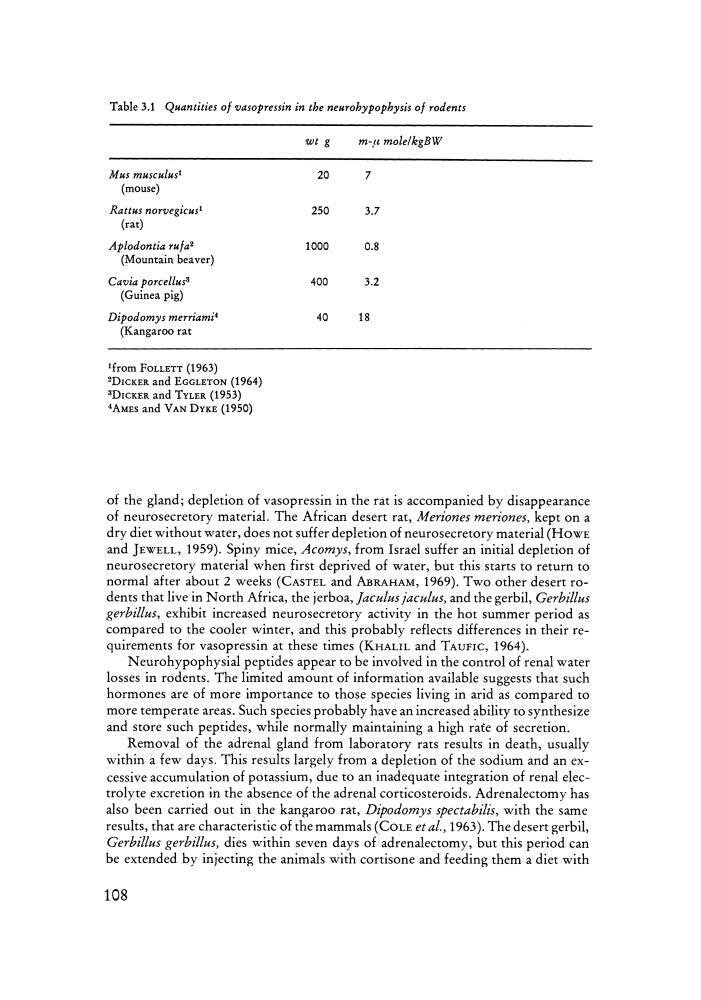
Table 3.1 Quantities of vasopressin in the neurohypophysis of rodents
Mus musculus!
(mouse)
Rattus noruegicus(rat)
Aplodontia rufa!
(Mountain beaver)
Cavia porcellust
(Guinea pig)
Dipodomys merriami'
(Kangaroo rat
wt g
m-,ll molelkgBW
20
7
250
3.7
1000
0.8
400
3.2
40
18
Ifrom FOLLETT (1963)
2DICKER and EGGLETON (1964)
3DICKER and TYLER (1953)
4AMES and VAN D YKE (1950)
of the gland; depletion of vasopressin in the rat is accompanied by disappearance
of neurosecretory material. The African desert rat, Meriones meriones, kept on a
dr y diet without water, does not suffer depletion of neurosecretory material (HOWE
and JEWELL , 1959). Spiny mice, Acomys, from Israel suffer an initial depletion of
neurosecretory material when first deprived of water, but this starts to return to
normal after about 2 weeks (CASTEL and ABRAHAM , 1969). Two other desert rodents that live in North Africa, the jerboa, ]aculus jaculus, and the gerbil, Gerbil/us
gerbil/us, exhibit increased neurosecretory activity in the hot summer period as
compared to the cooler winter, and this probably reflects differences in their requirements for vasopressin at these times (KHALIL and TAuFIe, 1964).
Neurohypophysial pep tides appear to be involved in the control of renal water
losses in rodents. The limited amo unt of information availab le sugges ts that such
hormones are of more importance to those species living in arid as compared to
more temperate areas . Such species probably have an increased ability to synthesize
and store such peptides, while normally maintaining a high rate of secretion.
Removal of the adrenal gland from laboratory rats results in death, usually
within a few days. This results largel y from a depletion of the sodium and an excessive accumulation of potassium, due to an inadequate integration of renal electrol yte excretion in the absence of the adrenal corticosteroids. Adrenalectomy has
also been carried out in the kangaroo rat , Dipodomys spectabilis, with the same
results, that are characteristic of the mammals (COLEet aI., 1963). The desert gerbil,
Gerbil/us gerbil/us, dies within seven days of adrenalectomy, but this period can
be extended by injecting the animals with cortisone and feeding them a diet with
108
Mus musculus!
(mouse)
Rattus noruegicus(rat)
Aplodontia rufa!
(Mountain beaver)
Cavia porcellust
(Guinea pig)
Dipodomys merriami'
(Kangaroo rat
wt g
m-,ll molelkgBW
20
7
250
3.7
1000
0.8
400
3.2
40
18
Ifrom FOLLETT (1963)
2DICKER and EGGLETON (1964)
3DICKER and TYLER (1953)
4AMES and VAN D YKE (1950)
of the gland; depletion of vasopressin in the rat is accompanied by disappearance
of neurosecretory material. The African desert rat, Meriones meriones, kept on a
dr y diet without water, does not suffer depletion of neurosecretory material (HOWE
and JEWELL , 1959). Spiny mice, Acomys, from Israel suffer an initial depletion of
neurosecretory material when first deprived of water, but this starts to return to
normal after about 2 weeks (CASTEL and ABRAHAM , 1969). Two other desert rodents that live in North Africa, the jerboa, ]aculus jaculus, and the gerbil, Gerbil/us
gerbil/us, exhibit increased neurosecretory activity in the hot summer period as
compared to the cooler winter, and this probably reflects differences in their requirements for vasopressin at these times (KHALIL and TAuFIe, 1964).
Neurohypophysial pep tides appear to be involved in the control of renal water
losses in rodents. The limited amo unt of information availab le sugges ts that such
hormones are of more importance to those species living in arid as compared to
more temperate areas . Such species probably have an increased ability to synthesize
and store such peptides, while normally maintaining a high rate of secretion.
Removal of the adrenal gland from laboratory rats results in death, usually
within a few days. This results largel y from a depletion of the sodium and an excessive accumulation of potassium, due to an inadequate integration of renal electrol yte excretion in the absence of the adrenal corticosteroids. Adrenalectomy has
also been carried out in the kangaroo rat , Dipodomys spectabilis, with the same
results, that are characteristic of the mammals (COLEet aI., 1963). The desert gerbil,
Gerbil/us gerbil/us, dies within seven days of adrenalectomy, but this period can
be extended by injecting the animals with cortisone and feeding them a diet with
108