

H
- - - - '
o Neural lobe
D Glandular lobe
Neural lobe as percentage of whole pituitary
10
20
30
40
50
Dormouse
Red squirrel
Poc et mouse
Merriam's kangaroo rat
BirCh mouse ,f
f------, ~
Mojave kangaroo rat
Desert rat (Meriones) c!
Water vole
• Laboratory rat
Bank vole
Long- tailed field mouse
Laboratory rat
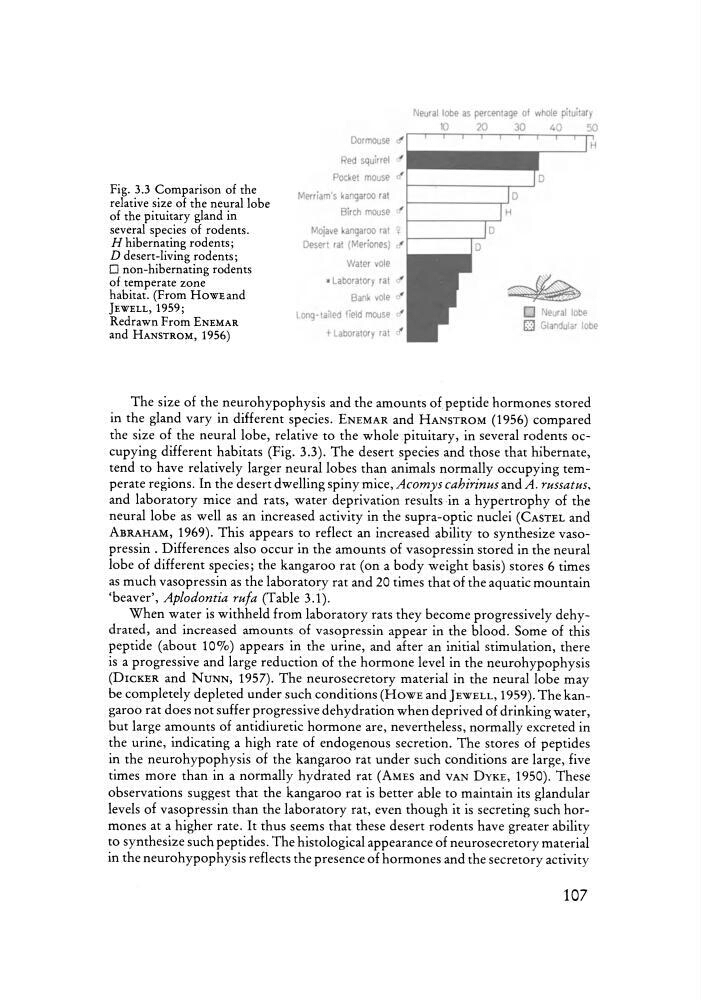
Fig. 3.3 Comparison of the
relative size of the neural lobe
of the pituitary gland in
several species of rodents.
H hibernating rodents;
D desert-living rodents;
o non-hibernating rodents
of temperate zone
habitat. (From HOWE and
JEWELL,1959;
Redrawn From ENEMAR
and HANSTROM, 1956)
The size of the neurohypophysis and the amounts of peptide hormones sto red
in the gland vary in different species. ENEMAR and HANSTROM (1956) compared
the size of the neural lob e, relative to the whole .pituitary , in several rod ents occupy ing different habitats (F ig. 3.3). The desert species and those that hibernate,
tend to have relati vely lar ger neural lobes than anim als normally occupying temperate regions . In the des ert dwelling spiny mice, A comys cahirinus and A . russatus,
and laboratory mice and rats, wa ter deprivation results -in a hypertrophy of the
neural lobe as well as an increased activit y in the supr a-optic nuclei (C ASTEL and
ABRAHAM, 1969). This app ears to reflect an increased ability to synthesize vasopressin . Differences also occur in the amounts of vasopressin stored in th e neural
lobe of different species; the kan garoo rat (on a body wei ght basis) sto res 6 times
as much vaso pressin as the laboratory rat and 20 tim es th at of th e aquatic mountain
' beaver' , Aplodontia rufa (Table 3.i).
When w ater is withheld from laboratory rats th ey become progressively deh ydra ted , and increased amounts of vasopressin appear in the blood. Some of thi s
peptide (about 10% ) appears in the urine, and after an initial stimulation, th ere
is a progressive and lar ge reduction of the hormone level in the neu rohypophysis
(DICKER and NUNN, 1957). The neurosecretory material in the neural lobe m ay
be completely depl eted under such conditions (H OWEand J EWELL, 1959). The kan -
garo o rat does not suffer progressive dehydration when deprived of drinkin g wat er ,
but lar ge amounts of antidiuretic hormone are, nevertheless, normally excr eted in
th e urine, indicating a high rat e of endogenous secretio n. The sto res of peptides
in the neurohypophysis of th e kangaroo rat under such conditions are lar ge, five
times more than in a normally hydrated rat (A MES and VAN DYKE, 1950). Th ese
obs ervations suggest that the kangaroo rat is better able to maintain its gland ular
levels of vasopressin than th e laboratory rat , even though it is secreting such hormones at a hi gher rat e. It thus seems that the se desert rod ents have greater ability
to synt hesize such peptides. The histological app ear ance of neurosecretory material
in th e neu rohypophysis reflects th e pr esence of ho rmones and th e secr etory activit y
107
- - - - '
o Neural lobe
D Glandular lobe
Neural lobe as percentage of whole pituitary
10
20
30
40
50
Dormouse
Red squirrel
Poc et mouse
Merriam's kangaroo rat
BirCh mouse ,f
f------, ~
Mojave kangaroo rat
Desert rat (Meriones) c!
Water vole
• Laboratory rat
Bank vole
Long- tailed field mouse
Laboratory rat
Fig. 3.3 Comparison of the
relative size of the neural lobe
of the pituitary gland in
several species of rodents.
H hibernating rodents;
D desert-living rodents;
o non-hibernating rodents
of temperate zone
habitat. (From HOWE and
JEWELL,1959;
Redrawn From ENEMAR
and HANSTROM, 1956)
The size of the neurohypophysis and the amounts of peptide hormones sto red
in the gland vary in different species. ENEMAR and HANSTROM (1956) compared
the size of the neural lob e, relative to the whole .pituitary , in several rod ents occupy ing different habitats (F ig. 3.3). The desert species and those that hibernate,
tend to have relati vely lar ger neural lobes than anim als normally occupying temperate regions . In the des ert dwelling spiny mice, A comys cahirinus and A . russatus,
and laboratory mice and rats, wa ter deprivation results -in a hypertrophy of the
neural lobe as well as an increased activit y in the supr a-optic nuclei (C ASTEL and
ABRAHAM, 1969). This app ears to reflect an increased ability to synthesize vasopressin . Differences also occur in the amounts of vasopressin stored in th e neural
lobe of different species; the kan garoo rat (on a body wei ght basis) sto res 6 times
as much vaso pressin as the laboratory rat and 20 tim es th at of th e aquatic mountain
' beaver' , Aplodontia rufa (Table 3.i).
When w ater is withheld from laboratory rats th ey become progressively deh ydra ted , and increased amounts of vasopressin appear in the blood. Some of thi s
peptide (about 10% ) appears in the urine, and after an initial stimulation, th ere
is a progressive and lar ge reduction of the hormone level in the neu rohypophysis
(DICKER and NUNN, 1957). The neurosecretory material in the neural lobe m ay
be completely depl eted under such conditions (H OWEand J EWELL, 1959). The kan -
garo o rat does not suffer progressive dehydration when deprived of drinkin g wat er ,
but lar ge amounts of antidiuretic hormone are, nevertheless, normally excr eted in
th e urine, indicating a high rat e of endogenous secretio n. The sto res of peptides
in the neurohypophysis of th e kangaroo rat under such conditions are lar ge, five
times more than in a normally hydrated rat (A MES and VAN DYKE, 1950). Th ese
obs ervations suggest that the kangaroo rat is better able to maintain its gland ular
levels of vasopressin than th e laboratory rat , even though it is secreting such hormones at a hi gher rat e. It thus seems that the se desert rod ents have greater ability
to synt hesize such peptides. The histological app ear ance of neurosecretory material
in th e neu rohypophysis reflects th e pr esence of ho rmones and th e secr etory activit y
107