

The Tethys and the Origins ofthe South West Asiatic Barrier
13
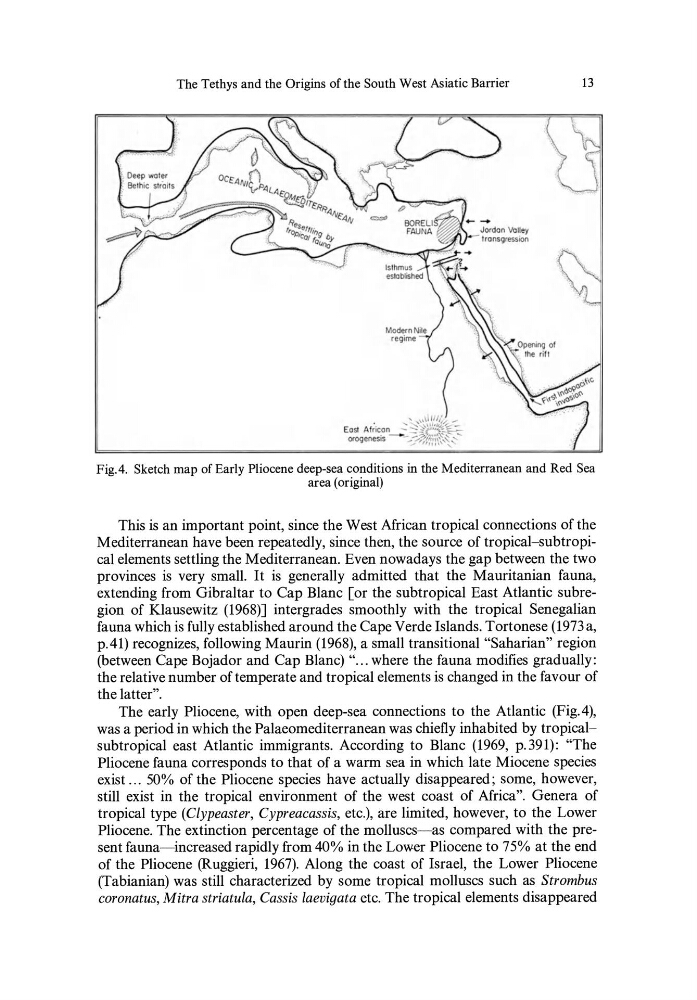
Fig.4. Sketch map of Early Pliocene deep-sea conditions in the Mediterranean and Red Sea
area (original)
This is an important point, since the West African tropical connections of the
Mediterranean have been repeatedly, since then, the source of tropical-subtropical elements settling the Mediterranean. Even nowadays the gap between the two
provinces is very smalI. It is generally admitted that the Mauritanian fauna,
extending from Gibraltar to Cap Blanc [or the subtropical East Atlantic subregion of Klausewitz (1968)] intergrades smoothly with the tropical Senegalian
fauna which is fully established around the Cape Verde Islands. Tortonese (1973a,
p.41) recognizes, following Maurin (1968), a small transitional "Saharian" region
(between Cape Bojador and Cap Blanc) " ... where the fauna modifies gradually:
the relative number oftemperate and tropical elements is changed in the favour of
the latter".
The early Pliocene, with open deep-sea connections to the Atlantic (Fig.4),
was aperiod in which the Palaeomediterranean was chiefly inhabited by tropicalsubtropical east Atlantic immigrants. According to Blanc (1969, p.391): "The
Pliocene fauna corresponds to that of a warm sea in which late Miocene species
exist. .. 50% of the Pliocene species have actually disappeared ; some, however,
still exist in the tropical environment of the west coast of Africa". Genera of
tropical type (Clypeaster, Cypreacassis, etc.), are limited, however, to the Lower
Pliocene. The extinction percentage of the molluscs-as compared with the present fauna-increased rapidly from 40% in the Lower Pliocene to 75% at the end
of the Pliocene (Ruggieri, 1967). Along the coast of Israel, the Lower Pliocene
(Tabianian) was still characterized by some tropical molluscs such as Strombus
coronatus, Mitra striatula, Cassis laevigata etc. The tropical elements disappeared
13
Fig.4. Sketch map of Early Pliocene deep-sea conditions in the Mediterranean and Red Sea
area (original)
This is an important point, since the West African tropical connections of the
Mediterranean have been repeatedly, since then, the source of tropical-subtropical elements settling the Mediterranean. Even nowadays the gap between the two
provinces is very smalI. It is generally admitted that the Mauritanian fauna,
extending from Gibraltar to Cap Blanc [or the subtropical East Atlantic subregion of Klausewitz (1968)] intergrades smoothly with the tropical Senegalian
fauna which is fully established around the Cape Verde Islands. Tortonese (1973a,
p.41) recognizes, following Maurin (1968), a small transitional "Saharian" region
(between Cape Bojador and Cap Blanc) " ... where the fauna modifies gradually:
the relative number oftemperate and tropical elements is changed in the favour of
the latter".
The early Pliocene, with open deep-sea connections to the Atlantic (Fig.4),
was aperiod in which the Palaeomediterranean was chiefly inhabited by tropicalsubtropical east Atlantic immigrants. According to Blanc (1969, p.391): "The
Pliocene fauna corresponds to that of a warm sea in which late Miocene species
exist. .. 50% of the Pliocene species have actually disappeared ; some, however,
still exist in the tropical environment of the west coast of Africa". Genera of
tropical type (Clypeaster, Cypreacassis, etc.), are limited, however, to the Lower
Pliocene. The extinction percentage of the molluscs-as compared with the present fauna-increased rapidly from 40% in the Lower Pliocene to 75% at the end
of the Pliocene (Ruggieri, 1967). Along the coast of Israel, the Lower Pliocene
(Tabianian) was still characterized by some tropical molluscs such as Strombus
coronatus, Mitra striatula, Cassis laevigata etc. The tropical elements disappeared