

12
The HistoricaI Background
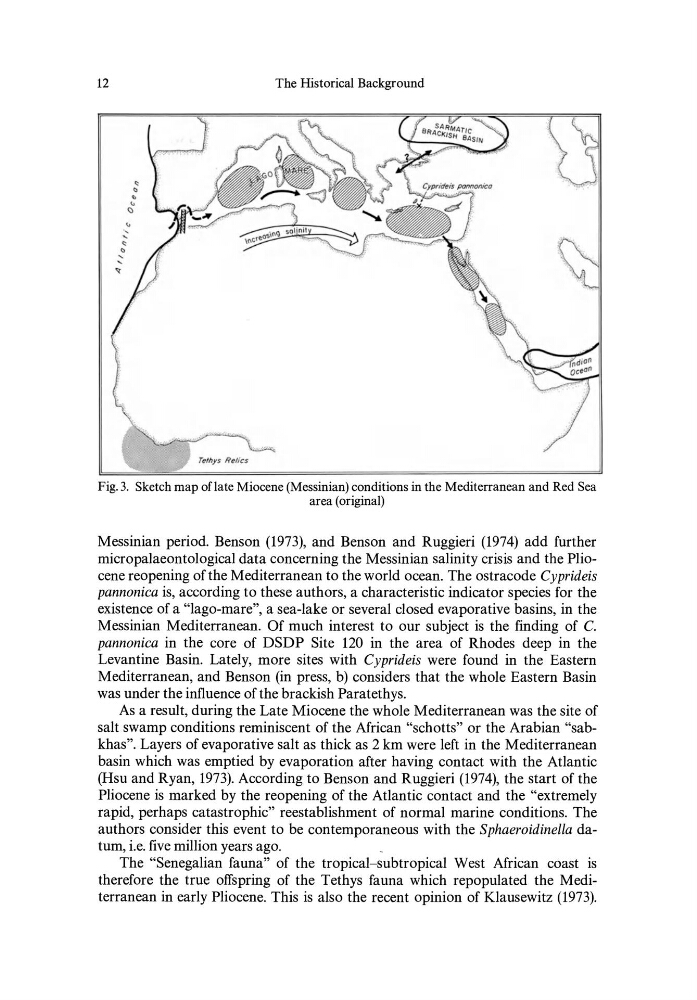
Fig. 3. Sketch map of late Miocene (Messinian) conditions in the Mediterranean and Red Sea
area (original)
Messinian period. Benson (1973), and Benson and Ruggieri (1974) add further
micropalaeontological data concerning the Messinian salinity crisis and the Pliocene reopening ofthe Mediterranean to the world ocean. The ostracode Cyprideis
pannonica is, according to these authors, a characteristic indicator species for the
existence of a "lago-mare", a sea-Iake or several closed evaporative basins, in the
Messinian Mediterranean. Of much interest to our subject is the fmding of C.
pannonica in the co re of DSDP Site 120 in the area of Rhodes deep in the
Levantine Basin. Lately, more sites with Cyprideis were found in the Eastern
Mediterranean, and Benson (in press, b) considers that the whole Eastern Basin
was under the influence of the brackish Paratethys.
As a resuH, during the Late Miocene the whole Mediterranean was the site of
saH swamp conditions reminiscent of the African "schotts" or the Arabian "sabkhas". Layers of evaporative saH as thick as 2 km were left in the Mediterranean
basin which was emptied by evaporation after having contact with the Atlantic
(Hsu and Ryan, 1973). According to Benson and Ruggieri (1974), the start of the
Pliocene is marked by the reopening of the Atlantic contact and the "extremely
rapid, perhaps catastrophic" reestablishment of normal marine conditions. The
authors consider this event to be contemporaneous with the Sphaeroidinella datum, i.e. five million years ago.
The "Senegalian fauna" of the tropical-subtropical West African coast is
therefore the true offspring of the Tethys fauna which repopulated the Mediterranean in early Pliocene. This is also the recent opinion of Klausewitz (1973).
The HistoricaI Background
Fig. 3. Sketch map of late Miocene (Messinian) conditions in the Mediterranean and Red Sea
area (original)
Messinian period. Benson (1973), and Benson and Ruggieri (1974) add further
micropalaeontological data concerning the Messinian salinity crisis and the Pliocene reopening ofthe Mediterranean to the world ocean. The ostracode Cyprideis
pannonica is, according to these authors, a characteristic indicator species for the
existence of a "lago-mare", a sea-Iake or several closed evaporative basins, in the
Messinian Mediterranean. Of much interest to our subject is the fmding of C.
pannonica in the co re of DSDP Site 120 in the area of Rhodes deep in the
Levantine Basin. Lately, more sites with Cyprideis were found in the Eastern
Mediterranean, and Benson (in press, b) considers that the whole Eastern Basin
was under the influence of the brackish Paratethys.
As a resuH, during the Late Miocene the whole Mediterranean was the site of
saH swamp conditions reminiscent of the African "schotts" or the Arabian "sabkhas". Layers of evaporative saH as thick as 2 km were left in the Mediterranean
basin which was emptied by evaporation after having contact with the Atlantic
(Hsu and Ryan, 1973). According to Benson and Ruggieri (1974), the start of the
Pliocene is marked by the reopening of the Atlantic contact and the "extremely
rapid, perhaps catastrophic" reestablishment of normal marine conditions. The
authors consider this event to be contemporaneous with the Sphaeroidinella datum, i.e. five million years ago.
The "Senegalian fauna" of the tropical-subtropical West African coast is
therefore the true offspring of the Tethys fauna which repopulated the Mediterranean in early Pliocene. This is also the recent opinion of Klausewitz (1973).