

Analysis of the Colonizing Success of Lessepsian Migrants
~
~
~
145
Abundant
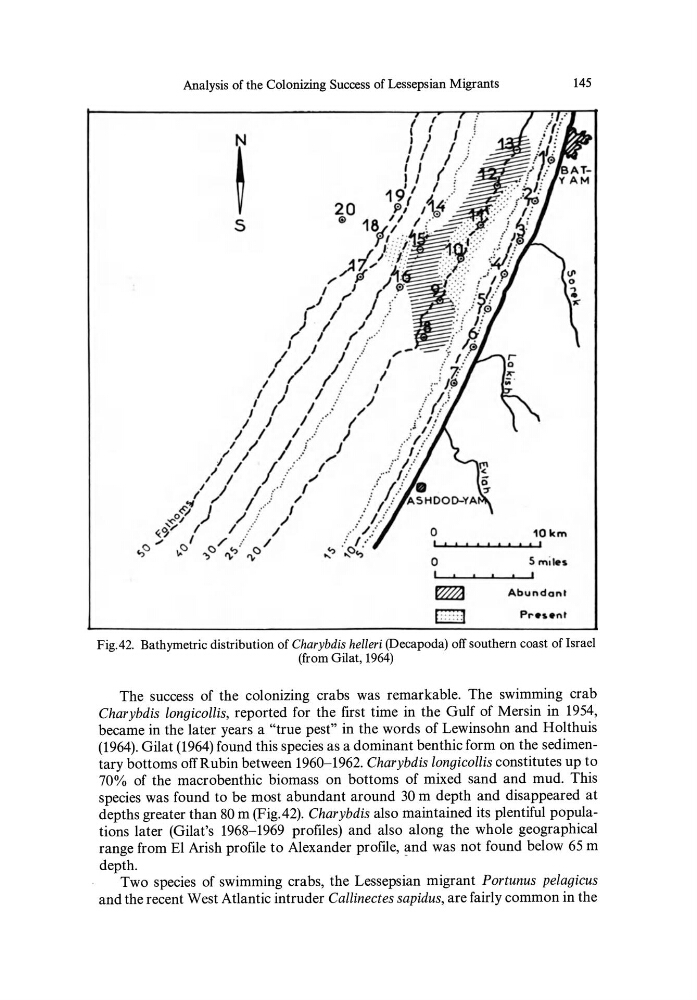
Fig.42. Bathymetric distribution of Charybdis helleri (Decapoda) ofT southern coast of Israel
(from Gilat, 1964)
The success of the colonizing crabs was remarkable. The swimming crab
Charybdis longicollis, reported for the first time in the Gulf of Mersin in 1954,
became in the later years a "true pest" in the words of Lewinsohn and Holthuis
(1964). Gilat (1964) found this species as a dominant benthic form on the sedimentary bottoms off Rubin between 1960-1962. Charybdis longicollis constitutes up to
70% of the macrobenthic biomass on bottoms of mixed sand and mud. This
species was found to be most abundant around 30 m depth and disappeared at
depths greater than 80 m (Fig.42). Charybdis also maintained its plentiful populations later (Gilat's 1968- 1969 profiles) and also along the whole geographical
range from EI Arish profile to Alexander profile, and was not found below 65 m
depth.
Two species of swimming crabs, the Lessepsian migrant Portunus pelagicus
and the recent West Atlantic intruder Callinectes sapidus, are fairly common in the
~
~
~
145
Abundant
Fig.42. Bathymetric distribution of Charybdis helleri (Decapoda) ofT southern coast of Israel
(from Gilat, 1964)
The success of the colonizing crabs was remarkable. The swimming crab
Charybdis longicollis, reported for the first time in the Gulf of Mersin in 1954,
became in the later years a "true pest" in the words of Lewinsohn and Holthuis
(1964). Gilat (1964) found this species as a dominant benthic form on the sedimentary bottoms off Rubin between 1960-1962. Charybdis longicollis constitutes up to
70% of the macrobenthic biomass on bottoms of mixed sand and mud. This
species was found to be most abundant around 30 m depth and disappeared at
depths greater than 80 m (Fig.42). Charybdis also maintained its plentiful populations later (Gilat's 1968- 1969 profiles) and also along the whole geographical
range from EI Arish profile to Alexander profile, and was not found below 65 m
depth.
Two species of swimming crabs, the Lessepsian migrant Portunus pelagicus
and the recent West Atlantic intruder Callinectes sapidus, are fairly common in the