

144
kg
400
350
300
250
200
50,
I
kg
.0
70
60
SO
40
30
20
10
0
%
25
20
15
10
5
0 50 51
The Migrant Biota
52
68
"
, ,
, ,
I
,
(a)
70
YEAR
, -
~,'.,
-_...
2
--.. -
(b)
,
lI2
(c)
52153
54/55
56/57
58159
60/61
62/63
64/65
66/61
68/69
70171
YEAR
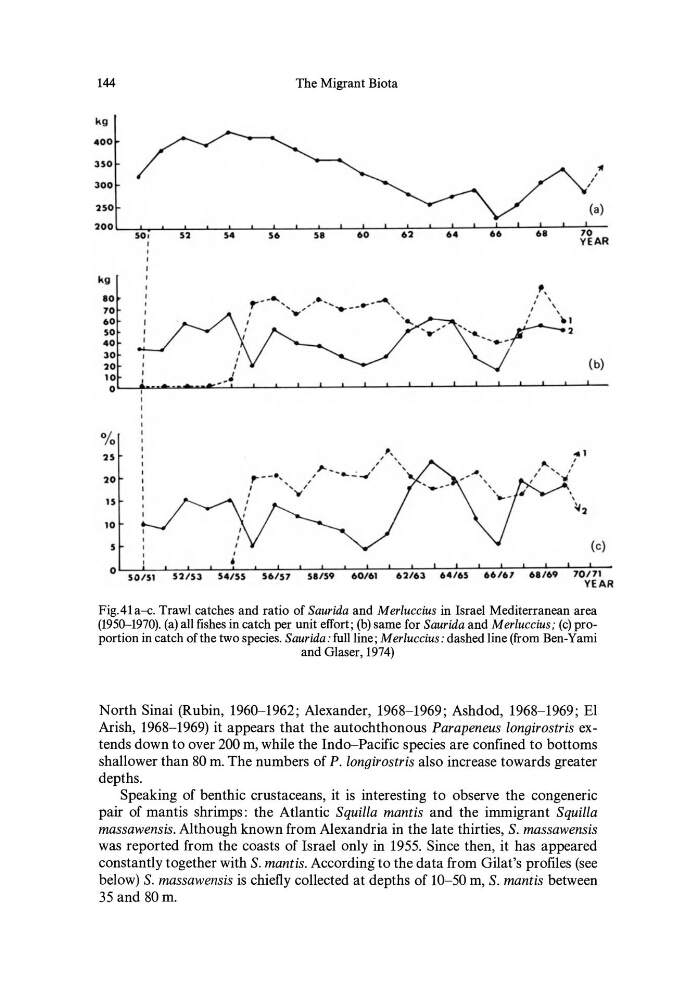
Fig.41 a--c. Trawl catches and ratio of Saurida and M erluccius in Israel Mediterranean area
(1950-1970). (a) all fishes in catch per unit effort; (b) same for Saurida and Merluccius; (c) proportion in catch ofthe two species. Saurida: fulliine; Merluccius: dashed line (from Ben-Yami
and Glaser, 1974)
North Sinai (Rubin, 1960-1962; Alexander, 1968-1969; Ashdod, 1968-1969; EI
Arish, 1968-1969) it appears that the autochthonous Parapeneus longirostris extends down to over 200 m, while the Indo-Pacific species are confined to bottoms
shallower than 80 m. The numbers of P. longirostris also increase towards greater
depths.
Speaking of benthic crustaceans, it is interesting to observe the congeneric
pair of mantis shrimps: the Atlantic Squilla mantis and the immigrant Squilla
massawensis. Although known from Alexandria in the late thirties, S. massawensis
was reported from the coasts of Israel only in 1955. Since then, it has appeared
constantly together with S. mantis. According to the data from Gilat's profiles (see
below) S. massawensis is chiefly collected at depths of 10-50 m, S. mantis between
35 and 80m.
kg
400
350
300
250
200
50,
I
kg
.0
70
60
SO
40
30
20
10
0
%
25
20
15
10
5
0 50 51
The Migrant Biota
52
68
"
, ,
, ,
I
,
(a)
70
YEAR
, -
~,'.,
-_...
2
--.. -
(b)
,
lI2
(c)
52153
54/55
56/57
58159
60/61
62/63
64/65
66/61
68/69
70171
YEAR
Fig.41 a--c. Trawl catches and ratio of Saurida and M erluccius in Israel Mediterranean area
(1950-1970). (a) all fishes in catch per unit effort; (b) same for Saurida and Merluccius; (c) proportion in catch ofthe two species. Saurida: fulliine; Merluccius: dashed line (from Ben-Yami
and Glaser, 1974)
North Sinai (Rubin, 1960-1962; Alexander, 1968-1969; Ashdod, 1968-1969; EI
Arish, 1968-1969) it appears that the autochthonous Parapeneus longirostris extends down to over 200 m, while the Indo-Pacific species are confined to bottoms
shallower than 80 m. The numbers of P. longirostris also increase towards greater
depths.
Speaking of benthic crustaceans, it is interesting to observe the congeneric
pair of mantis shrimps: the Atlantic Squilla mantis and the immigrant Squilla
massawensis. Although known from Alexandria in the late thirties, S. massawensis
was reported from the coasts of Israel only in 1955. Since then, it has appeared
constantly together with S. mantis. According to the data from Gilat's profiles (see
below) S. massawensis is chiefly collected at depths of 10-50 m, S. mantis between
35 and 80m.