

646
16 Sterols and Steroids
are usually lower than those in the arthropods
[79, 82, 85]. A notable exception is the Mediterranean anemone Gerardia savaglia, which has
about 3 g 20-hydroxyecdysone per kg dry weight
[42].
16.5 Bile Acids and Bile Alcohols
The liver of all vertebrates produces a secretion,
bile, which in many species is temporarily stored
in a gall bladder before it is released into the first
section of the small intestine, the duodenum. Bile
contains steroids which as bile alcohols carry several hydroxyl groups and as bile acids carry an
additional carboxyl group. In native bile, the bile
alcohols are always esterified with sulphate and
the bile acids are conjugated with taurine or glycine. Both steroid types are therefore present as
anions and are referred to collectively as bile
salts. Because the polar groups of the bile salts lie
exclusively, or predominantly, on one side of the
flat molecule (Fig. 16.16a), they have marked
amphiphilic properties. Hence, bile salts can
carry out several important functions in fat digestion and absorption:
1. They participate in the emulsification of fats in
the small intestine and stabilize the fat emulsion by orientating themselves on the fat droplets with their hydrophilic side facing outwards.
2. They stimulate lipases and cholesterol esterases.
3. They allow the formation of the mixed micelles required for the effective transport of lipolysis products through the hydration layer of
the microvillous border of the gut epithelium.
In fact, triacylglycerols and phospholipids can be
hydrolysed and resorbed in the gut lumen without
bile, albeit at about one-third of the efficiency as
with bile, but cholesterol and most of the fatsoluble vitamins can only be resorbed with the
participation of bile [25].
Bile acids and bile alcohols are found only in
vertebrates. However, invertebrates do make use
of biodetergents that are involved in a similar way
in fat digestion and resorption, but which have
completely different chemical structures. In the
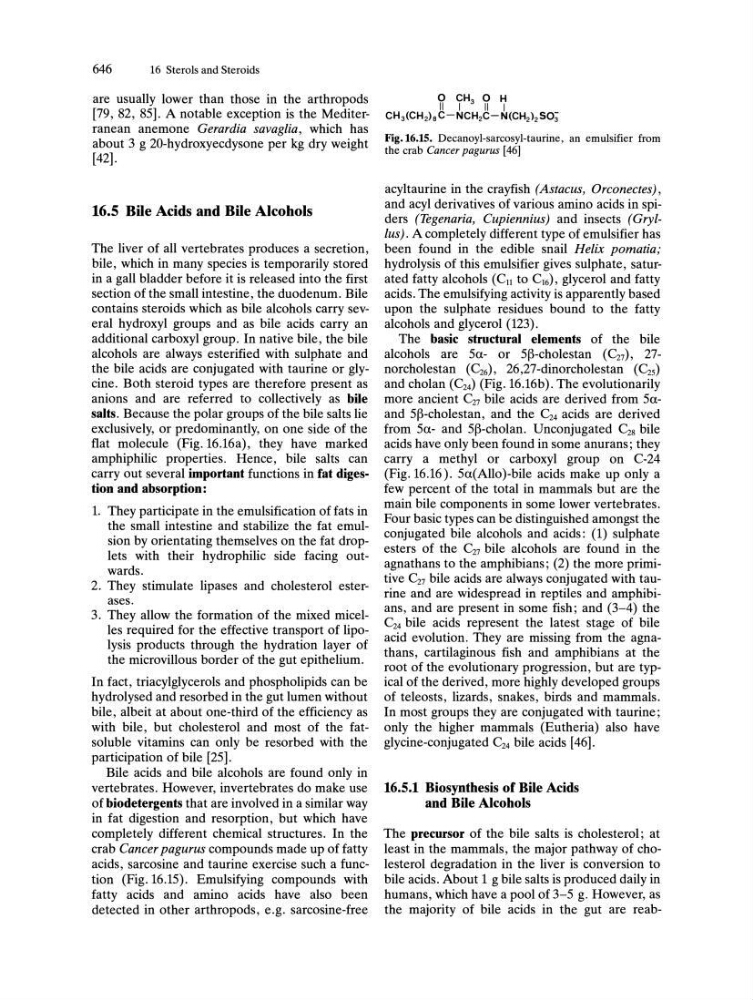
crab Cancer pagurus compounds made up of fatty
acids, sarcosine and taurine exercise such a function (Fig. 16.15). Emulsifying compounds with
fatty acids and amino acids have also been
detected in other arthropods, e.g. sarcosine-free
Fig.16.15. Decanoyl-sarcosyl-taurine, an emulsifier from
the crab Cancer pagurus [46)
acyltaurine in the crayfish (Astacus, Orconectes) ,
and acyl derivatives of various amino acids in spiders (Tegenaria, Cupiennius) and insects (GrylIus). A completely different type of emulsifier has
been found in the edible snail Helix pomatia;
hydrolysis of this emulsifier gives sulphate, saturated fatty alcohols (Cn to C16), glycerol and fatty
acids. The emulsifying activity is apparently based
upon the sulphate residues bound to the fatty
alcohols and glycerol (123).
The basic structnral elements of the bile
alcohols are 5a- or 5~-cholestan (C27) , 27norcholestan (C26) , 26,27-dinorcholestan (C2S)
and cholan (C24) (Fig. 16.16b). The evolutionarily
more ancient C27 bile acids are derived from 5aand 5~-cholestan, and the C24 acids are derived
from 5a- and 5~-cholan. Unconjugated C28 bile
acids have only been found in some anurans; they
carry a methyl or carboxyl group on C-24
(Fig. 16.16). 5a(Allo )-bile acids make up only a
few percent of the total in mammals but are the
main bile components in some lower vertebrates.
Four basic types can be distinguished amongst the
conjugated bile alcohols and acids: (1) sulphate
esters of the C27 bile alcohols are found in the
agnathans to the amphibians; (2) the more primitive C27 bile acids are always conjugated with taurine and are widespread in reptiles and amphibians, and are present in some fish; and (3-4) the
C24 bile acids represent the latest stage of bile
acid evolution. They are missing from the agnathans, cartilaginous fish and amphibians at the
root of the evolutionary progression, but are typical of the derived, more highly developed groups
of teleosts, lizards, snakes, birds and mammals.
In most groups they are conjugated with taurine;
only the higher mammals (Eutheria) also have
glycine-conjugated C24 bile acids [46].
16.5.1 Biosynthesis of Bile Acids
and Bile Alcohols
The precnrsor of the bile salts is cholesterol; at
least in the mammals, the major pathway of cholesterol degradation in the liver is conversion to
bile acids. About 1 g bile salts is produced daily in
humans, which have a pool of 3-5 g. However, as
the majority of bile acids in the gut are reab-