

HO
HO
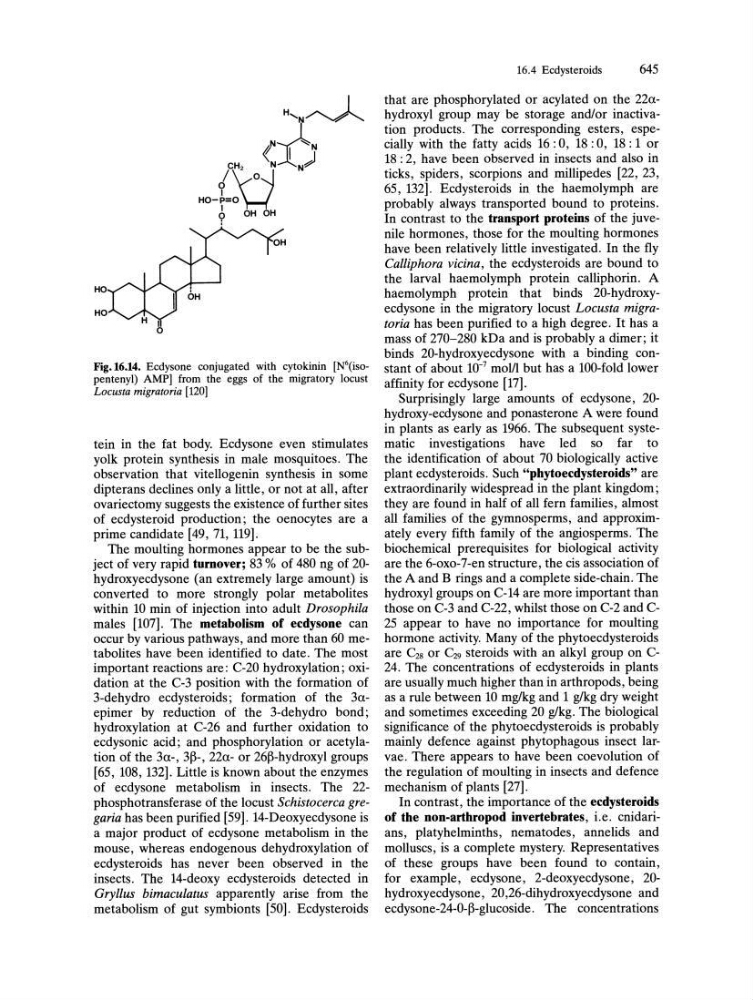
Fig.16.14. Ecdysone conjugated with cytokinin [W(isopentenyl) AMP] from the eggs of the migratory locust
Locusta migratoria [120]
tein in the fat body. Ecdysone even stimulates
yolk protein synthesis in male mosquitoes. The
observation that vitellogenin synthesis in some
dipterans declines only a little, or not at all, after
ovariectomy suggests the existence of further sites
of ecdysteroid production; the oenocytes are a
prime candidate [49, 71, 119].
The moulting hormones appear to be the subject of very rapid turnover; 83 % of 480 ng of 20hydroxyecdysone (an extremely large amount) is
converted to more strongly polar metabolites
within 10 min of injection into adult Drosophila
males [107]. The metabolism of ecdysone can
occur by various pathways, and more than 60 metabolites have been identified to date. The most
important reactions are: C-20 hydroxylation; oxidation at the C-3 position with the formation of
3-dehydro ecdysteroids; formation of the 3aepimer by reduction of the 3-dehydro bond;
hydroxylation at C-26 and further oxidation to
ecdysonic acid; and phosphorylation or acetylation of the 3a-, 3~-, 22a- or 26~-hydroxyl groups
[65, 108, 132]. Little is known about the enzymes
of ecdysone metabolism in insects. The 22phosphotransferase of the locust Schistocerca gregaria has been purified [59]. 14-Deoxyecdysone is
a major product of ecdysone metabolism in the
mouse, whereas endogenous dehydroxylation of
ecdysteroids has never been observed in the
insects. The 14-deoxy ecdysteroids detected in
Gryllus bimaculatus apparently arise from the
metabolism of gut symbionts [50]. Ecdysteroids
16.4 Ecdysteroids
645
that are phosphorylated or acylated on the 22ahydroxyl group may be storage and/or inactivation products. The corresponding esters, especially with the fatty acids 16: 0, 18: 0, 18: 1 or
18 : 2, have been observed in insects and also in
ticks, spiders, scorpions and millipedes [22, 23,
65, 132]. Ecdysteroids in the haemolymph are
probably always transported bound to proteins.
In contrast to the transport proteins of the juvenile hormones, those for the moulting hormones
have been relatively little investigated. In the fly
Calliphora vicina, the ecdysteroids are bound to
the larval haemolymph protein calliphorin. A
haemolymph protein that binds 20-hydroxyecdysone in the migratory locust Locusta migratoria has been purified to a high degree. It has a
mass of 270-280 kDa and is probably a dimer; it
binds 20-hydroxyecdysone with a binding constant of about 10- 7 molll but has a 100-fold lower
affinity for ecdysone [17].
Surprisingly large amounts of ecdysone, 20hydroxy-ecdysone and ponasterone A were found
in plants as early as 1966. The subsequent systematic investigations have led so far to
the identification of about 70 biologically active
plant ecdysteroids. Such "phytoecdysteroids" are
extraordinarily widespread in the plant kingdom;
they are found in half of all fern families, almost
all families of the gymnosperms, and approximately every fifth family of the angiosperms. The
biochemical prerequisites for biological activity
are the 6-oxo-7-en structure, the cis association of
the A and B rings and a complete side-chain. The
hydroxyl groups on C-14 are more important than
those on C-3 and C-22, whilst those on C-2 and C25 appear to have no importance for moulting
hormone activity. Many of the phytoecdysteroids
are C28 or C29 steroids with an alkyl group on C24. The concentrations of ecdysteroids in plants
are usually much higher than in arthropods, being
as a rule between 10 mg/kg and 1 g/kg dry weight
and sometimes exceeding 20 g/kg. The biological
significance of the phytoecdysteroids is probably
mainly defence against phytophagous insect larvae. There appears to have been coevolution of
the regulation of moulting in insects and defence
mechanism of plants [27].
In contrast, the importance of the ecdysteroids
of the non-arthropod invertebrates, i.e. cnidarians, platyhelminths, nematodes, annelids and
molluscs, is a complete mystery. Representatives
of these groups have been found to contain,
for example, ecdysone, 2-deoxyecdysone, 20hydroxyecdysone, 20,26-dihydroxyecdysone and
ecdysone-24-0-~-glucoside. The concentrations