

636
16 Sterols and Steroids
a)
R
b)
HO
C)
d)
f)
i)
h)
~
.1 5
\,
\
16.2.7 Sterols of the Protozoa
There is a marked absence of systematic studies
of sterol content and metabolism in the Protozoa,
and given the heterogeneity of this group, no generalizations are possible. Ciliates of the genus Tetrahymena cyclicize squalene in anaerobic reactions to tetrahymanol (Fig. 16.3), which then
assumes sterol functions as a membrane component. However, whenever sterols are present in
the diet, these are incorporated into the membrane and tetrahymanol synthesis is suppressed
[25]. Cholesterol is an essential nutrient for
Paramecium tetraurelia and rumen Ciliata [96].
The synthesis of cholesterol by the amoebae
Acanthamoeba and Naegleria via cycloartenol
(Fig. 16.3), instead of lanosterol as in other animals, has already been mentioned [91].
16.3 Steroid Hormones of the Vertebrates
Certain steroids with 21, 19 or 18 C atoms function as sex hormones or as regulators of carbohydrate or mineral metabolism in all vertebrates.
In accordance with the aims of this book, the
structure and metabolism of the steroid hormones
will be the main concern (as was the case in Chapter 8 for the proteo- and peptide hormones); a
discussion of the functional aspects should be
R
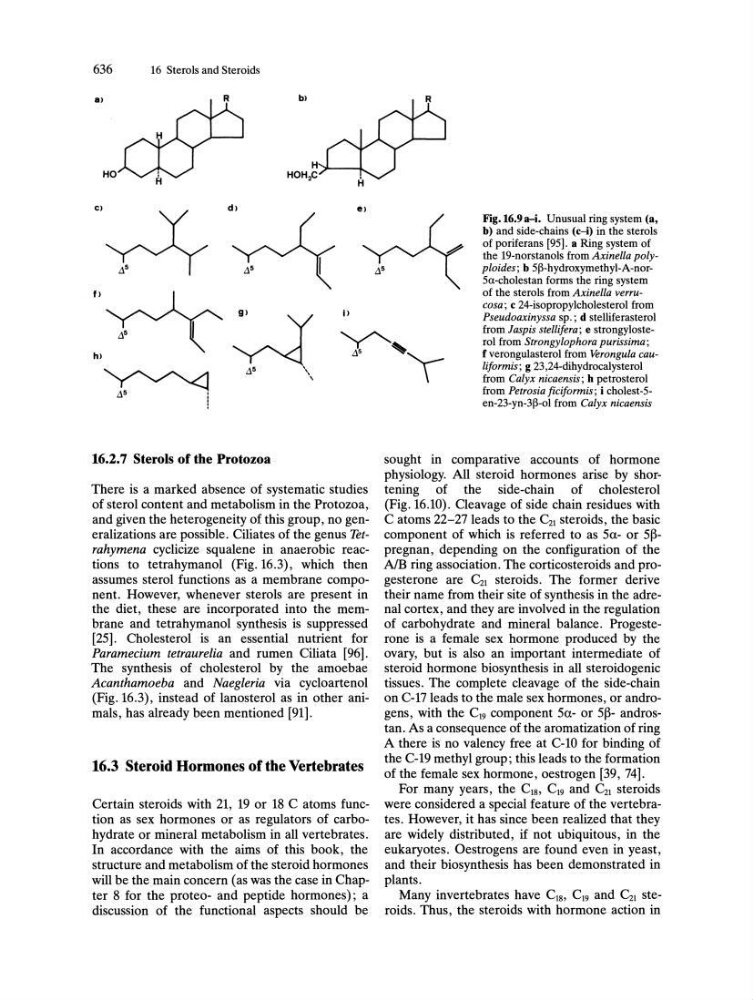
Fig. 16.9 a-i. Unusual ring system (a,
b) and side-chains (c-i) in the sterols
of poriferans [95]. a Ring system of
the 19-norstanols from Axinella polyploides; b 5~-hydroxymethyl-A-nor5a-cholestan forms the ring system
of the sterols from Axinella verrucosa; c 24-isopropylcholesterol from
Pseudoaxinyssa sp.; d stelliferasterol
from Jaspis stellifera; e strongylosterol from Strongylophora purissima;
f verongulasterol from Verongula cauliformis; g 23,24-dihydrocalysterol
from Calyx nicaensis; h petrosterol
from Petrosia ficiformis; i cholest-5en-23-yn-3~-ol from Calyx nicaensis
sought in comparative accounts of hormone
physiology. All steroid hormones arise by shortening of the side-chain of cholesterol
(Fig. 16.10). Cleavage of side chain residues with
C atoms 22-27 leads to the C21 steroids, the basic
component of which is referred to as 5a- or 5Bpregnan, depending on the configuration of the
AlB ring association. The corticosteroids and progesterone are C21 steroids. The former derive
their name from their site of synthesis in the adrenal cortex, and they are involved in the regulation
of carbohydrate and mineral balance. Progesterone is a female sex hormone produced by the
ovary, but is also an important intermediate of
steroid hormone biosynthesis in all steroidogenic
tissues. The complete cleavage of the side-chain
on C-17 leads to the male sex hormones, or androgens, with the C19 component 5a- or 5B- androstan. As a consequence of the aromatization of ring
A there is no valency free at C-10 for binding of
the C-19 methyl group; this leads to the formation
of the female sex hormone, oestrogen [39, 74].
For many years, the C1S, C19 and C21 steroids
were considered a special feature of the vertebrates. However, it has since been realized that they
are widely distributed, if not ubiquitous, in the
eukaryotes. Oestrogens are found even in yeast,
and their biosynthesis has been demonstrated in
plants.
Many invertebrates have C1S, C19 and ~1 steroids. Thus, the steroids with hormone action in