

634
16 Sterols and Steroids
HO
c)
HO
CH3
I
C=O
b)
HO
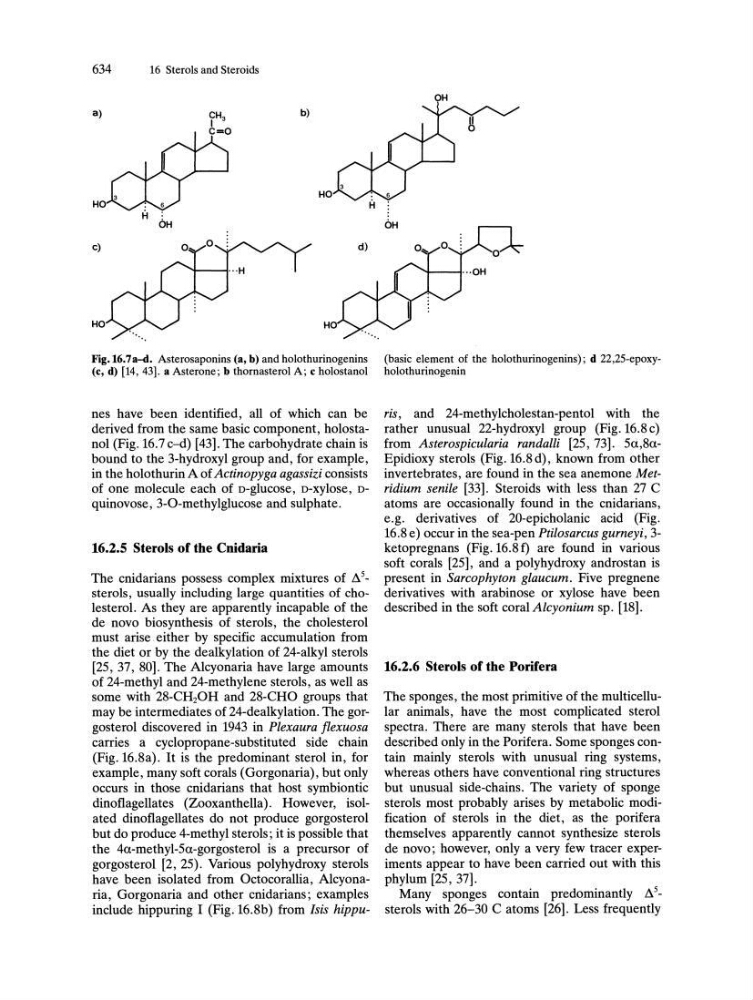
Fig.16.7a-d. Asterosaponins (a, b) and holothurinogenins
(c, d) [14, 43]. a Asterone; b thornasterol A; c holostanol
nes have been identified, all of which can be
derived from the same basic component, holostanol (Fig. 16.7 c-d) [43]. The carbohydrate chain is
bound to the 3-hydroxyl group and, for example,
in the holothurin A ofActinopyga agassizi consists
of one molecule each of D-glucose, D-xylose, Dquinovose, 3-0-methylglucose and sulphate.
16.2.5 Sterols of the Cnidaria
The cnidarians possess complex mixtures of /15_
sterols, usually including large quantities of cholesterol. As they are apparently incapable of the
de novo biosynthesis of sterols, the cholesterol
must arise either by specific accumulation from
the diet or by the de alkylation of 24-alkyl sterols
[25, 37, SO]. The Alcyonaria have large amounts
of 24-methyl and 24-methylene sterols, as well as
some with 2S-CHzOH and 2S-CHO groups that
may be intermediates of 24-dealkylation. The gorgosterol discovered in 1943 in Plexaura flexuosa
carries a cyclopropane-substituted side chain
(Fig. 16.Sa). It is the predominant sterol in, for
example, many soft corals (Gorgonaria), but only
occurs in those cnidarians that host symbiontic
dinoflagellates (Zooxanthella). However, isolated dinoflagellates do not produce gorgosterol
but do produce 4-methyl sterols; it is possible that
the 4a-methyl-5a-gorgosterol is a precursor of
gorgosterol [2, 25). Various polyhydroxy sterols
have been isolated from Octocorallia, Alcyonaria, Gorgonaria and other cnidarians; examples
include hippuring I (Fig. 16.Sb) from Isis hippuOH
(basic element of the holothurinogenins); d 22,25-epoxyholothurinogenin
ris, and 24-methylcholestan-pentol with the
rather unusual 22-hydroxyl group (Fig.16.Sc)
from Asterospicularia randalli [25, 73]. 5a,SaEpidioxy sterols (Fig. 16.Sd), known from other
invertebrates, are found in the sea anemone Metridium senile [33]. Steroids with less than 27 C
atoms are occasionally found in the cnidarians,
e.g. derivatives of 20-epicholanic acid (Fig.
16.S e) occur in the sea-pen Ptilosarcus gurneyi, 3ketopregnans (Fig. 16.S f) are found in various
soft corals [25], and a polyhydroxy androstan is
present in Sarcophyton glaucum. Five pregnene
derivatives with arabinose or xylose have been
described in the soft coral Alcyonium sp. [IS].
16.2.6 Sterols of the Porifera
The sponges, the most primitive of the multicellular animals, have the most complicated sterol
spectra. There are many sterols that have been
described only in the Porifera. Some sponges contain mainly sterols with unusual ring systems,
whereas others have conventional ring structures
but unusual side-chains. The variety of sponge
sterols most probably arises by metabolic modification of sterols in the diet, as the porifera
themselves apparently cannot synthesize sterols
de novo; however, only a very few tracer experiments appear to have been carried out with this
phylum [25, 37].
Many sponges contain predominantly /15_
sterols with 26-30 C atoms [26]. Less frequently