

632
16 Sterols and Steroids
16.2.3 Sterols of Tunicates, Annelids,
Crustaceans and Molluscs
Ascidians, polychaetes, crustaceans, cephalopods
and gastropods contain mainly cholesterol [8, 64,
100, 111]; other sterols, usually present at low
concentrations, probably originate in the diet.
The 24-alkyl sterols in the diet of marine crustaceans are dealkylated to cholesterol; the presumed intermediates, 24-ethylidencholest-5-en3~-01 and desmosterol (cholest-5,24-dien-3~-01;
Fig. 16.4a), are found in trace amounts [52]. Steroids of the vertebrate hormone type have also
been identified in crustaceans [29, 84].
HO
HO
HO
HO
Cholesterol constitutes only about 50 % of the
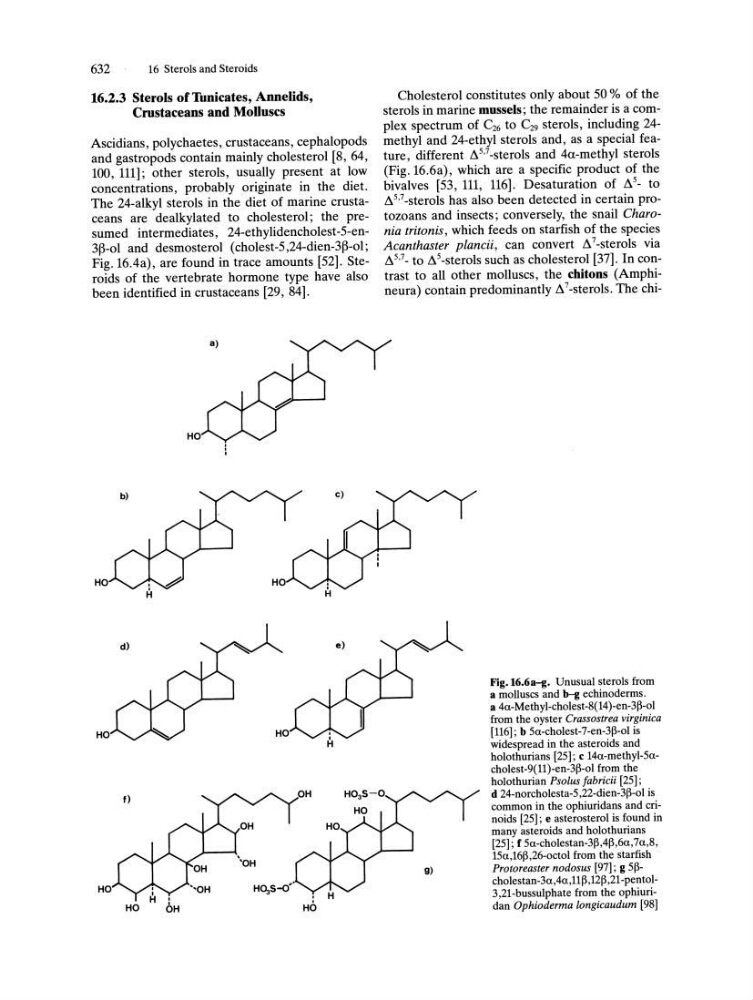
sterols in marine mussels; the remainder is a complex spectrum of C26 to Cz9 sterols, including 24methyl and 24-ethyl sterols and, as a special feature, different il5,7-sterols and 4a-methyl sterols
(Fig. 16.6a), which are a specific product of the
bivalves [53, 111, 116]. Desaturation of il 5 _ to
il5,7-sterols has also been detected in certain protozoans and insects; conversely, the snail Charonia triton is , which feeds on starfish of the species
Acanthaster plancii, can convert il 7 -sterols via
il 5 ,7_ to il 5 -sterols such as cholesterol [37]. In contrast to all other molluscs, the chitons (Amphineura) contain predominantly il 7 -sterols. The chiFig.16.6a-g. Unusual sterols from
a molluscs and b-g echinoderms.
a 4a-Methyl-cholest-8(14)-en-3~-ol
from the oyster Crassostrea virginica
[116]; b 5a-cholest-7-en-3~-ol is
widespread in the asteroids and
holothurians [25]; c 14a-methyl-5acholest-9(11)-en-3~-ol from the
holothurian Psolus fabricii [25];
d 24-norcholesta-5,22-dien-3~-ol is
common in the ophiuridans and crinoids [25]; e asterosterol is found in
many asteroids and holothurians
[25]; f 5a-cholestan-3~,4~,6a,7a,8,
15a,16~,26-octol from the starfish
Protoreaster nodosus [97]; g 5~cholestan-3a,4a ,11~ ,12~ ,21-pentol3,21-bussulphate from the ophiuridan Ophioderma longicaudum [98]