

610
15 Lipids
Blaberus colosseus. These "blaberosides" contain
6' -3-hydroxy-ll-eicosenoyl-gentiobiose as the
carbohydrate component and are unusual in that
this carbohydrate is located in position sn-2
of a l-alkyl-3-acyl-glycerol [256]. l-Alkyl-2-acyl3-(2' ,3' -diacylglycerol)-glycerol, discovered in Harderian gland tumours of mice, may be considered
the representative of a new class of lipids [123].
The glycosyl phosphatidylinositols (GPls) of the
plasma membrane form the anchor for the different proteins of the cell surface, e.g. thy-lor acetylcholinesterase. The membrane-bound GPls of
unicellular eukaryotes have similar functions; the
GPls found in the cytoplasm are precursors of the
membrane components. The attachment of the
variable surface glycoproteins (VSGs) of Trypanosoma brucei has already been described
(p.240). The parasitic protozoans of the genus
Leishmania inhabit their sandfly (Phlebotominae) vector as extracellular promastigotes, and
mutiply in the mammalian host as intracellular
amastigotes in the phagolysosomal compartment
of the macrophages. The GPls of the promastigotes are membrane anchors for the surface proteins and the heterogeneous lipophosphoglycan,
which plays a central role during the infection of
mammalian macrophages and during survival in
the phagolysosomes. The promastigote surface
protease (PSP) of L. major is a zinc endopeptidase. The glycan of its GPI anchor is very similar
to the VSG of T. brucei and to the thy-l of the rat
brain. The lipid component, in contrast to that of
VSG and thy-l, is a completely saturated l-alkyl2-acyl-phosphatidylinositol [233]. The lipophosphoglycans (LPGs) of L. major are made up of
repetitive phosphoglycans of 5-40 kDa, a phosphorylated hexasaccharide core and a lysoalkylphosphatidylinositol anchor. The LPGs of the
related species L. donovani are similar, but less
complex in structure [166, 167]. The glycosylphosphopolyprenols are the only glycolipids in
which the carbohydrate and lipid is linked by a
phosphoric acid; they function in the Nglycosylation of animal proteins (see Fig. 13.17,
p. 491). The lipid component is provided by the
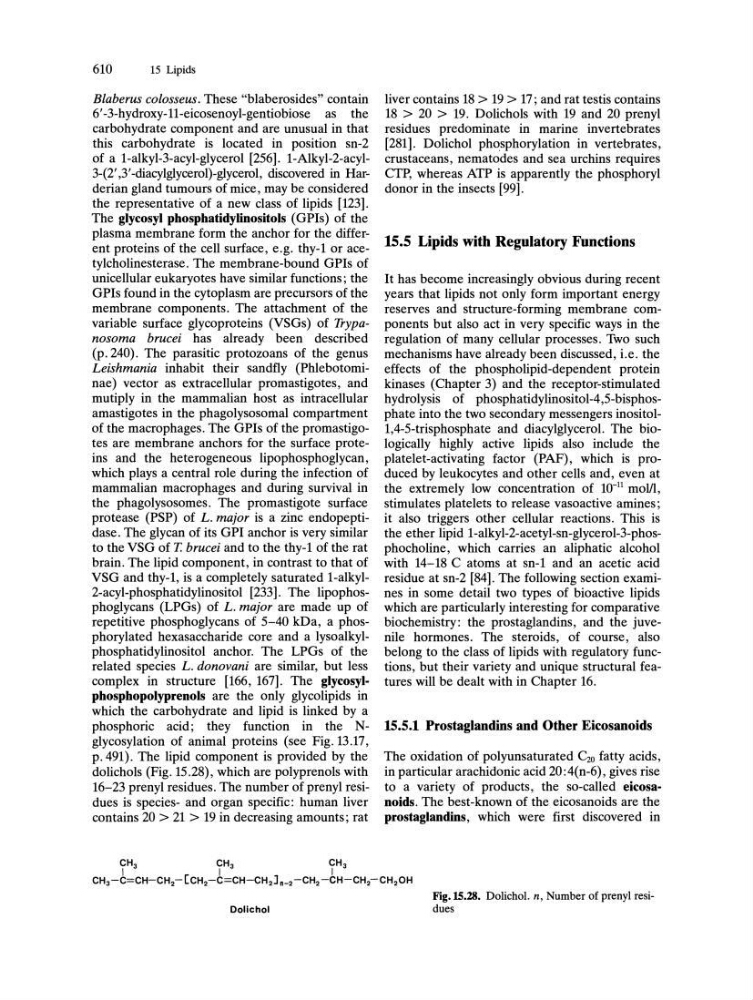
dolichols (Fig. 15.28), which are polyprenols with
16-23 prenyl residues. The number of prenyl residues is species- and organ specific: human liver
contains 20 > 21 > 19 in decreasing amounts; rat
Dolichol
liver contains 18 > 19> 17; and rat testis contains
18 > 20 > 19. Dolichols with 19 and 20 prenyl
residues predominate in marine invertebrates
[281]. Dolichol phosphorylation in vertebrates,
crustaceans, nematodes and sea urchins requires
CTP, whereas ATP is apparently the phosphoryl
donor in the insects [99].
15.5 Lipids with Regulatory Functions
It has become increasingly obvious during recent
years that lipids not only form important energy
reserves and structure-forming membrane components but also act in very specific ways in the
regulation of many cellular processes. Two such
mechanisms have already been discussed, i.e. the
effects of the phospholipid-dependent protein
kinases (Chapter 3) and the receptor-stimulated
hydrolysis of phosphatidylinositol-4,5-bisphosphate into the two secondary messengers inositol1,4-5-trisphosphate and diacylglycerol. The biologically highly active lipids also include the
platelet-activating factor (PAF) , which is produced by leukocytes and other cells and, even at
the extremely low concentration of 10- 11 mol/l,
stimulates platelets to release vasoactive amines;
it also triggers other cellular reactions. This is
the ether lipid l-alkyl-2-acetyl-sn-glycerol-3-phosphocholine, which carries an aliphatic alcohol
with 14-18 C atoms at sn-l and an acetic acid
residue at sn-2 [84]. The following section examines in some detail two types of bioactive lipids
which are particularly interesting for comparative
biochemistry: the prostaglandins, and the juvenile hormones. The steroids, of course, also
belong to the class of lipids with regulatory functions, but their variety and unique structural features will be dealt with in Chapter 16.
15.5.1 Prostaglandins and Other Eicosanoids
The oxidation of polyunsaturated Czo fatty acids,
in particular arachidonic acid 20:4(n-6), gives rise
to a variety of products, the so-called eicosanoids. The best-known of the eicosanoids are the
prostaglandins, which were first discovered in
Fig.15.28. Dolichol. n, Number of prenyl residues