

functional properties of cellular membranes.
Phospholipids with saturated fatty acids result in
dense packing with reduced fluidity and permeability, whereas those with polyunsaturated fatty
acids are much less dense. It is, however, difficult
to imagine that the exchange of fatty acid 20:4(n6) with 22:5(n-3) or 22:6(n-3) would have a significant effect on membrane properties; thus, the
high proportion of such fatty acids in the cell
membranes of marine fish must be related to
some other function [14].
In addition to phosphatidylcholine, a further
choline-containing phospholipid, sphingomyelin or
ceramide phosphocholine (Fig. 15.20k), plays an
important role in some cell membranes. However,
the proportion of this phospholipid in the brain and
erythrocytes of mammals differs widely with the
species: 10% in the red blood cells of the rat, dog
and horse; 20-25 % in the rabbit, pig, and humans;
and as much as 45-50 % in sheep, cattle and goats
[89, 138]. Amongst the insects, the dipterans are
particularly poor in choline-containing phospholipids; in these animals ceramide phosphoethanolamine is found instead of sphingomyelins [56]. The
long-chain bases of the sphingolipids are derived
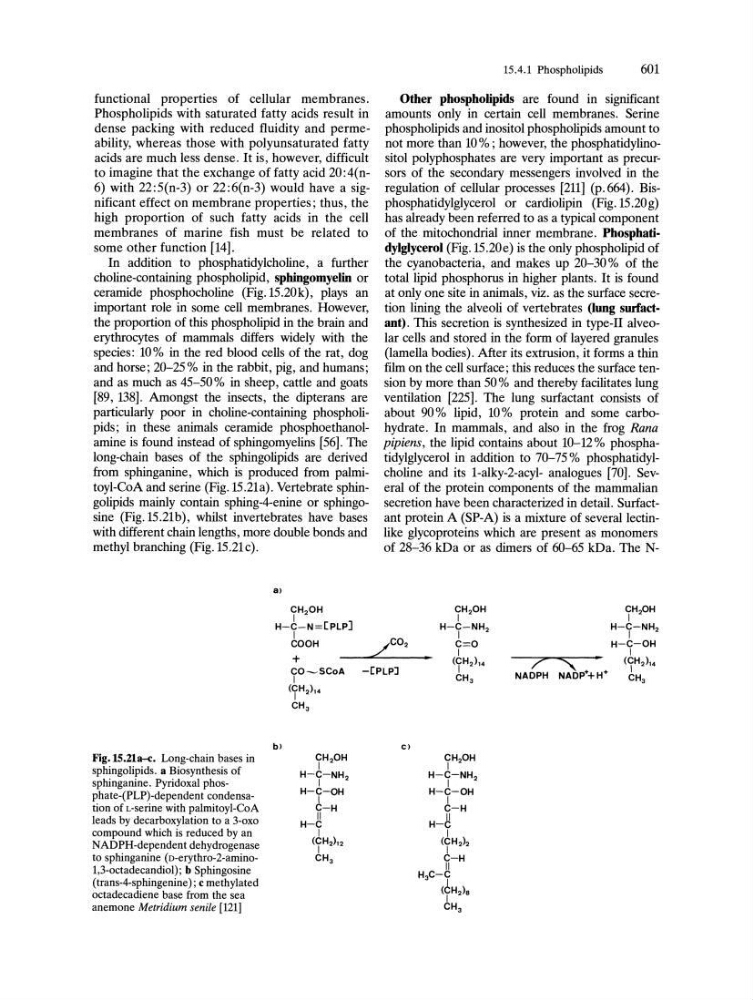
from sphinganine, which is produced from palmitoyl-CoA and serine (Fig. 15.21a). Vertebrate sphingolipids mainly contain sphing-4-enine or sphingosine (Fig. 15.21 b), whilst invertebrates have bases
with different chain lengths, more double bonds and
methyl branching (Fig. 15.21c).
Fig.15.2la-c. Long-chain bases in
sphingolipids. a Biosynthesis of
sphinganine. Pyridoxal phosphate-(PLP)-dependent condensation of L-serine with palmitoyl-CoA
leads by decarboxylation to a 3-oxo
compound which is reduced by an
NADPH-dependent dehydrogenase
to sphinganine (D-erythro-2-amino1,3-octadecandiol); b Sphingosine
(trans-4-sphingenine); c methylated
octadecadiene base from the sea
anemone Metridium senile [121]
a)
CH 2 0H
I
H-C-N=[PLP]
b)
I
COOH
+
CO~SCoA
I
(CH 2 )14
I
CH 3
CH 20H
I
H-C-NH
I
2
H-C-OH
I
C-H
II
H-C
I
(CH 2)'2
I
CH 3
15.4.1 Phospholipids
601
Other phospholipids are found in significant
amounts only in certain cell membranes. Serine
phospholipids and inositol phospholipids amount to
not more than 10 % ; however, the phosphatidylinositol polyphosphates are very important as precursors of the secondary messengers involved in the
regulation of cellular processes [211] (p. 664). Bisphosphatidylglycerol or cardiolipin (Fig.15.20g)
has already been referred to as a typical component
of the mitochondrial inner membrane. PhosphatidylgIycerol (Fig. 15.20 e) is the only phospholipid of
the cyanobacteria, and makes up 20-30% of the
total lipid phosphorus in higher plants. It is found
at only one site in animals, viz. as the surface secretion lining the alveoli of vertebrates (lung surfactant). This secretion is synthesized in type-II alveolar cells and stored in the form of layered granules
(lamella bodies). After its extrusion, it forms a thin
film on the cell surface; this reduces the surface tension by more than 50 % and thereby facilitates lung
ventilation [225]. The lung surfactant consists of
about 90 % lipid, 10 % protein and some carbohydrate. In mammals, and also in the frog Rana
pipiens, the lipid contains about 10-12 % phosphatidylglycerol in addition to 70-75 % phosphatidylcholine and its l-alky-2-acyl- analogues [70]. Several of the protein components of the mammalian
secretion have been characterized in detail. Surfactant protein A (SP-A) is a mixture of several lectinlike glycoproteins which are present as monomers
of 28-36 kDa or as dimers of 60-65 kDa. The NC)
CH20H
I
H-C-NH
I
2
H-C-OH
I
C-H
II
H-C
I
(CH 2)2
I
C-H
II
H C-C
3
I
(CH2)e
I
CH 3