

methylalkanes and dimethylalkanes are also
widely found, although they are completely
absent from, for example, Drosphila melanogaster and Apis mellifera. Complete series may often
be found based upon the localization of the substitutions, e.g. 5- to 15-methyl-nonacosane and 4to 14-methyl-triacontane in the beetle Physadesmia globosa [154, 156]. In the di-substituted
hydrocarbons, the substitutions are often separated by three C atoms, e.g. they occupy positions
9,13- to 17,21-. There are other possibilities, e.g.
11,19- in the moth Heliothis or 11,12- in the cigarette beetle Attagenus megatome. To date, trimethylalkanes have only been detected in about 15
insect species, e.g. the tobacco hornworm Manduca, the orthopterans Schistocerca and Hemideina, the stable fly Glossina and several ant species
[77, 155, 156]. Tetramethylaikanes are present in
Glossina sp. and the potato beetle Leptinotarsa
decemlineata [161, 190].
The variety and species-specificity of the cuticular hydrocarbons make them very useful for
taxonomic purposes. For example, investigations
of 22 beetle species from the family Tenebrionidae, 6 species of the termite genus Odontotermes
and 3 species of the ant genus Iridomyrmex have
clearly demonstrated the suitability of the hydrocarbon spectrum for species diagnosis; a single
gas chromatogram is in many cases sufficient
[116, 154, 156]. However, cuticular hydrocarbons
are not appropriate for the analysis of phylogenetic relationships; for example, cluster analysis
of hydrocarbon spectra from 11 species of the
Drosophila virilis group often show great similarity between closely related species but no really
satisfactory agreement with the already wellcharted family relationships [11]. As with other
low molecular weight biological substances, the
causal connections with the genetic information
are so long and complicated that no unambiguous
correlation with phylogenetic relationships can
really be expected.
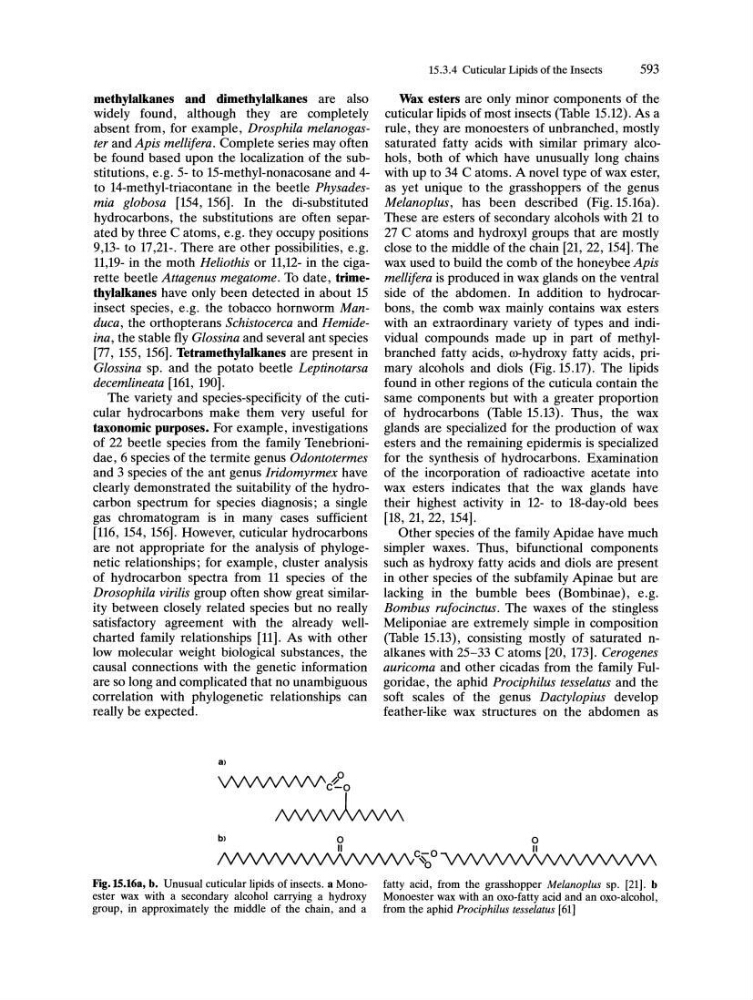
b)
Fig. 15.16a, b. Unusual cuticular lipids of insects. a Monoester wax with a secondary alcohol carrying a hydroxy
group, in approximately the middle of the chain, and a
15.3.4 Cuticular Lipids ofthe Insects
593
Wax esters are only minor components of the
cuticular lipids of most insects (Table 15.12). As a
rule, they are monoesters of unbranched, mostly
saturated fatty acids with similar primary alcohols, both of which have unusually long chains
with up to 34 C atoms. A novel type of wax ester,
as yet unique to the grasshoppers of the genus
Melanoplus, has been described (Fig. 15.16a).
These are esters of secondary alcohols with 21 to
27 C atoms and hydroxyl groups that are mostly
close to the middle of the chain [21, 22, 154]. The
wax used to build the comb of the honeybee Apis
mellifera is produced in wax glands on the ventral
side of the abdomen. In addition to hydrocarbons, the comb wax mainly contains wax esters
with an extraordinary variety of types and individual compounds made up in part of methylbranched fatty acids, w-hydroxy fatty acids, primary alcohols and diols (Fig. 15.17). The lipids
found in other regions of the cuticula contain the
same components but with a greater proportion
of hydrocarbons (Table 15.13). Thus, the wax
glands are specialized for the production of wax
esters and the remaining epidermis is specialized
for the synthesis of hydrocarbons. Examination
of the incorporation of radioactive acetate into
wax esters indicates that the wax glands have
their highest activity in 12- to 18-day-old bees
[18, 21, 22, 154].
Other species of the family Apidae have much
simpler waxes. Thus, bifunctional components
such as hydroxy fatty acids and diols are present
in other species of the subfamily Apinae but are
lacking in the bumble bees (Bombinae), e.g.
Bombus rufocinctus. The waxes of the stingless
Meliponiae are extremely simple in composition
(Table 15.13), consisting mostly of saturated nalkanes with 25-33 C atoms [20, 173]. Cerogenes
auricoma and other cicadas from the family Fulgoridae, the aphid Prociphilus tesselatus and the
soft scales of the genus Dactylopius develop
feather-like wax structures on the abdomen as
fatty acid, from the grasshopper Melanoplus sp. [21]. b
Monoester wax with an oxo-fatty acid and an oxo-alcohol,
from the aphid Prociphilus tesselatus [61]