

sists mainly of wax esters. An unexpectedly high
TAG content (50 %) found in the blubber of a
very young beaked whale Mesoplodon bidens is
probably related to the changeover from TAGrich milk to a wax-ester-rich diet [157]. Enormous
cavities in the head of the sperm whale contain
several tonnes of a fat substance known as spermaceti. This gives rise to spermaceti wax which
consists of esters of cetyl alcohol 12: 0 with different saturated fatty acids of C12 to C18. The large
commercial interest in this wax has led to the near
extinction of the sperm whale [133]. An
extremely long-chain fatty alcohol with chains of
38 to more than 44 C atoms and one to three
methyl branches has been detected in the internal, but not the surface, lipids of the pupae of the
lepidopterans Trichoplusia ni and Manduca sexta.
The internal fatty alcohols differ from the
branched hydrocarbons of the surface lipids in the
localization of the methyl branches. Tracer experiments with 14C-acetate and 14C-propionate
showed these fatty alcohols to be the most actively synthesized lipids of the pupa. In M. sexta
they reach a maximum of 550 ILglpupa 9 days
after pupation; they are completely absent from
the larvae and adults [192].
Hydrocarbons are found in all marine organisms but usually comprise no more than 1 % of
the total lipids. Marine phytoplankton contains
large quantities of highly unsaturated hydrocarbon compounds, especially heneicosahexane
(21: 6), which arises by the decarboxylation of the
fatty acid 22:6(n-3). Alkanes, alkenes and alkadienes with chain lengths of 17 to 25 C atoms are
also found in the tissues of various shark species
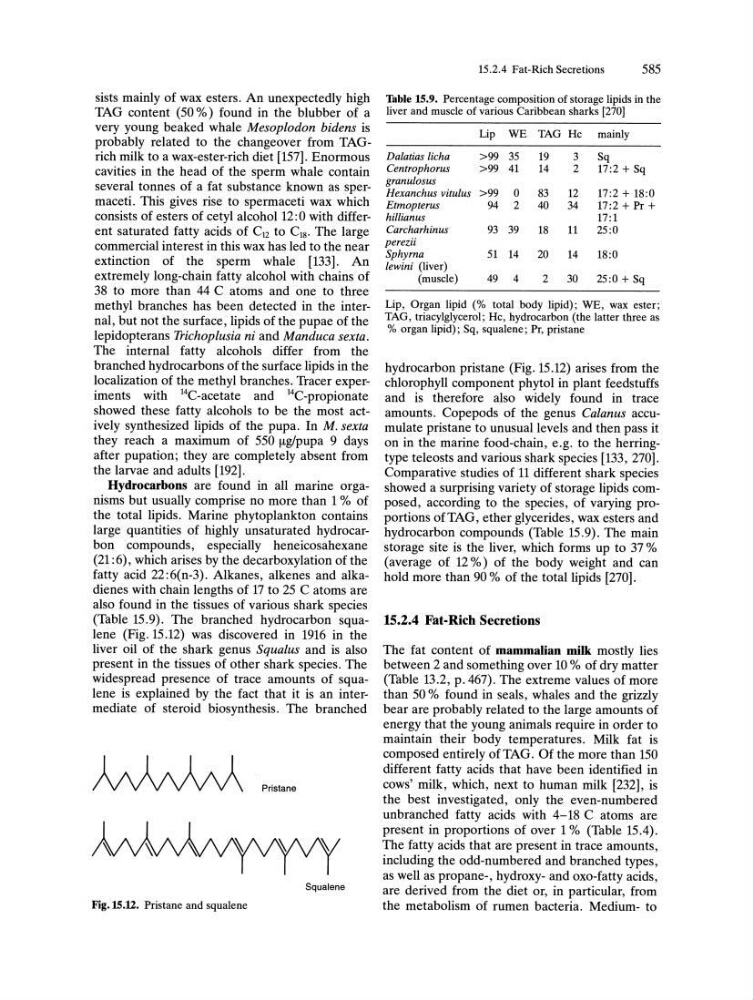
(Table 15.9). The branched hydrocarbon squalene (Fig. 15.12) was discovered in 1916 in the
liver oil of the shark genus Squalus and is also
present in the tissues of other shark species. The
widespread presence of trace amounts of squalene is explained by the fact that it is an intermediate of steroid biosynthesis. The branched
Prislane
Squalene
Fig.15.12. Pristane and squalene
15.2.4 Fat-Rich Secretions
585
Table 15.9. Percentage composition of storage lipids in the
liver and muscle of various Caribbean sharks [270]
Lip WE TAG Hc mainly
Dalatias licha
>99 35
19
3
Sq
Centrophorus
>99 41
14
2
17:2 + Sq
granulosus
Hexanchus vitulus >99 0
83
12
17:2 + 18:0
Etmopterus
94 2
40
34
17:2 + Pr +
hillianus
17:1
Carcharhinus
93 39
18
11
25:0
perezii
Sphyrna
51 14
20
14
18:0
lewini (liver)
(muscle)
49 4
2
30
25:0 + Sq
Lip, Organ lipid (% total body lipid); WE, wax ester;
TAG, triacylglycerol; Hc, hydrocarbon (the latter three as
% organ lipid); Sq, squalene; Pr, pristane
hydrocarbon pristane (Fig. 15.12) arises from the
chlorophyll component phytol in plant feedstuffs
and is therefore also widely found in trace
amounts. Copepods of the genus Calanus accumulate pristane to unusual levels and then pass it
on in the marine food-chain, e.g. to the herringtype teleosts and various shark species [133, 270].
Comparative studies of 11 different shark species
showed a surprising variety of storage lipids composed, according to the species, of varying proportions of TAG, ether glycerides, wax esters and
hydrocarbon compounds (Table 15.9). The main
storage site is the liver, which forms up to 37 %
(average of 12 %) of the body weight and can
hold more than 90 % of the total lipids [270].
15.2.4 Fat-Rich Secretions
The fat content of mammalian milk mostly lies
between 2 and something over 10 % of dry matter
(Table 13.2, p. 467). The extreme values of more
than 50 % found in seals, whales and the grizzly
bear are probably related to the large amounts of
energy that the young animals require in order to
maintain their body temperatures. Milk fat is
composed entirely of TAG. Of the more than 150
different fatty acids that have been identified in
cows' milk, which, next to human milk [232], is
the best investigated, only the even-numbered
unbranched fatty acids with 4-18 C atoms are
present in proportions of over 1 % (Table 15.4).
The fatty acids that are present in trace amounts,
including the odd-numbered and branched types,
as well as propane-, hydroxy- and oxo-fatty acids,
are derived from the diet or, in particular, from
the metabolism of rumen bacteria. Medium- to