

584
15 Lipids
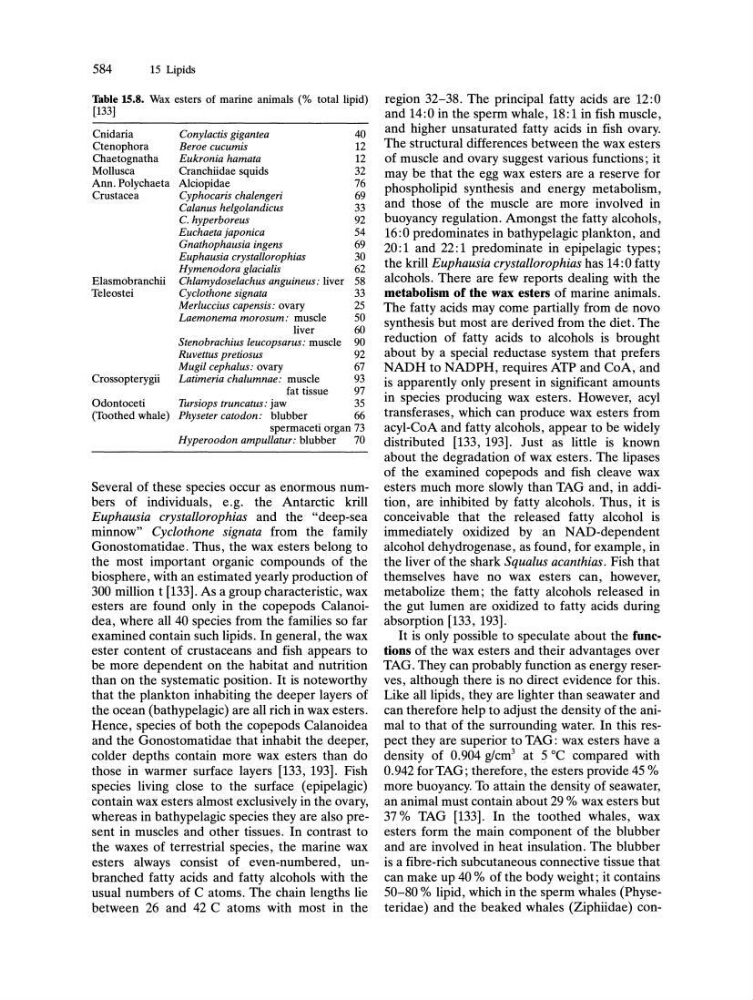
Table 15.8. Wax esters of marine animals (% total lipid)
[133]
Cnidaria
Ctenophora
Chaetognatha
Mollusca
Ann. Polychaeta
Crustacea
Elasmobranchii
Teleostei
Crossopterygii
Odontoceti
(Toothed whale)
Conylactis gigantea
40
Beroe cucumis
12
Eukronia hamata
12
Cranchiidae squids
32
Alciopidae
76
Cyphocaris chalengeri
69
Calanus helgolandicus
33
C. hyperboreus
92
Euchaeta japonica
54
Gnathophausia ingens
69
Euphausia crystallorophias
30
Hymenodora glacialis
62
Chlamydoselachus anguineus: liver 58
Cyclothone signata
33
M erluccius capensis: ovary
25
Laemonema morosum: muscle
50
liver
60
Stenobrachius leucopsarus: muscle 90
Ruvettus pretiosus
92
Mugil cephalus: ovary
67
Latimeria chalumnae: muscle
93
fat tissue
97
Tursiops truncatus: jaw
35
Physeter catodon: blubber
66
spermaceti organ 73
Hyperoodon ampullatur: blubber
70
Several of these species occur as enormous numbers of individuals, e.g. the Antarctic krill
Euphausia crystallorophias and the "deep-sea
minnow" Cyclothone signata from the family
Gonostomatidae. Thus, the wax esters belong to
the most important organic compounds of the
biosphere, with an estimated yearly production of
300 million t [133]. As a group characteristic, wax
esters are found only in the copepods Calanoidea, where all 40 species from the families so far
examined contain such lipids. In general, the wax
ester content of crustaceans and fish appears to
be more dependent on the habitat and nutrition
than on the systematic position. It is noteworthy
that the plankton inhabiting the deeper layers of
the ocean (bathypelagic) are all rich in wax esters.
Hence, species of both the copepods Calanoidea
and the Gonostomatidae that inhabit the deeper,
colder depths contain more wax esters than do
those in warmer surface layers [133, 193]. Fish
species living close to the surface (epipelagic)
contain wax esters almost exclusively in the ovary,
whereas in bathypelagic species they are also present in muscles and other tissues. In contrast to
the waxes of terrestrial species, the marine wax
esters always consist of even-numbered, unbranched fatty acids and fatty alcohols with the
usual numbers of C atoms. The chain lengths lie
between 26 and 42 C atoms with most in the
region 32-38. The principal fatty acids are 12:0
and 14:0 in the sperm whale, 18:1 in fish muscle,
and higher unsaturated fatty acids in fish ovary.
The structural differences between the wax esters
of muscle and ovary suggest various functions; it
may be that the egg wax esters are a reserve for
phospholipid synthesis and energy metabolism,
and those of the muscle are more involved in
buoyancy regulation. Amongst the fatty alcohols,
16:0 predominates in bathypelagic plankton, and
20: 1 and 22: 1 predominate in epipelagic types;
the krill Euphausia crystallorophias has 14:0 fatty
alcohols. There are few reports dealing with the
metabolism of the wax esters of marine animals.
The fatty acids may come partially from de novo
synthesis but most are derived from the diet. The
reduction of fatty acids to alcohols is brought
about by a special reductase system that prefers
NADH to NADPH, requires ATP and CoA, and
is apparently only present in significant amounts
in species producing wax esters. However, acyl
transferases, which can produce wax esters from
acyl-CoA and fatty alcohols, appear to be widely
distributed [133, 193]. Just as little is known
about the degradation of wax esters. The lipases
of the examined copepods and fish cleave wax
esters much more slowly than TAG and, in addition, are inhibited by fatty alcohols. Thus, it is
conceivable that the released fatty alcohol is
immediately oxidized by an NAD-dependent
alcohol dehydrogenase, as found, for example, in
the liver of the shark Squalus acanthias. Fish that
themselves have no wax esters can, however,
metabolize them; the fatty alcohols released in
the gut lumen are oxidized to fatty acids during
absorption [133, 193].
It is only possible to speculate about the functions of the wax esters and their advantages over
TAG. They can probably function as energy reserves, although there is no direct evidence for this.
Like all lipids, they are lighter than seawater and
can therefore help to adjust the density of the animal to that of the surrounding water. In this respect they are superior to TAG: wax esters have a
density of 0.904 g/cm 3 at 5°C compared with
0.942 for TAG; therefore, the esters provide 45 %
more buoyancy. To attain the density of seawater,
an animal must contain about 29 % wax esters but
37 % TAG [133]. In the toothed whales, wax
esters form the main component of the blubber
and are involved in heat insulation. The blubber
is a fibre-rich subcutaneous connective tissue that
can make up 40 % of the body weight; it contains
50-80 % lipid, which in the sperm whales (Physeteridae) and the beaked whales (Ziphiidae) con-