

15.1.5 Ketone Body Formation and Degradation
579
mes that vary in their specificity for the C atom
carrying the hydroperoxy or hydroxy group [188];
corresponding enzyme activities have also been
reported in the gills ofthe trout Salmo trutta [69].
15.1.5 Ketone Body Formation
and Degradation
Hunger brings about within a few hours a switch
in the mammalian liver from carbohydrate consumption and fatty acid biosynthesis to fatty acid
oxidation and ketone body formation, the latter
process predominating in diabetes. The term
ketone bodies refers to acetoacetate, D-3hydroxybutyrate and acetone. The ketone bodies
produced by the liver can be oxidized by many
extra-hepatic tissues. Because of their high solubility in water, ketone bodies are preferentially
consumed as respiratory substrates by cells during
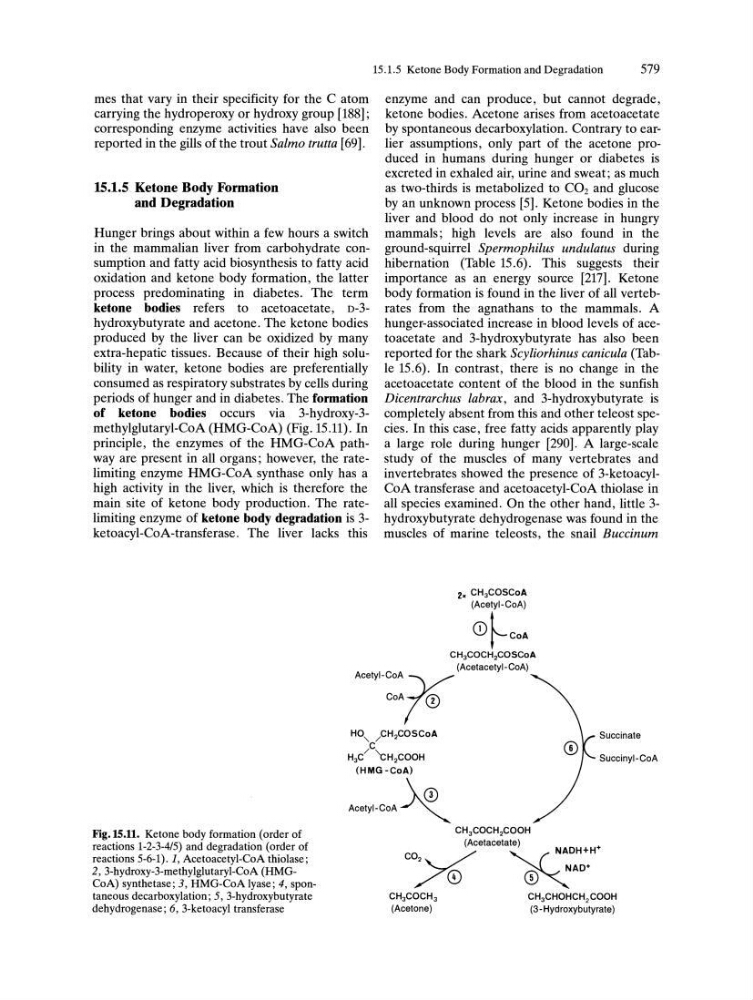
periods of hunger and in diabetes. The formation
of ketone bodies occurs via 3-hydroxy-3methylglutaryl-CoA (HMG-CoA) (Fig. 15.11). In
principle, the enzymes of the HMG-CoA pathway are present in all organs; however, the ratelimiting enzyme HMG-CoA synthase only has a
high activity in the liver, which is therefore the
main site of ketone body production. The ratelimiting enzyme of ketone body degradation is 3ketoacyl-CoA-transferase. The liver lacks this
enzyme and can produce, but cannot degrade,
ketone bodies. Acetone arises from acetoacetate
by spontaneous decarboxylation. Contrary to earlier assumptions, only part of the acetone produced in humans during hunger or diabetes is
excreted in exhaled air, urine and sweat; as much
as two-thirds is metabolized to CO2 and glucose
by an unknown process [5]. Ketone bodies in the
liver and blood do not only increase in hungry
mammals; high levels are also found in the
ground-squirrel Spermophilus undulatus during
hibernation (Table 15.6). This suggests their
importance as an energy source [217]. Ketone
body formation is found in the liver of all vertebrates from the agnathans to the mammals. A
hunger-associated increase in blood levels of acetoacetate and 3-hydroxybutyrate has also been
reported for the shark Scyliorhinus canicula (Table 15.6). In contrast, there is no change in the
acetoacetate content of the blood in the sunfish
Dicentrarchus labrax, and 3-hydroxybutyrate is
completely absent from this and other teleost species. In this case, free fatty acids apparently play
a large role during hunger [290]. A large-scale
study of the muscles of many vertebrates and
invertebrates showed the presence of 3-ketoacylCoA transferase and acetoacetyl-CoA thiolase in
all species examined. On the other hand, little 3hydroxybutyrate dehydrogenase was found in the
muscles of marine teleosts, the snail Buccinum
2. CH 3COSCoA
(Acetyl-CoA)
CD~COA
CH3COCH2COSCoA
(Acetacetyl-CoA)
Acetyl-CoA y
COAl CD
Fig.IS.ll. Ketone body formation (order of
reactions 1-2-3-4/5) and degradation (order of
reactions 5-6-1). 1, Acetoacetyl-CoA thiolase;
2, 3-hydroxy-3-methylglutaryl-CoA (HMGCoA) synthetase; 3, HMG-CoA lyase; 4, spontaneous decarboxylation; 5, 3-hydroxybutyrate
dehydrogenase; 6, 3-ketoacyl transferase
HO" /CH 2COSCoA
Succinate
/C
H3C "CH 2COOH
Succinyl-CoA
(HMG -CoAl
Aoo.,I-CoA ~
CH 3COCH 2COOH
(Acetacetate)
CO2 ~
~( N:DH+H+
/ 0
(ffy,
CH3CHOHCH 2 COOH
(Acetone)
(3-Hydroxybutyrate)