

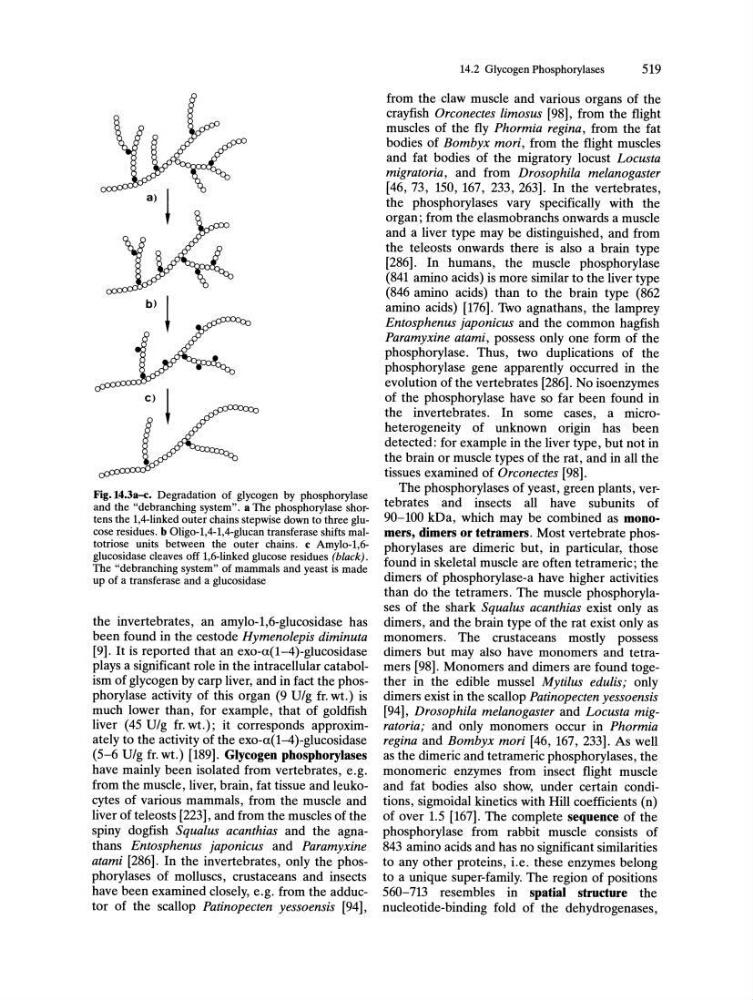
Fig.14.3a-c. Degradation of glycogen by phosphorylase
and the "debranching system". a The phosphorylase shortens the l,4-linked outer chains stepwise down to three glucose residues. b Oligo-1,4-1,4-glucan transferase shifts maltotriose units between the outer chains. c Amylo-1,6glucosidase cleaves off 1,6-linked glucose residues (black).
The "debranching system" of mammals and yeast is made
up of a transferase and a glucosidase
the invertebrates, an amylo-1,6-glucosidase has
been found in the cestode Hymenolepis diminuta
[9]. It is reported that an exo-a(1-4)-glucosidase
plays a significant role in the intracellular catabolism of glycogen by carp liver, and in fact the phosphorylase activity of this organ (9 U/g fro wt.) is
much lower than, for example, that of goldfish
liver (45 U/g fro wt.); it corresponds approximately to the activity of the exo-a(l-4)-glucosidase
(5-6 U/g fro wt.) [189]. Glycogen pbospborylases
have mainly been isolated from vertebrates, e.g.
from the muscle, liver, brain, fat tissue and leukocytes of various mammals, from the muscle and
liver of teleosts [223], and from the muscles of the
spiny dogfish Squalus acanthias and the agnathans Entosphenus japonicus and Paramyxine
atami [286]. In the invertebrates, only the phosphorylases of molluscs, crustaceans and insects
have been examined closely, e.g. from the adductor of the scallop Patinopecten yessoensis [94],
14.2 Glycogen Phosphorylases
519
from the claw muscle and various organs of the
crayfish Orconectes limosus [98], from the flight
muscles of the fly Phormia regina, from the fat
bodies of Bombyx mori, from the flight muscles
and fat bodies of the migratory locust Locusta
migratoria, and from Drosophila melanogaster
[46, 73, 150, 167, 233,263]. In the vertebrates,
the phosphorylases vary specifically with the
organ; from the elasmobranchs onwards a muscle
and a liver type may be distinguished, and from
the teleosts onwards there is also a brain type
[286]. In humans, the muscle phosphorylase
(841 amino acids) is more similar to the liver type
(846 amino acids) than to the brain type (862
amino acids) [176]. Two agnathans, the lamprey
Entosphenus japonicus and the common hagfish
Paramyxine atami, possess only one form of the
phosphorylase. Thus, two duplications of the
phosphorylase gene apparently occurred in the
evolution of the vertebrates [286]. No isoenzymes
of the phosphorylase have so far been found in
the invertebrates. In some cases, a microheterogeneity of unknown origin has been
detected: for example in the liver type, but not in
the brain or muscle types of the rat, and in all the
tissues examined of Orconectes [98].
The phosphorylases of yeast, green plants, vertebrates and insects all have subunits of
90-100 kDa, which may be combined as monomers, dimers or tetramers. Most vertebrate phosphorylases are dimeric but, in particular, those
found in skeletal muscle are often tetrameric; the
dimers of phosphorylase-a have higher activities
than do the tetramers. The muscle phosphorylases of the shark Squalus acanthias exist only as
dimers, and the brain type of the rat exist only as
monomers. The crustaceans mostly possess
dimers but may also have monomers and tetramers [98]. Monomers and dimers are found together in the edible mussel Mytilus edulis; only
dimers exist in the scallop Patino pecten yessoensis
[94], Drosophila melanogaster and Locusta migratoria; and only monomers occur in Phormia
regina and Bombyx mori [46, 167, 233]. As well
as the dimeric and tetrameric phosphorylases, the
monomeric enzymes from insect flight muscle
and fat bodies also show, under certain conditions, sigmoidal kinetics with Hill coefficients (n)
of over 1.5 [167]. The complete sequence of the
phosphorylase from rabbit muscle consists of
843 amino acids and has no significant similarities
to any other proteins, i.e. these enzymes belong
to a unique super-family. The region of positions
560-713 resembles in spatial structure the
nucleotide-binding fold of the dehydrogenases,