

518
14 Glycolysis
between glucose and Glc-6-P as well as between
Fru-6-P and Fru-l,6-P2 will be presented in the
sections dealing with the enzymes involved,
namely hexokinase and phosphofructokinase.
The regulation of glycolysis in most animal
cells appears to conform to the scheme determined from the many investigations of mammalian muscle (Fig. 14.1). However, the simple concept of a universal regulatory role for phosphofructokinase must be qualified even for the mammals. Whilst the ratio Fru-6-P:Fru-l,6-P2 is
greater than 1 for most mammalian cells, it is less
than 0.1 in ascites tumour cells and in rat spermatids. Because in such cases the product of phosphofructokinase accumulates, this cannot be the
rate-limiting enzyme [16]. Extreme deviations
from the scheme of glycolysis regulation that
occurs in yeast and mammalian cells are to be
found in the Protozoa. For example, neither
hexokinase nor phosphofructokinase have typical
allosteric properties in Trypanosoma cruzi or
T. brucei; the only known glycolysis regulatory
mechanism in this case is the activation of pyruvate kinase by Fru-l,6-P2 [25].
In general, glycolysis usually begins with free
glucose or the glucose residues of glycogen, but
other sugars in the diet can be introduced into the
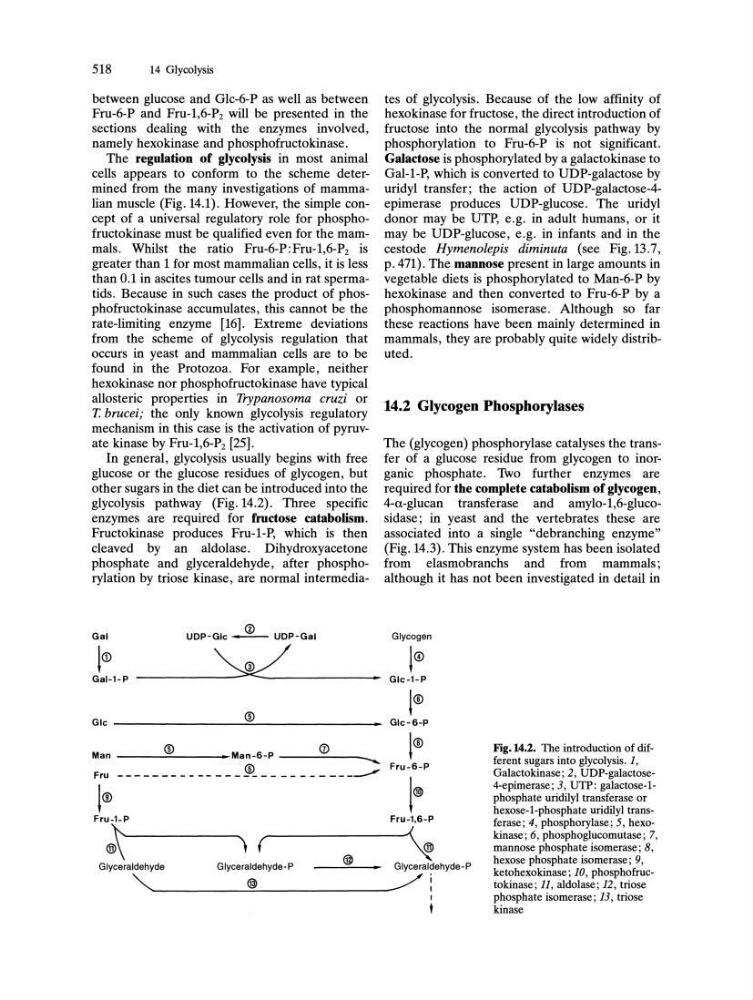
glycolysis pathway (Fig. 14.2). Three specific
enzymes are required for fructose catabolism.
Fructokinase produces Fru-l-P, which is then
cleaved by an aldolase. Dihydroxyacetone
phosphate and glyceraldehyde, after phosphorylation by triose kinase, are normal intermediaGal
®
UDP-Glc -
UDP-Gal
tes of glycolysis. Because of the low affinity of
hexokinase for fructose, the direct introduction of
fructose into the normal glycolysis pathway by
phosphorylation to Fru-6-P is not significant.
Galactose is phosphorylated by a gal acto kinase to
Gal-l-P, which is converted to UDP-galactose by
uridyl transfer; the action of UDP-galactose-4epimerase produces UDP-glucose. The uridyl
donor may be UTP, e.g. in adult humans, or it
may be UDP-glucose, e.g. in infants and in the
cestode Hymenolepis diminuta (see Fig. 13.7,
p. 471). The mannose present in large amounts in
vegetable diets is phosphorylated to Man-6-P by
hexokinase and then converted to Fru-6-P by a
phosphomannose isomerase. Although so far
these reactions have been mainly determined in
mammals, they are probably quite widely distributed.
14.2 Glycogen Phosphorylases
The (glycogen) phosphorylase catalyses the transfer of a glucose residue from glycogen to inorganic phosphate. Two further enzymes are
required for the complete catabolism of glycogen,
4-a-glucan transferase and amylo-l,6-glucosidase; in yeast and the vertebrates these are
associated into a single "debranching enzyme"
(Fig. 14.3). This enzyme system has been isolated
from elasmobranchs and from mammals;
although it has not been investigated in detail in
Glycogen
leD
Gal-1-P ------~- ® - - - - - - - - - . GIJ~
l®
Gic _ _ _ _ _ _ _ _ _ ®.::5~ _ _ _ _ _ _ _ _ , Glc-6-P
I®
®
• Man-6-P
(1)
~
®
.............. Fru-6-P
Fru - - - - - - - -- - - - - - - - - - - - - - - - - -----"
!®
!@
Man
F,"~ _ _ _ _ _ _ _ ....... " (..-_ _ _ _ _ @ _ _ _ Fr_"\;
Glyceraldehyde
Glyceraldehyde-P
Glyceraldehyde-P
~~--------~@~-------------~ :
Fig.14.2. The introduction of different sugars into glycolysis. 1,
Galactokinase; 2, UDP-galactose4-epimerase; 3, UTP: galactose-lphosphate uridilyl transferase or
hexose-I-phosphate uridilyl transferase; 4, phosphorylase; 5, hexokinase; 6, phosphoglucomutase; 7,
mannose phosphate isomerase; 8,
hexose phosphate isomerase; 9,
ketohexokinase; 10, phosphofructokinase; 11, aldolase; 12, triose
phosphate isomerase; 13, triose
kinase