

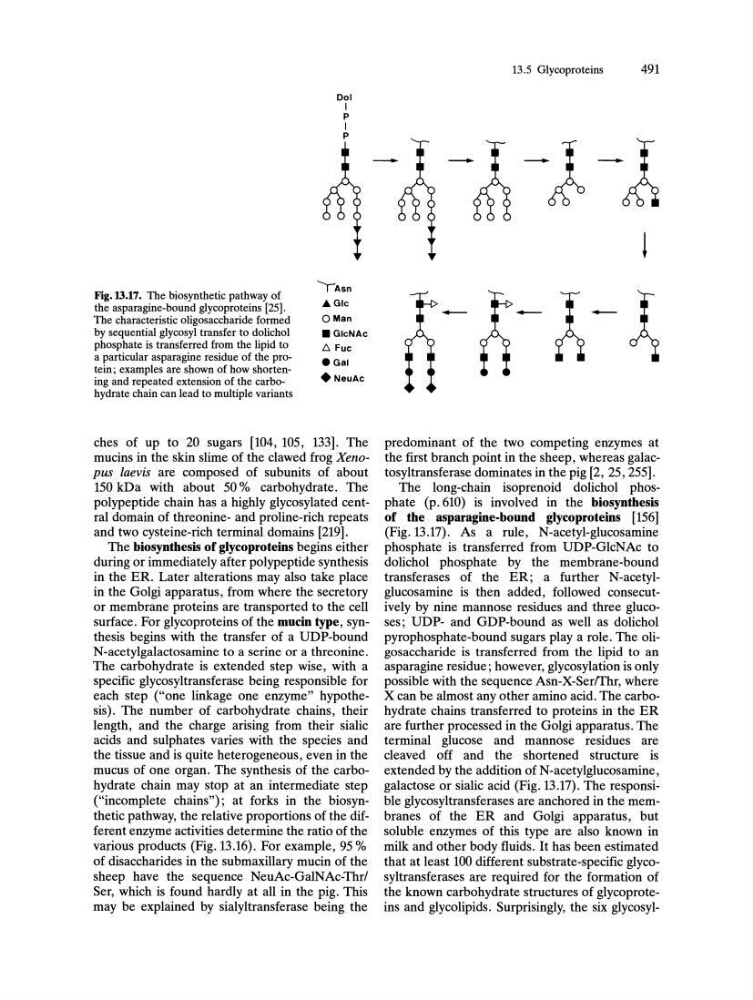
Fig.13.17. The biosynthetic pathway of
the asparagine-bound glycoproteins [25].
The characteristic oligosaccharide formed
by sequential glycosyl transfer to dolichol
phosphate is transferred from the lipid to
a particular asparagine residue of the protein; examples are shown of how shortening and repeated extension of the carbohydrate chain can lead to multiple variants
Dol
I
p
I
p
T-Asn
.,.Glc
OMan
• GlcNAc
/::,. Fuc
eGal
• NeuAc
ches of up to 20 sugars [104, 105, 133]. The
mucins in the skin slime of the clawed frog Xenopus laevis are composed of subunits of about
150 kDa with about 50 % carbohydrate. The
polypeptide chain has a highly glycosylated central domain of threonine- and proline-rich repeats
and two cysteine-rich terminal domains [219].
The biosynthesis of gIycoproteins begins either
during or immediately after polypeptide synthesis
in the ER. Later alterations may also take place
in the Golgi apparatus, from where the secretory
or membrane proteins are transported to the cell
surface. For glycoproteins of the mucin type, synthesis begins with the transfer of a UDP-bound
N-acetylgalactosamine to a serine or a threonine.
The carbohydrate is extended step wise, with a
specific glycosyltransferase being responsible for
each step ("one linkage one enzyme" hypothesis). The number of carbohydrate chains, their
length, and the charge arising from their sialic
acids and sulphates varies with the species and
the tissue and is quite heterogeneous, even in the
mucus of one organ. The synthesis of the carbohydrate chain may stop at an intermediate step
("incomplete chains"); at forks in the biosynthetic pathway, the relative proportions of the different enzyme activities determine the ratio of the
various products (Fig. 13.16). For example, 95 %
of disaccharides in the submaxillary mucin of the
sheep have the sequence NeuAc-GaINAc-Thrl
Ser, which is found hardly at all in the pig. This
may be explained by sialyltransferase being the
13.5 Glycoproteins
491
-
predominant of the two competing enzymes at
the first branch point in the sheep, whereas galactosyltransferase dominates in the pig [2,25,255].
The long-chain isoprenoid dolichol phosphate (p.610) is involved in the biosynthesis
of the asparagine-bound gIycoproteins [156]
(Fig. 13.17). As a rule, N-acetyl-glucosamine
phosphate is transferred from UDP-GlcNAc to
dolichol phosphate by the membrane-bound
transferases of the ER; a further N-acetylglucosamine is then added, followed consecutively by nine mannose residues and three glucoses; UDP- and GDP-bound as well as dolichol
pyrophosphate-bound sugars playa role. The oligosaccharide is transferred from the lipid to an
asparagine residue; however, glycosylation is only
possible with the sequence Asn-X-SerlThr, where
X can be almost any other amino acid. The carbohydrate chains transferred to proteins in the ER
are further processed in the Golgi apparatus. The
terminal glucose and mannose residues are
cleaved off and the shortened structure is
extended by the addition of N-acetylglucosamine,
galactose or sialic acid (Fig. 13.17). The responsible glycosyltransferases are anchored in the membranes of the ER and Golgi apparatus, but
soluble enzymes of this type are also known in
milk and other body fluids. It has been estimated
that at least 100 different substrate-specific glycosyltransferases are required for the formation of
the known carbohydrate structures of glycoproteins and glycolipids. Surprisingly, the six glycosyl-