

482
13 The Structure and Metabolism of Carbohydrates
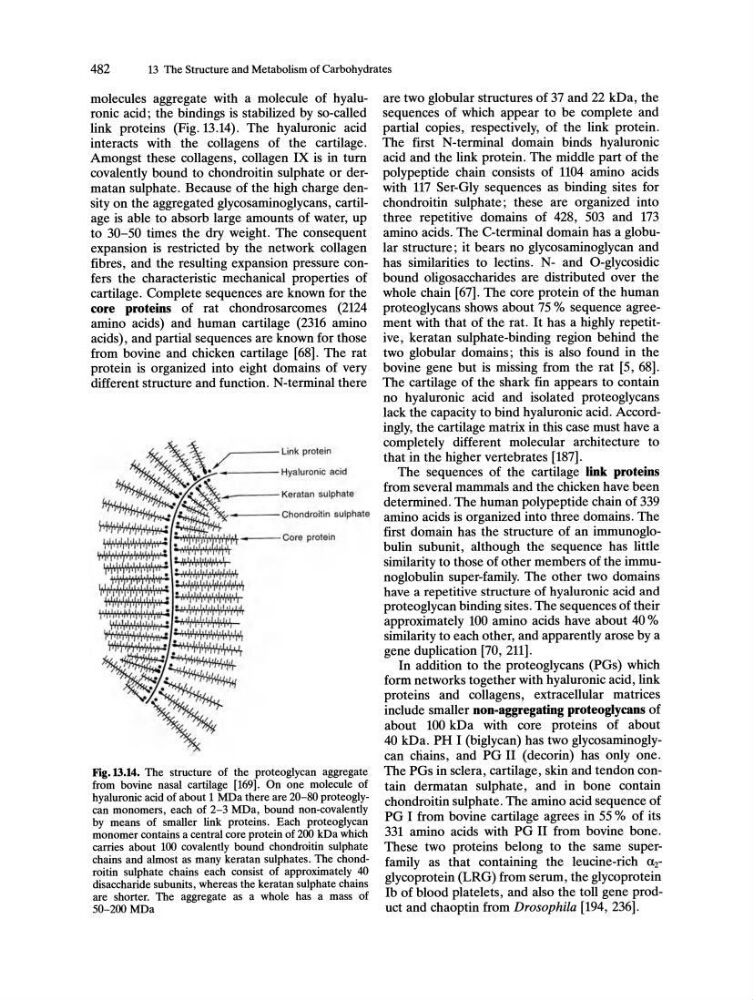
molecules aggregate with a molecule of hyaluronic acid; the bindings is stabilized by so-called
link proteins (Fig. 13.14). The hyaluronic acid
interacts with the collagens of the cartilage.
Amongst these collagens, collagen IX is in tum
covalently bound to chondroitin sulphate or dermatan sulphate. Because of the high charge density on the aggregated glycosaminoglycans, cartilage is able to absorb large amounts of water, up
to 30-50 times the dry weight. The consequent
expansion is restricted by the network collagen
fibres, and the resulting expansion pressure confers the characteristic mechanical properties of
cartilage. Complete sequences are known for the
core proteins of rat chondrosarcomes (2124
amino acids) and human cartilage (2316 amino
acids), and partial sequences are known for those
from bovine and chicken cartilage [68] . The rat
protein is organized into eight domains of very
different structure and function. N-terminal there
Core protein
Fig.13.14. The structure of the proteoglycan aggregate
from bovine nasal cartilage [169]. On one molecule of
hyaluronic acid of about 1 MDa there are 20-80 proteoglycan monomers, each of 2-3 MDa, bound non-covalently
by means of smaller link proteins. Each proteoglycan
monomer contains a central core protein of 200 kDa which
carries about 100 covalently bound chondroitin sulphate
chains and almost as many keratan sulphates. The chondroitin sulphate chains each consist of approximately 40
disaccharide subunits, whereas the keratan sulphate chains
are shorter. The aggregate as a whole has a mass of
50-200 MDa
are two globular structures of 37 and 22 kDa, the
sequences of which appear to be complete and
partial copies, respectively, of the link protein.
The first N-terminal domain binds hyaluronic
acid and the link protein. The middle part of the
polypeptide chain consists of 1104 amino acids
with 117 Ser-Gly sequences as binding sites for
chondroitin sulphate; these are organized into
three repetitive domains of 428, 503 and 173
amino acids. The C-terminal domain has a globular structure; it bears no glycosaminoglycan and
has similarities to lectins. N- and O-glycosidic
bound oligosaccharides are distributed over the
whole chain [67]. The core protein of the human
proteoglycans shows about 75 % sequence agreement with that of the rat. It has a highly repetitive, keratan sulphate-binding region behind the
two globular domains; this is also found in the
bovine gene but is missing from the rat [5,68].
The cartilage of the shark fin appears to contain
no hyaluronic acid and isolated proteoglycans
lack the capacity to bind hyaluronic acid. Accordingly, the cartilage matrix in this case must have a
completely different molecular architecture to
that in the higher vertebrates [187].
The sequences of the cartilage link proteins
from several mammals and the chicken have been
determined. The human polypeptide chain of 339
amino acids is organized into three domains. The
first domain has the structure of an immunoglobulin subunit, although the sequence has little
similarity to those of other members of the immunoglobulin super-family. The other two domains
have a repetitive structure of hyaluronic acid and
proteoglycan binding sites. The sequences of their
approximately 100 amino acids have about 40 %
similarity to each other, and apparently arose by a
gene duplication [70, 211] .
In addition to the proteoglycans (PGs) which
form networks together with hyaluronic acid, link
proteins and collagens, extracellular matrices
include smaller non-aggregating proteoglycans of
about 100 kDa with core proteins of about
40 kDa. PH I (biglycan) has two glycosaminoglycan chains, and PG II (decorin) has only one.
The PGs in sclera, cartilage, skin and tendon contain dermatan sulphate, and in bone contain
chondroitin sulphate. The amino acid sequence of
PG I from bovine cartilage agrees in 55 % of its
331 amino acids with PG II from bovine bone.
These two proteins belong to the same superfamily as that containing the leucine-rich Ur
glycoprotein (LRG) from serum, the glycoprotein
Ib of blood platelets, and also the toll gene product and chaoptin from Drosophila [194, 236].