

13.4.1 Glycosaminoglycans
481
a) Chondroitin sulphate
~(1-4)GlcUA~(1-3)GalNAc~(1-4)G1cUA~(1-3)Gal~(1-3)Ga1~(1-4)xy1~Ser
4-ord 6-Sf
"Dermatan sulphate'
~(1-4)IdUAa(1-3)GalNAc~(1-4)GlcUA~(1-3)Gal~(1-3)Gal~(1-4)Xyl~Ser
2-Sf
4-Sf
Heparin
a(1-4)IdUAa(1-4)GlcNSfa(1-4)GlcUA~(1-3)Ga1~(1-3)Gal~(1-4)Xyl~Ser
2-Sf
6-Sf
Heparan sUlphate
a(1-4)GlcUA~(1-4)GlcNAca(1-4)GlcUA~(1-3)Gal~(1-3)Gal~(1-4)Xyl~Ser
6-Sf
Keratan sulphate I
~(1-4)GlcNAc~(1-3)Gal~(1-4)GlcNAc~(1-3)Gal(GalNAc,Man)GlCNAc~Asn
6-Sf
6-Sf
Keratan sulphate II
~(1-4)GlcNAc~(1-3)Gal~(1-4)GlcNAc~(1-3)Gal(1-6)GalNAcaThr(Ser)
6-Sf
6-Sf
Gal-NANA
Hyaluronic acid
~(1-4)GlcUA~(1-3)GlcNAc~(1-4)GlcUA~(1-3)GlcNAc~(1-4) ...
b) Elasmobranchei
Myxine
xiphosura
Cephalopoda
~(1-4)GlcUA~(1-3)GalNAc~(1-4) ...
2-or 3-Sf 6-Sf
~ (1-4) GlcUA~ (1-3) GalNAc~ (1-4) ...
2-or 3-Sf 4,6-BisSf
~(1-4)GlcUA~(l-3)GalNAc~(1-4) ...
2-or 3-Sf 4-Sf
~(1-4)GlcUA~(1-3)GalNAc~(1-4)GlcUA~(1-3)GalNAc~(1-4) ...
4,6-BisSf
6-Glc
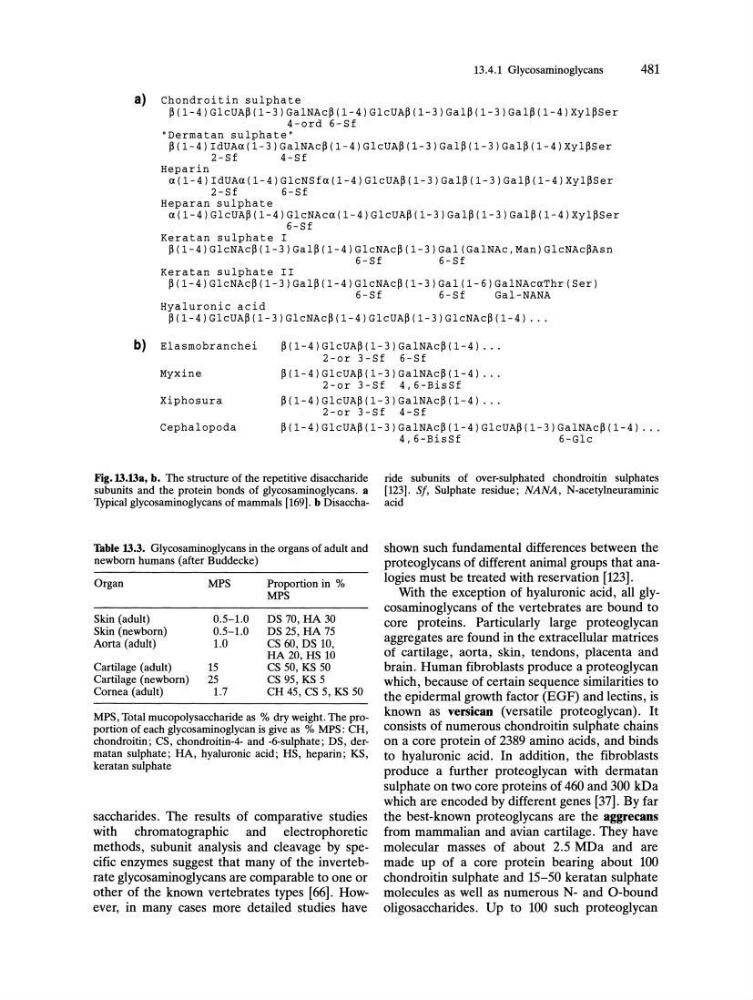
Fig. 13.13a, b. The structure of the repetitive disaccharide
subunits and the protein bonds of glycosaminoglycans. a
Typical glycosaminoglycans of mammals [169]. b Disaccharide subunits of over-sulphated chondroitin sulphates
[123]. Sf, Sulphate residue; NANA, N-acetylneuraminic
acid
Table 13.3. Glycosaminoglycans in the organs of adult and
newborn humans (after Buddecke)
Organ
MPS
Proportion in %
MPS
Skin (adult)
0.5-1.0
DS 70, HA 30
Skin (newborn)
0.5-1.0
DS 25, HA 75
Aorta (adult)
1.0
CS 60, DS 10,
HA 20, HS 10
Cartilage (adult)
15
CS 50, KS 50
Cartilage (newborn)
25
CS 95, KS 5
Cornea (adult)
1.7
CH 45, CS 5, KS 50
MPS, Total mucopolysaccharide as % dry weight. The proportion of each glycosaminoglycan is give as % MPS: CH,
chondroitin; CS, chondroitin-4- and -6-sulphate; DS, dermatan sulphate; HA, hyaluronic acid; HS, heparin; KS,
keratan sulphate
saccharides. The results of comparative studies
with chromatographic and electrophoretic
methods, subunit analysis and cleavage by specific enzymes suggest that many of the invertebrate glycosaminoglycans are comparable to one or
other of the known vertebrates types [66]. However, in many cases more detailed studies have
shown such fundamental differences between the
proteoglycans of different animal groups that analogies must be treated with reservation [123].
With the exception of hyaluronic acid, all glycosaminoglycans of the vertebrates are bound to
core proteins. Particularly large proteoglycan
aggregates are found in the extracellular matrices
of cartilage, aorta, skin, tendons, placenta and
brain. Human fibroblasts produce a proteoglycan
which, because of certain sequence similarities to
the epidermal growth factor (EGF) and lectins, is
known as versican (versatile proteoglycan). It
consists of numerous chondroitin sulphate chains
on a core protein of 2389 amino acids, and binds
to hyaluronic acid. In addition, the fibroblasts
produce a further proteoglycan with dermatan
sulphate on two core proteins of 460 and 300 kDa
which are encoded by different genes [37]. By far
the best-known proteoglycans are the aggrecans
from mammalian and avian cartilage. They have
molecular masses of about 2.5 MDa and are
made up of a core protein bearing about 100
chondroitin sulphate and 15-50 keratan sulphate
molecules as well as numerous N- and O-bound
oligosaccharides. Up to 100 such proteoglycan