

448
12 Small Nitrogenous Compounds
reflected in organ specialization in the snail Helix
aspersa; in the nephridium, it is mainly uric acid
which is produced from 14C-glycine, whereas in
the hepatopancreas it is guanine. The appearance
in terrestrial snails of guanine and xanthine, in
addition to uric acid, as excretion products is
probably due to reduced specificity of the excretion process.
Many of the parasitic protozoans belong to the
class of animals which are unable to synthesize
purine de novo. Of the Kinetoplastida, Crithidia
oncopelti and Trypanosoma equiperdum can produce purine de novo, whereas the bloodstream
form of T. cruzi, which in fact carries out no cell
division, T. lewisi and various Leishmania species
cannot. This synthesis capacity is also absent from
Giardia lamblia, Toxoplasma gondii and various
Trichomonas and Plasmodium species [21, 131,
194, 243]. Amongst the Platyhelminthes, larvae
of the tapeworm Mesocestoides corti can carry out
purine synthesis but the schistosome Schistosoma
mansoni cannot; positive results are reported for
the nematode genera Angiostronglyus and
Metastronglyus [18]. Among the arthropods, de
novo purine synthesis is not found in the brine
shrimp Artemia salina or in certain aphids and
dipterans [40]. The ascidian Molgula manhattensis, which like related species deposits uric acid in
special storage organs, cannot make purines de
novo but apparently obtains them preformed
from its diet.
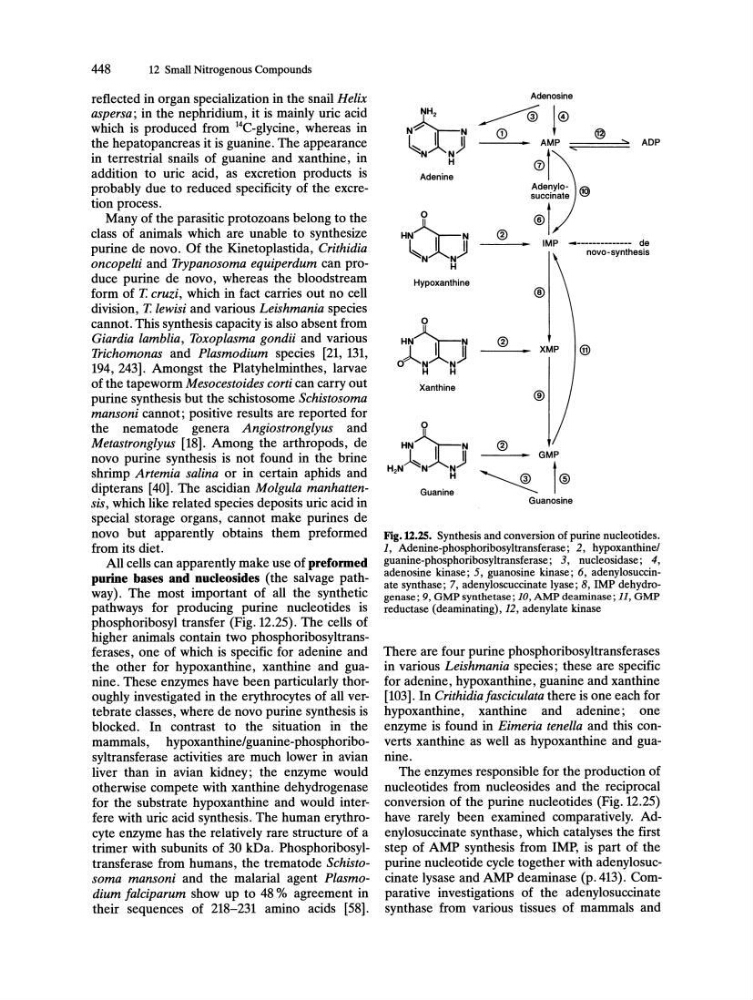
All cells can apparently make use of preformed
purine bases and nucleosides (the salvage pathway). The most important of all the synthetic
pathways for producing purine nucleotides is
phosphoribosyl transfer (Fig. 12.25). The cells of
higher animals contain two phosphoribosyltransferases, one of which is specific for adenine and
the other for hypoxanthine, xanthine and guanine. These enzymes have been particularly thoroughly investigated in the erythrocytes of all vertebrate classes, where de novo purine synthesis is
blocked. In contrast to the situation in the
mammals, hypoxanthine/guanine-phosphoribosyltransferase activities are much lower in avian
liver than in avian kidney; the enzyme would
otherwise compete with xanthine dehydrogenase
for the substrate hypoxanthine and would interfere with uric acid synthesis. The human erythrocyte enzyme has the relatively rare structure of a
trimer with subunits of 30 kDa. Phosphoribosyltransferase from humans, the trematode Schistosoma mansoni and the malarial agent Plasmodium falciparum show up to 48 % agreement in
their sequences of 218-231 amino acids [58].
Adenosine
N:c NH2 N ~ l®@
I~ I II
1 .
AMP ~==="> ADP
~N N/
t '
H
CD
Adenine
o
HcJcJ
N
N
H
Hypoxanthine
Xanthine
HN\--N
HN~NJCJ 2
H
Guanine
Adenylo- ~
succinate ~
IMP --------------- de
novo-synthesis
®
®
--~._ XMP
®
- - _ . GMP
~ l®
Guanosine
Fig.12.25. Synthesis and conversion of purine nucleotides.
1, Adenine-phosphoribosyltransferase; 2, hypoxanthine!
guanine-phosphoribosyltransferase; 3, nucleosidase; 4,
adenosine kinase; 5, guanosine kinase; 6, adenylosuccinate synthase; 7, adenyloscuccinate lyase; 8, IMP dehydrogenase; 9, GMPsynthetase; lO,AMP deaminase; 11, GMP
reductase (deaminating), 12, adenylate kinase
There are four purine phosphoribosyltransferases
in various Leishmania species; these are specific
for adenine, hypoxanthine, guanine and xanthine
[103]. In Crithidiafasciculata there is one each for
hypoxanthine, xanthine and adenine; one
enzyme is found in Eimeria tene/la and this converts xanthine as well as hypoxanthine and guanine.
The enzymes responsible for the production of
nucleotides from nucleosides and the reciprocal
conversion of the purine nucleotides (Fig. 12.25)
have rarely been examined comparatively. Adenylosuccinate synthase, which catalyses the first
step of AMP synthesis from IMP, is part of the
purine nucleotide cycle together with adenylosuccinate lysase and AMP deaminase (p. 413). Comparative investigations of the adenylosuccinate
synthase from various tissues of mammals and