

case, urea accumulates in the blood; it is not
excreted but is hydrolysed by a urease in the gut.
Thus, the toadfishes are also ammoniotelic. The
air-breathing catfish Heterpneustes tossilis also
possesses all five enzymes of the urea cycle [154].
Urea synthesis in the vertebrates is confined to
the liver; the activities of the enzymes in sheep
lung, heart, kidney and rumen epithelium are at
least lOOO-fold lower than in the liver. In the pulmonate snails, urea synthesis takes place mainly
in the hepatopancreas, and in the earthworm it
occurs in the gut tissues.
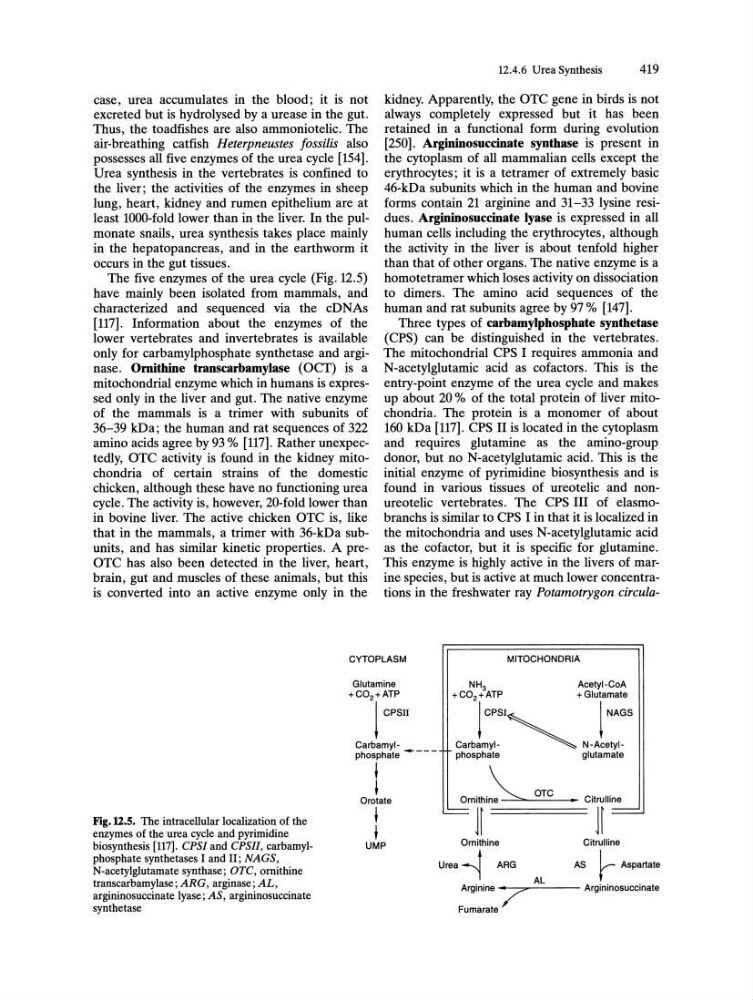
The five enzymes of the urea cycle (Fig. 12.5)
have mainly been isolated from mammals, and
characterized and sequenced via the cDNAs
[117]. Information about the enzymes of the
lower vertebrates and invertebrates is available
only for carbamylphosphate synthetase and arginase. Ornithine transcarbamylase (OCT) is a
mitochondrial enzyme which in humans is expressed only in the liver and gut. The native enzyme
of the mammals is a trimer with subunits of
36-39 kDa; the human and rat sequences of 322
amino acids agree by 93 % [117]. Rather unexpectedly, OTC activity is found in the kidney mitochondria of certain strains of the domestic
chicken, although these have no functioning urea
cycle. The activity is, however, 20-fold lower than
in bovine liver. The active chicken OTC is, like
that in the mammals, a trimer with 36-kDa subunits, and has similar kinetic properties. A preOTC has also been detected in the liver, heart,
brain, gut and muscles of these animals, but this
is converted into an active enzyme only in the
12.4.6 Urea Synthesis
419
kidney. Apparently, the OTC gene in birds is not
always completely expressed but it has been
retained in a functional form during evolution
[250]. Argininosllccinate synthase is present in
the cytoplasm of all mammalian cells except the
erythrocytes; it is a tetramer of extremely basic
46-kDa subunits which in the human and bovine
forms contain 21 arginine and 31-33 lysine residues. Argininosllccinate lyase is expressed in all
human cells including the erythrocytes, although
the activity in the liver is about tenfold higher
than that of other organs. The native enzyme is a
homotetramer which loses activity on dissociation
to dimers. The amino acid sequences of the
human and rat subunits agree by 97 % [147].
Three types of carbamylphosphate synthetase
(CPS) can be distinguished in the vertebrates.
The mitochondrial CPS I requires ammonia and
N-acetylglutamic acid as cofactors. This is the
entry-point enzyme of the urea cycle and makes
up about 20 % of the total protein of liver mitochondria. The protein is a monomer of about
160 kDa [117]. CPS II is located in the cytoplasm
and requires glutamine as the amino-group
donor, but no N-acetylglutamic acid. This is the
initial enzyme of pyrimidine biosynthesis and is
found in various tissues of ureotelic and nonureotelic vertebrates. The CPS III of elasmobranchs is similar to CPS I in that it is localized in
the mitochondria and uses N-acetylglutamic acid
as the cofactor, but it is specific for glutamine.
This enzyme is highly active in the livers of marine species, but is active at much lower concentrations in the freshwater ray Potamotrygon circulaCYTOPLASM
MITOCHONDRIA
Fig.U.S. The intracellular localization of the
enzymes of the urea cycle and pyrimidine
biosynthesis [117]. CPS] and CPSIl, carbamylphosphate synthetases I and II; NAGS,
N-acetylglutamate synthase; OTC, ornithine
transcarbamylase; ARG, arginase; AL,
argininosuccinate lyase; AS, argininosuccinate
synthetase
Glutamine
+C0 2 +ATP
l CPSII
Carbamylphosphate - - - -
,
~
Orotate
~
~
UMP
NH3
Acetyl-CoA
+ CO 2 + ATP
+ Glutamate
l CPSI
l NAGS
Carbamyl- ~ N-Acetylphosphate
glutamate
~ OTC
Ornithine - - " ' - - - - - - Citrulline
lr
If
Ornithine
Citrulline
urea~ ARG
AS ~ Aspartate
Arginine .... 7f--~--- Argininosuccinate
Fumarate
AL
excreted but is hydrolysed by a urease in the gut.
Thus, the toadfishes are also ammoniotelic. The
air-breathing catfish Heterpneustes tossilis also
possesses all five enzymes of the urea cycle [154].
Urea synthesis in the vertebrates is confined to
the liver; the activities of the enzymes in sheep
lung, heart, kidney and rumen epithelium are at
least lOOO-fold lower than in the liver. In the pulmonate snails, urea synthesis takes place mainly
in the hepatopancreas, and in the earthworm it
occurs in the gut tissues.
The five enzymes of the urea cycle (Fig. 12.5)
have mainly been isolated from mammals, and
characterized and sequenced via the cDNAs
[117]. Information about the enzymes of the
lower vertebrates and invertebrates is available
only for carbamylphosphate synthetase and arginase. Ornithine transcarbamylase (OCT) is a
mitochondrial enzyme which in humans is expressed only in the liver and gut. The native enzyme
of the mammals is a trimer with subunits of
36-39 kDa; the human and rat sequences of 322
amino acids agree by 93 % [117]. Rather unexpectedly, OTC activity is found in the kidney mitochondria of certain strains of the domestic
chicken, although these have no functioning urea
cycle. The activity is, however, 20-fold lower than
in bovine liver. The active chicken OTC is, like
that in the mammals, a trimer with 36-kDa subunits, and has similar kinetic properties. A preOTC has also been detected in the liver, heart,
brain, gut and muscles of these animals, but this
is converted into an active enzyme only in the
12.4.6 Urea Synthesis
419
kidney. Apparently, the OTC gene in birds is not
always completely expressed but it has been
retained in a functional form during evolution
[250]. Argininosllccinate synthase is present in
the cytoplasm of all mammalian cells except the
erythrocytes; it is a tetramer of extremely basic
46-kDa subunits which in the human and bovine
forms contain 21 arginine and 31-33 lysine residues. Argininosllccinate lyase is expressed in all
human cells including the erythrocytes, although
the activity in the liver is about tenfold higher
than that of other organs. The native enzyme is a
homotetramer which loses activity on dissociation
to dimers. The amino acid sequences of the
human and rat subunits agree by 97 % [147].
Three types of carbamylphosphate synthetase
(CPS) can be distinguished in the vertebrates.
The mitochondrial CPS I requires ammonia and
N-acetylglutamic acid as cofactors. This is the
entry-point enzyme of the urea cycle and makes
up about 20 % of the total protein of liver mitochondria. The protein is a monomer of about
160 kDa [117]. CPS II is located in the cytoplasm
and requires glutamine as the amino-group
donor, but no N-acetylglutamic acid. This is the
initial enzyme of pyrimidine biosynthesis and is
found in various tissues of ureotelic and nonureotelic vertebrates. The CPS III of elasmobranchs is similar to CPS I in that it is localized in
the mitochondria and uses N-acetylglutamic acid
as the cofactor, but it is specific for glutamine.
This enzyme is highly active in the livers of marine species, but is active at much lower concentrations in the freshwater ray Potamotrygon circulaCYTOPLASM
MITOCHONDRIA
Fig.U.S. The intracellular localization of the
enzymes of the urea cycle and pyrimidine
biosynthesis [117]. CPS] and CPSIl, carbamylphosphate synthetases I and II; NAGS,
N-acetylglutamate synthase; OTC, ornithine
transcarbamylase; ARG, arginase; AL,
argininosuccinate lyase; AS, argininosuccinate
synthetase
Glutamine
+C0 2 +ATP
l CPSII
Carbamylphosphate - - - -
,
~
Orotate
~
~
UMP
NH3
Acetyl-CoA
+ CO 2 + ATP
+ Glutamate
l CPSI
l NAGS
Carbamyl- ~ N-Acetylphosphate
glutamate
~ OTC
Ornithine - - " ' - - - - - - Citrulline
lr
If
Ornithine
Citrulline
urea~ ARG
AS ~ Aspartate
Arginine .... 7f--~--- Argininosuccinate
Fumarate
AL