

418
12 Small Nitrogenous Compounds
have the typical pH optimum of the shell-bearing
forms, which are important for calcification.
Ammonia formation in the tapeworm Gyrocotyle
fimbriata, which infests cartilaginous fish, is due
mainly to hydrolysis by ureases of the large
quantity of urea in the gut cavity; worms maintained in urea-free saline mostly excrete amino
acids, which are thus the end product of its own
protein metabolism.
Ureases are widely found in the invertebrates,
but only a few have been purified and characterized, e.g. those from the polychaete Arenicola cristata, the sea urchin Lytechinus variegatus and the
snail Otala lactea. Ureases have pH optima of 8-9
and K.n values of 0.1-4.5 mmolll. However, the
enzyme from the tapeworm Lacistorhynchus tennuis, which infests sharks, has a Km of 15 mmolll,
corresponding to the urea concentration of its
environment (300 mmolll). The origin of the
urease substrate, urea, is in many cases obscure.
For example, the coral Acropora acuminata has a
highly active urease but neither a functioning urea
cycle nor the enzymes of uricolysis [26, 82].
12.4.6 Urea Synthesis
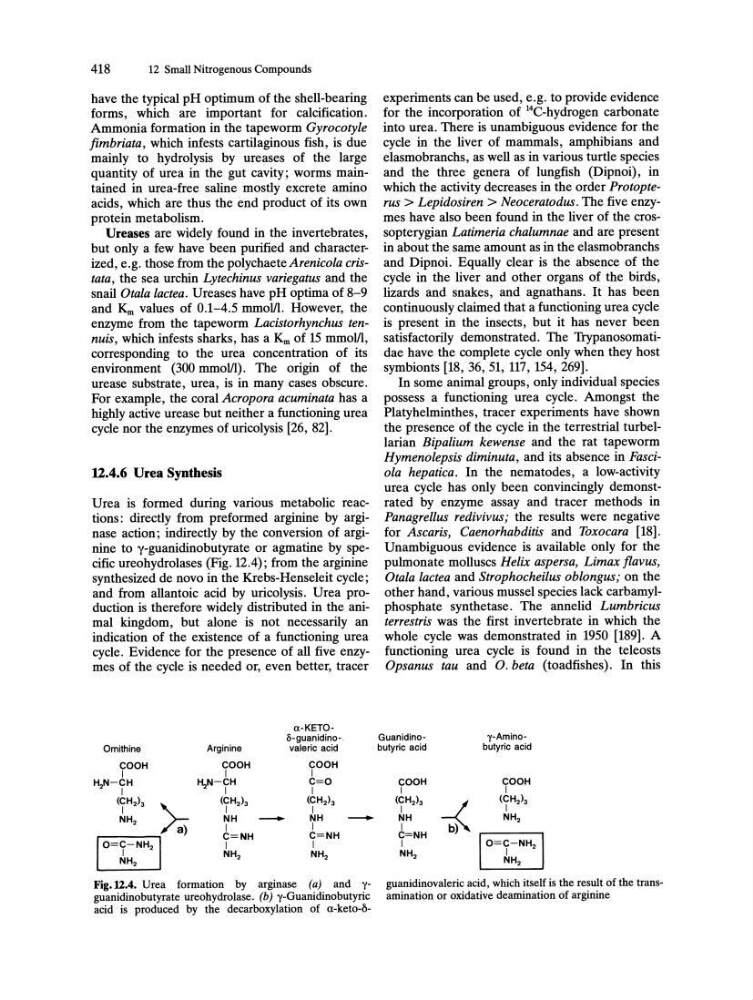
Urea is formed during various metabolic reactions: directly from preformed arginine by arginase action; indirectly by the conversion of arginine to y-guanidinobutyrate or agmatine by specific ureohydrolases (Fig. 12.4); from the arginine
synthesized de novo in the Krebs-Henseleit cycle;
and from allantoic acid by uricolysis. Urea production is therefore widely distributed in the animal kingdom, but alone is not necessarily an
indication of the existence of a functioning urea
cycle. Evidence for the presence of all five enzymes of the cycle is needed or, even better, tracer
a-KETO6-guanidino-.
Ornithine
Arginine
valerie acid
COOH
COOH
COOH
I
I
I
H 2 N-CH
~N-CH
C=O
I
I
I
(CH2)3
I
(CH2)3
I
(CH2)3
I
NH2
NH
-
NH
-
I
I
C=NH
C=NH
I
I
NH2
NH2
Fig.12.4. Urea formation by arginase (a) and yguanidinobutyrate ureohydrolase. (b) y-Guanidinobutyric
acid is produced by the decarboxylation of a-keto-bexperiments can be used, e.g. to provide evidence
for the incorporation of 14C-hydrogen carbonate
into urea. There is unambiguous evidence for the
cycle in the liver of mammals, amphibians and
elasmobranchs, as well as in various turtle species
and the three genera of lungfish (Dipnoi), in
which the activity decreases in the order Protopterus > Lepidosiren > Neoceratodus. The five enzymes have also been found in the liver of the crossopterygian Latimeria chalumnae and are present
in about the same amount as in the elasmobranchs
and Dipnoi. Equally clear is the absence of the
cycle in the liver and other organs of the birds,
lizards and snakes, and agnathans. It has been
continuously claimed that a functioning urea cycle
is present in the insects, but it has never been
satisfactorily demonstrated. The Trypanosomatidae have the complete cycle only when they host
symbionts [18, 36, 51, 117, 154, 269].
In some animal groups, only individual species
possess a functioning urea cycle. Amongst the
Platyhelminthes, tracer experiments have shown
the presence of the cycle in the terrestrial turbellarian Bipalium kewense and the rat tapeworm
Hymenolepsis diminuta, and its absence in Fasciola hepatica. In the nematodes, a low-activity
urea cycle has only been convincingly demonstrated by enzyme assay and tracer methods in
Panagrellus redivivus; the results were negative
for Ascaris, Caenorhabditis and Toxocara [18].
Unambiguous evidence is available only for the
pulmonate molluscs Helix aspersa, Limax flavus,
Otala lactea and Strophocheilus oblongus; on the
other hand, various mussel species lack carbamylphosphate synthetase. The annelid Lumbricus
terrestris was the first invertebrate in which the
whole cycle was demonstrated in 1950 [189]. A
functioning urea cycle is found in the teleosts
Opsanus tau and O. beta (toadfishes). In this
y-Aminobutyric acid
butyric acid
COOH
COOH
I
I
(CH2)3
~
(CH2)3
I
I
NH
NH2
I
C=NH
I
O=C-NH2
NH2
I
NH2
guanidinovaleric acid, which itself is the result of the transamination or oxidative deamination of arginine
12 Small Nitrogenous Compounds
have the typical pH optimum of the shell-bearing
forms, which are important for calcification.
Ammonia formation in the tapeworm Gyrocotyle
fimbriata, which infests cartilaginous fish, is due
mainly to hydrolysis by ureases of the large
quantity of urea in the gut cavity; worms maintained in urea-free saline mostly excrete amino
acids, which are thus the end product of its own
protein metabolism.
Ureases are widely found in the invertebrates,
but only a few have been purified and characterized, e.g. those from the polychaete Arenicola cristata, the sea urchin Lytechinus variegatus and the
snail Otala lactea. Ureases have pH optima of 8-9
and K.n values of 0.1-4.5 mmolll. However, the
enzyme from the tapeworm Lacistorhynchus tennuis, which infests sharks, has a Km of 15 mmolll,
corresponding to the urea concentration of its
environment (300 mmolll). The origin of the
urease substrate, urea, is in many cases obscure.
For example, the coral Acropora acuminata has a
highly active urease but neither a functioning urea
cycle nor the enzymes of uricolysis [26, 82].
12.4.6 Urea Synthesis
Urea is formed during various metabolic reactions: directly from preformed arginine by arginase action; indirectly by the conversion of arginine to y-guanidinobutyrate or agmatine by specific ureohydrolases (Fig. 12.4); from the arginine
synthesized de novo in the Krebs-Henseleit cycle;
and from allantoic acid by uricolysis. Urea production is therefore widely distributed in the animal kingdom, but alone is not necessarily an
indication of the existence of a functioning urea
cycle. Evidence for the presence of all five enzymes of the cycle is needed or, even better, tracer
a-KETO6-guanidino-.
Ornithine
Arginine
valerie acid
COOH
COOH
COOH
I
I
I
H 2 N-CH
~N-CH
C=O
I
I
I
(CH2)3
I
(CH2)3
I
(CH2)3
I
NH2
NH
-
NH
-
I
I
C=NH
C=NH
I
I
NH2
NH2
Fig.12.4. Urea formation by arginase (a) and yguanidinobutyrate ureohydrolase. (b) y-Guanidinobutyric
acid is produced by the decarboxylation of a-keto-bexperiments can be used, e.g. to provide evidence
for the incorporation of 14C-hydrogen carbonate
into urea. There is unambiguous evidence for the
cycle in the liver of mammals, amphibians and
elasmobranchs, as well as in various turtle species
and the three genera of lungfish (Dipnoi), in
which the activity decreases in the order Protopterus > Lepidosiren > Neoceratodus. The five enzymes have also been found in the liver of the crossopterygian Latimeria chalumnae and are present
in about the same amount as in the elasmobranchs
and Dipnoi. Equally clear is the absence of the
cycle in the liver and other organs of the birds,
lizards and snakes, and agnathans. It has been
continuously claimed that a functioning urea cycle
is present in the insects, but it has never been
satisfactorily demonstrated. The Trypanosomatidae have the complete cycle only when they host
symbionts [18, 36, 51, 117, 154, 269].
In some animal groups, only individual species
possess a functioning urea cycle. Amongst the
Platyhelminthes, tracer experiments have shown
the presence of the cycle in the terrestrial turbellarian Bipalium kewense and the rat tapeworm
Hymenolepsis diminuta, and its absence in Fasciola hepatica. In the nematodes, a low-activity
urea cycle has only been convincingly demonstrated by enzyme assay and tracer methods in
Panagrellus redivivus; the results were negative
for Ascaris, Caenorhabditis and Toxocara [18].
Unambiguous evidence is available only for the
pulmonate molluscs Helix aspersa, Limax flavus,
Otala lactea and Strophocheilus oblongus; on the
other hand, various mussel species lack carbamylphosphate synthetase. The annelid Lumbricus
terrestris was the first invertebrate in which the
whole cycle was demonstrated in 1950 [189]. A
functioning urea cycle is found in the teleosts
Opsanus tau and O. beta (toadfishes). In this
y-Aminobutyric acid
butyric acid
COOH
COOH
I
I
(CH2)3
~
(CH2)3
I
I
NH
NH2
I
C=NH
I
O=C-NH2
NH2
I
NH2
guanidinovaleric acid, which itself is the result of the transamination or oxidative deamination of arginine