

28
2 Nucleic Acids and Nuclear Proteins
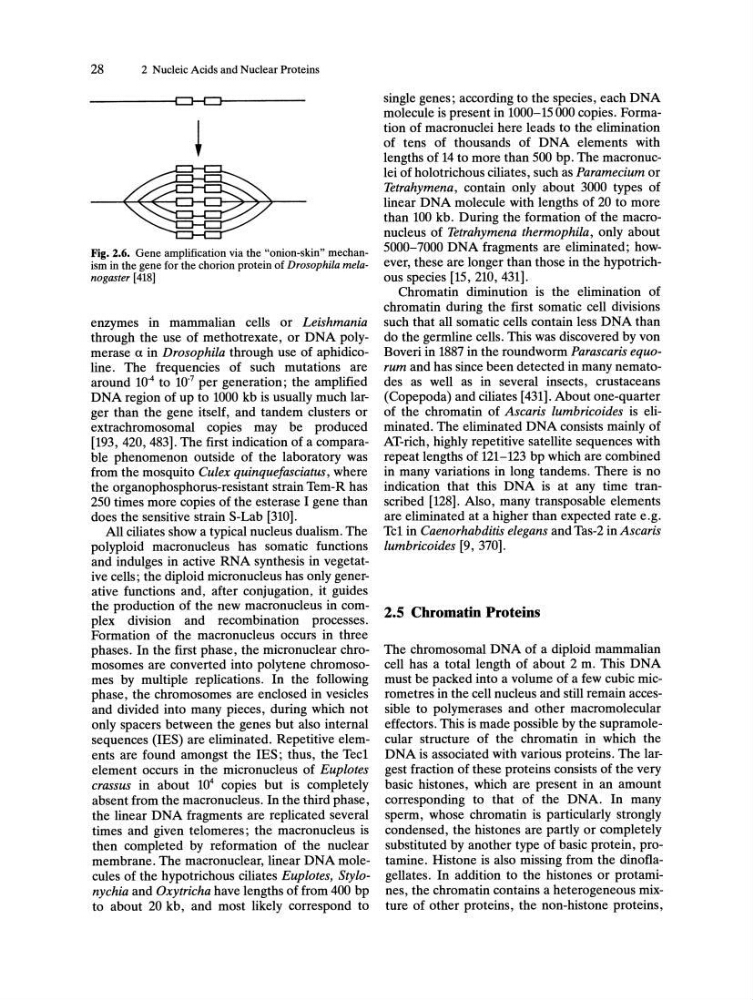
----------~~r_--------Fig. 2.6. Gene amplification via the "onion-skin" mechanism in the gene for the chorion protein of Drosophila melanogaster [418]
enzymes in mammalian cells or Leishmania
through the use of methotrexate, or DNA polymerase a in Drosophila through use of aphidicoline. The frequencies of such mutations are
around 10- 4 to 10- 7 per generation; the amplified
DNA region of up to 1000 kb is usually much larger than the gene itself, and tandem clusters or
extrachromosomal copies may be produced
[193, 420,483]. The first indication of a comparable phenomenon outside of the laboratory was
from the mosquito Culex quinquefasciatus, where
the organophosphorus-resistant strain Tem-R has
250 times more copies of the esterase I gene than
does the sensitive strain S-Lab [310].
All ciliates show a typical nucleus dualism. The
polyploid macronucleus has somatic functions
and indulges in active RNA synthesis in vegetative cells; the diploid micronucleus has only generative functions and, after conjugation, it guides
the production of the new macronucleus in complex division and recombination processes.
Formation of the macronucleus occurs in three
phases. In the first phase, the micronuclear chromosomes are converted into polytene chromosomes by multiple replications. In the following
phase, the chromosomes are enclosed in vesicles
and divided into many pieces, during which not
only spacers between the genes but also internal
sequences (IES) are eliminated. Repetitive elements are found amongst the IES; thus, the Tecl
element occurs in the micronucleus of Euplotes
crass us in about 10 4 copies but is completely
absent from the macronucleus. In the third phase,
the linear DNA fragments are replicated several
times and given telomeres; the macronucleus is
then completed by reformation of the nuclear
membrane. The macronuclear, linear DNA molecules of the hypotrichous ciliates Euplotes, Stylonychia and Oxytricha have lengths of from 400 bp
to about 20 kb, and most likely correspond to
single genes; according to the species, each DNA
molecule is present in 1000-15000 copies. Formation of macronuclei here leads to the elimination
of tens of thousands of DNA elements with
lengths of 14 to more than 500 bp. The macronuclei of holotrichous ciliates, such as Paramecium or
Tetrahymena, contain only about 3000 types of
linear DNA molecule with lengths of 20 to more
than 100 kb. During the formation of the macronucleus of Tetrahymena thermophila, only about
5000-7000 DNA fragments are eliminated; however, these are longer than those in the hypotrichous species [15, 210,431].
Chromatin diminution is the elimination of
chromatin during the first somatic cell divisions
such that all somatic cells contain less DNA than
do the germline cells. This was discovered by von
Boveri in 1887 in the roundworm Parascaris equorum and has since been detected in many nematodes as well as in several insects, crustaceans
(Copepoda) and ciliates [431]. About one-quarter
of the chromatin of Ascaris lumbricoides is eliminated. The eliminated DNA consists mainly of
AT-rich, highly repetitive satellite sequences with
repeat lengths of 121-123 bp which are combined
in many variations in long tandems. There is no
indication that this DNA is at any time transcribed [128]. Also, many transposable elements
are eliminated at a higher than expected rate e.g.
Tcl in Caenorhabditis elegans and Tas-2 in Ascaris
lumbricoides [9, 370].
2.5 Chromatin Proteins
The chromosomal DNA of a diploid mammalian
cell has a total length of about 2 m. This DNA
must be packed into a volume of a few cubic micrometres in the cell nucleus and still remain accessible to polymerases and other macromolecular
effectors. This is made possible by the supramolecular structure of the chromatin in which the
DNA is associated with various proteins. The largest fraction of these proteins consists of the very
basic histones, which are present in an amount
corresponding to that of the DNA. In many
sperm, whose chromatin is particularly strongly
condensed, the histones are partly or completely
substituted by another type of basic protein, protamine. Histone is also missing from the dinoflagellates. In addition to the histones or protamines, the chromatin contains a heterogeneous mixture of other proteins, the non-histone proteins,
2 Nucleic Acids and Nuclear Proteins
----------~~r_--------Fig. 2.6. Gene amplification via the "onion-skin" mechanism in the gene for the chorion protein of Drosophila melanogaster [418]
enzymes in mammalian cells or Leishmania
through the use of methotrexate, or DNA polymerase a in Drosophila through use of aphidicoline. The frequencies of such mutations are
around 10- 4 to 10- 7 per generation; the amplified
DNA region of up to 1000 kb is usually much larger than the gene itself, and tandem clusters or
extrachromosomal copies may be produced
[193, 420,483]. The first indication of a comparable phenomenon outside of the laboratory was
from the mosquito Culex quinquefasciatus, where
the organophosphorus-resistant strain Tem-R has
250 times more copies of the esterase I gene than
does the sensitive strain S-Lab [310].
All ciliates show a typical nucleus dualism. The
polyploid macronucleus has somatic functions
and indulges in active RNA synthesis in vegetative cells; the diploid micronucleus has only generative functions and, after conjugation, it guides
the production of the new macronucleus in complex division and recombination processes.
Formation of the macronucleus occurs in three
phases. In the first phase, the micronuclear chromosomes are converted into polytene chromosomes by multiple replications. In the following
phase, the chromosomes are enclosed in vesicles
and divided into many pieces, during which not
only spacers between the genes but also internal
sequences (IES) are eliminated. Repetitive elements are found amongst the IES; thus, the Tecl
element occurs in the micronucleus of Euplotes
crass us in about 10 4 copies but is completely
absent from the macronucleus. In the third phase,
the linear DNA fragments are replicated several
times and given telomeres; the macronucleus is
then completed by reformation of the nuclear
membrane. The macronuclear, linear DNA molecules of the hypotrichous ciliates Euplotes, Stylonychia and Oxytricha have lengths of from 400 bp
to about 20 kb, and most likely correspond to
single genes; according to the species, each DNA
molecule is present in 1000-15000 copies. Formation of macronuclei here leads to the elimination
of tens of thousands of DNA elements with
lengths of 14 to more than 500 bp. The macronuclei of holotrichous ciliates, such as Paramecium or
Tetrahymena, contain only about 3000 types of
linear DNA molecule with lengths of 20 to more
than 100 kb. During the formation of the macronucleus of Tetrahymena thermophila, only about
5000-7000 DNA fragments are eliminated; however, these are longer than those in the hypotrichous species [15, 210,431].
Chromatin diminution is the elimination of
chromatin during the first somatic cell divisions
such that all somatic cells contain less DNA than
do the germline cells. This was discovered by von
Boveri in 1887 in the roundworm Parascaris equorum and has since been detected in many nematodes as well as in several insects, crustaceans
(Copepoda) and ciliates [431]. About one-quarter
of the chromatin of Ascaris lumbricoides is eliminated. The eliminated DNA consists mainly of
AT-rich, highly repetitive satellite sequences with
repeat lengths of 121-123 bp which are combined
in many variations in long tandems. There is no
indication that this DNA is at any time transcribed [128]. Also, many transposable elements
are eliminated at a higher than expected rate e.g.
Tcl in Caenorhabditis elegans and Tas-2 in Ascaris
lumbricoides [9, 370].
2.5 Chromatin Proteins
The chromosomal DNA of a diploid mammalian
cell has a total length of about 2 m. This DNA
must be packed into a volume of a few cubic micrometres in the cell nucleus and still remain accessible to polymerases and other macromolecular
effectors. This is made possible by the supramolecular structure of the chromatin in which the
DNA is associated with various proteins. The largest fraction of these proteins consists of the very
basic histones, which are present in an amount
corresponding to that of the DNA. In many
sperm, whose chromatin is particularly strongly
condensed, the histones are partly or completely
substituted by another type of basic protein, protamine. Histone is also missing from the dinoflagellates. In addition to the histones or protamines, the chromatin contains a heterogeneous mixture of other proteins, the non-histone proteins,