

388
11 Extracellular Structural and Secretory Proteins
pared with in the birds (Iguana iguana 44 %, Anolis limifrons 34 %, chicken 12 % ), but reptiles
lack the hydroxyproline and -lysine found in
chicken egg-shell proteins [145].
Insect resilin is a protein with almost perfect
elastic properties; 96-97 % of the energy stored
on stretching is released on shortening. It is found
in various insect organs, e.g. in wing joints and
tendons, in feather-like elastic structures in fleas,
locusts and beetles, in the proboscis of butterflies
and in the sucking apparatus of some bugs; it is
also present in millipedes and crustaceans. Resilin has a very simple amino acid composition,
with more than one-half of positions occupied by
either glycine or alanine [Table 11.2 (4)]. The
chains are linked by bis- and tertyrosine residues
(Fig. 11.4), which are formed from tyrosines by
the activity of phenoloxidases or peroxidases.
Resilin contains about 3 % free tyrosine, 0.8 %
bistyrosine and 0.4 % tertyrosine [29].
The ligament of the mussel shell is formed from
mantle tissue, just like the solid part of the shell,
and was originally part of the complete shell structure. It is covered externally by the periostracum
and is divided into two layers. The outer ligament
is made of non-calcified but quinone-treated proteins, about which little is known. The inner ligament of most mussels contains calcium carbonate
to about 60-80 % of the dry weight; only that of
the scallop (Pectinidae) is low in calcium. In this
latter type of swimming mussel, the outer ligament is reduced to a thin band and the inner ligament has the form of a wedge-shaped cushion
which functions as antagonist to the single adductor muscle present. The high elasticity of the inner
ligament allows up to three flapping movements
of the shell per second during recoil swimming.
The inner mussel ligament consists of fibrillar
elastic proteins, the abductins [Table 11.2 (2a1b)].
The polypeptide chains of the abductins, like
those of all elastic proteins, are cross-linked but in
this case the linking structures are not known. The
ligament proteins of the mussels in the superfamily Mactracea contain 20-25 % methionine
sulphoxide in addition to 45-50 % glycine; this
can be demonstrated spectrometrically in intact
ligaments. The two diastereomers of this unusual
amino acid appear to be present in equal proportions. The Pectinidae, in contrast, have a much
lower methionine fraction, of which only 40-50 %
is oxidized [64].
The cephalopods have a vascular system with a
relatively high blood pressure. Their aortas and
large arteries, like those of the vertebrates, help
maintain the blood pressure and have a layer of
elastic fibrils in their walls. The elastic protein
was first isolated from the aorta of Octopus dofleini and, consequently, received the name octopus
arterial elastomer (OAE) [113]. The OAE fibrils
have considerable elastic properties, although
their amino acid composition is not as extreme as
that of the other elastic proteins [Table 11.2 (3)].
11.5 Albumen Proteins of Birds
and Reptiles
The egg-white (albumen) of the chicken and
other avian species contains at least 50 different,
electrophoretically distinct protein components,
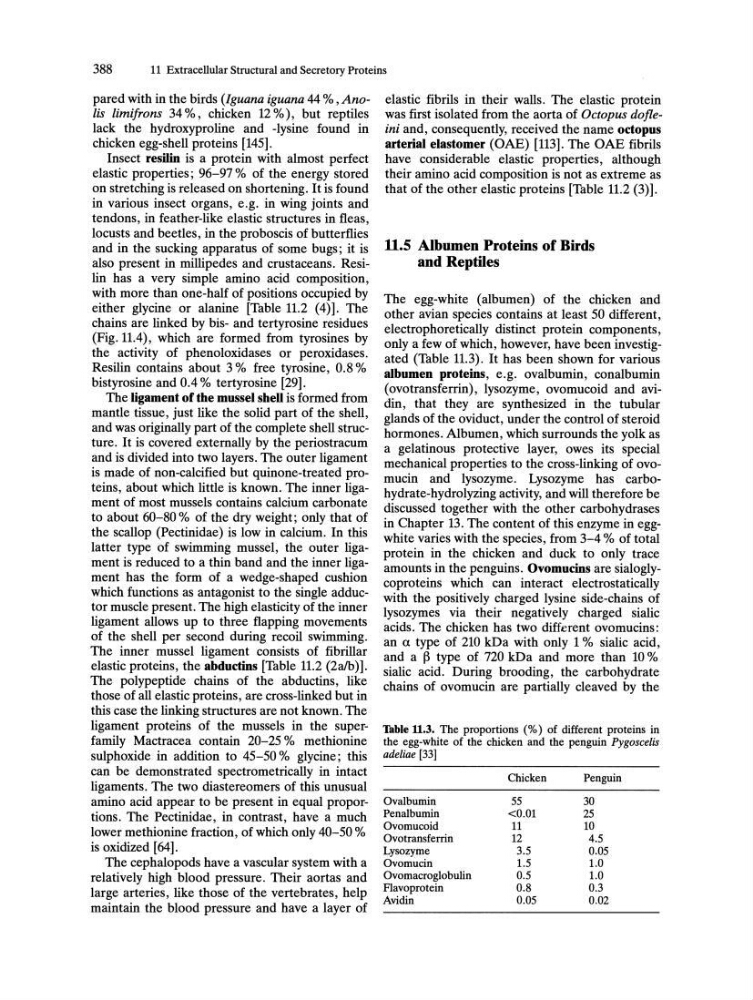
only a few of which, however, have been investigated (Table 11.3). It has been shown for various
albumen proteins, e.g. ovalbumin, conalbumin
(ovotransferrin), lysozyme, ovomucoid and avidin, that they are synthesized in the tubular
glands of the oviduct, under the control of steroid
hormones. Albumen, which surrounds the yolk as
a gelatinous protective layer, owes its special
mechanical properties to the cross-linking of ovomucin and lysozyme. Lysozyme has carbohydrate-hydrolyzing activity, and will therefore be
discussed together with the other carbohydrases
in Chapter 13. The content of this enzyme in eggwhite varies with the species, from 3-4 % of total
protein in the chicken and duck to only trace
amounts in the penguins. Ovomucins are sialoglycoproteins which can interact electrostatically
with the positively charged lysine side-chains of
lysozymes via their negatively charged sialic
acids. The chicken has two different ovomucins:
an a type of 210 kDa with only 1 % sialic acid,
and a ~ type of 720 kDa and more than 10 %
sialic acid. During brooding, the carbohydrate
chains of ovomucin are partially cleaved by the
Thble n.3. The proportions (%) of different proteins in
the egg-white of the chicken and the penguin Pygoscelis
adeliae [33]
Ovalbumin
Penalburnin
Ovomucoid
Ovotransferrin
Lysozyme
Ovomucin
Ovomacroglobulin
Flavoprotein
Avidin
Chicken
55
<0.01
11
12
3.5
1.5
0.5
0.8
0.05
Penguin
30
25
10
4.5
0.05
1.0
1.0
0.3
0.02
11 Extracellular Structural and Secretory Proteins
pared with in the birds (Iguana iguana 44 %, Anolis limifrons 34 %, chicken 12 % ), but reptiles
lack the hydroxyproline and -lysine found in
chicken egg-shell proteins [145].
Insect resilin is a protein with almost perfect
elastic properties; 96-97 % of the energy stored
on stretching is released on shortening. It is found
in various insect organs, e.g. in wing joints and
tendons, in feather-like elastic structures in fleas,
locusts and beetles, in the proboscis of butterflies
and in the sucking apparatus of some bugs; it is
also present in millipedes and crustaceans. Resilin has a very simple amino acid composition,
with more than one-half of positions occupied by
either glycine or alanine [Table 11.2 (4)]. The
chains are linked by bis- and tertyrosine residues
(Fig. 11.4), which are formed from tyrosines by
the activity of phenoloxidases or peroxidases.
Resilin contains about 3 % free tyrosine, 0.8 %
bistyrosine and 0.4 % tertyrosine [29].
The ligament of the mussel shell is formed from
mantle tissue, just like the solid part of the shell,
and was originally part of the complete shell structure. It is covered externally by the periostracum
and is divided into two layers. The outer ligament
is made of non-calcified but quinone-treated proteins, about which little is known. The inner ligament of most mussels contains calcium carbonate
to about 60-80 % of the dry weight; only that of
the scallop (Pectinidae) is low in calcium. In this
latter type of swimming mussel, the outer ligament is reduced to a thin band and the inner ligament has the form of a wedge-shaped cushion
which functions as antagonist to the single adductor muscle present. The high elasticity of the inner
ligament allows up to three flapping movements
of the shell per second during recoil swimming.
The inner mussel ligament consists of fibrillar
elastic proteins, the abductins [Table 11.2 (2a1b)].
The polypeptide chains of the abductins, like
those of all elastic proteins, are cross-linked but in
this case the linking structures are not known. The
ligament proteins of the mussels in the superfamily Mactracea contain 20-25 % methionine
sulphoxide in addition to 45-50 % glycine; this
can be demonstrated spectrometrically in intact
ligaments. The two diastereomers of this unusual
amino acid appear to be present in equal proportions. The Pectinidae, in contrast, have a much
lower methionine fraction, of which only 40-50 %
is oxidized [64].
The cephalopods have a vascular system with a
relatively high blood pressure. Their aortas and
large arteries, like those of the vertebrates, help
maintain the blood pressure and have a layer of
elastic fibrils in their walls. The elastic protein
was first isolated from the aorta of Octopus dofleini and, consequently, received the name octopus
arterial elastomer (OAE) [113]. The OAE fibrils
have considerable elastic properties, although
their amino acid composition is not as extreme as
that of the other elastic proteins [Table 11.2 (3)].
11.5 Albumen Proteins of Birds
and Reptiles
The egg-white (albumen) of the chicken and
other avian species contains at least 50 different,
electrophoretically distinct protein components,
only a few of which, however, have been investigated (Table 11.3). It has been shown for various
albumen proteins, e.g. ovalbumin, conalbumin
(ovotransferrin), lysozyme, ovomucoid and avidin, that they are synthesized in the tubular
glands of the oviduct, under the control of steroid
hormones. Albumen, which surrounds the yolk as
a gelatinous protective layer, owes its special
mechanical properties to the cross-linking of ovomucin and lysozyme. Lysozyme has carbohydrate-hydrolyzing activity, and will therefore be
discussed together with the other carbohydrases
in Chapter 13. The content of this enzyme in eggwhite varies with the species, from 3-4 % of total
protein in the chicken and duck to only trace
amounts in the penguins. Ovomucins are sialoglycoproteins which can interact electrostatically
with the positively charged lysine side-chains of
lysozymes via their negatively charged sialic
acids. The chicken has two different ovomucins:
an a type of 210 kDa with only 1 % sialic acid,
and a ~ type of 720 kDa and more than 10 %
sialic acid. During brooding, the carbohydrate
chains of ovomucin are partially cleaved by the
Thble n.3. The proportions (%) of different proteins in
the egg-white of the chicken and the penguin Pygoscelis
adeliae [33]
Ovalbumin
Penalburnin
Ovomucoid
Ovotransferrin
Lysozyme
Ovomucin
Ovomacroglobulin
Flavoprotein
Avidin
Chicken
55
<0.01
11
12
3.5
1.5
0.5
0.8
0.05
Penguin
30
25
10
4.5
0.05
1.0
1.0
0.3
0.02