

366
10 Proteins of Musele and the Cytoskeleton
product. The bovine orthologous chains differ
from those of the rat or mouse by only 4-5 % , giving an estimate of about 4 % per 100 million years
for the rate of evolution. Thus, the separation of
the different chain types probably occurred about
300 million years ago. Homologous chains should
be present in all mammals, birds and reptiles, and
most of them also occur in amphibians and fish
[97]. A crystallin sequenced via the cDNA from
the frog Rana temporaria is highly homologous to
the ~A1 crystallins of the mammals and birds
[170]. The so-called ~s crystallin ofthe mammalian
lens is rather unique in the ~ crystallin family; it
behaves electrophoretically like a ~ crystallin but
is always present as a monomer and corresponds
more in its sequence to a y crystallin [234].
The y crystallins are always monomers (Table 10.3) and, like the ~ crystallins, show marked
heterogeneity in all vertebrates. They have a typical tertiary structure, which is also seen in the ~crystallin subunits; there are two globular
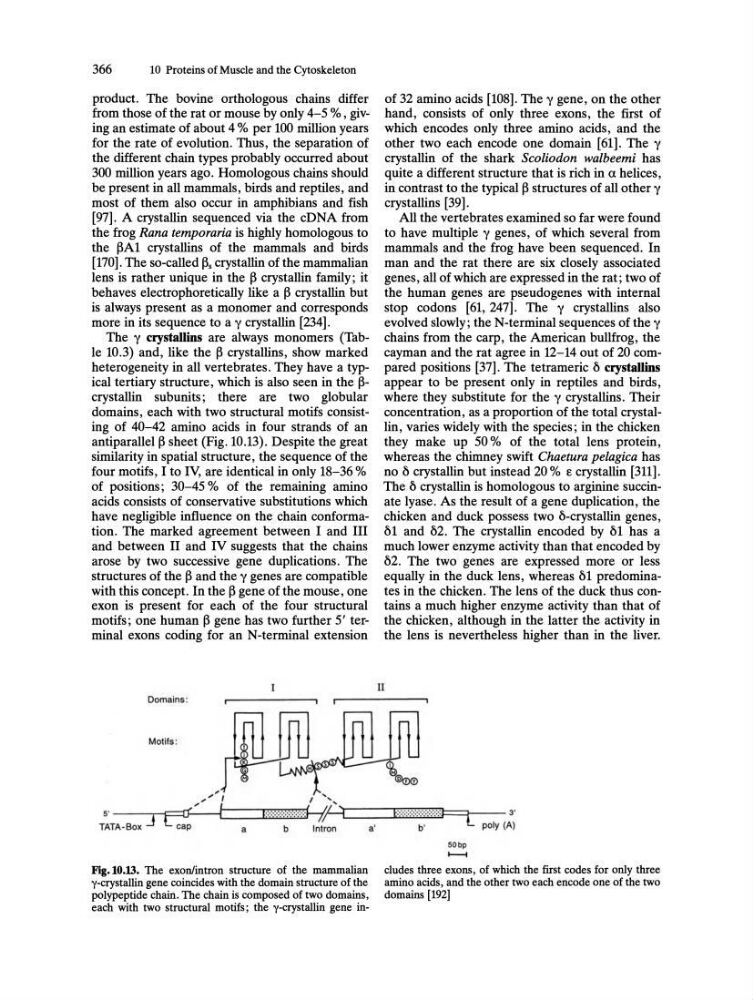
domains, each with two structural motifs consisting of 40-42 amino acids in four strands of an
antiparallel ~ sheet (Fig. 10.13). Despite the great
similarity in spatial structure, the sequence of the
four motifs, I to IV, are identical in only 18-36 %
of positions; 30-45 % of the remaining amino
acids consists of conservative substitutions which
have negligible influence on the chain conformation. The marked agreement between I and III
and between II and IV suggests that the chains
arose by two successive gene duplications. The
structures of the ~ and the y genes are compatible
with this concept. In the ~ gene of the mouse, one
exon is present for each of the four structural
motifs; one human ~ gene has two further 5' terminal exons coding for an N-terminal extension
Domains:
Fig.IO.13. The exonlintron structure of the mammalian
y-crystallin gene coincides with the domain structure of the
polypeptide chain. The chain is composed of two domains,
each with two structural motifs; the y-crystallin gene inof 32 amino acids [108]. The y gene, on the other
hand, consists of only three exons, the first of
which encodes only three amino acids, and the
other two each encode one domain [61]. The y
crystallin of the shark Scoliodon walbeemi has
quite a different structure that is rich in a helices,
in contrast to the typical ~ structures of all other y
crystallins [39].
All the vertebrates examined so far were found
to have multiple y genes, of which several from
mammals and the frog have been sequenced. In
man and the rat there are six closely associated
genes, all of which are expressed in the rat; two of
the human genes are pseudo genes with internal
stop co dons [61, 247]. The y crystallins also
evolved slowly; the N-terminal sequences of the y
chains from the carp, the American bullfrog, the
cayman and the rat agree in 12-14 out of 20 compared positions [37]. The tetrameric fJ crystallins
appear to be present only in reptiles and birds,
where they substitute for the y crystallins. Their
concentration, as a proportion of the total crystallin, varies widely with the species; in the chicken
they make up 50 % of the total lens protein,
whereas the chimney swift Chaetura pelagica has
no fJ crystallin but instead 20 % E crystallin [311].
The fJ crystallin is homologous to arginine succinate lyase. As the result of a gene duplication, the
chicken and duck possess two fJ-crystallin genes,
()1 and fJ2. The crystallin encoded by ()1 has a
much lower enzyme activity than that encoded by
fJ2. The two genes are expressed more or less
equally in the duck lens, whereas ()1 predominates in the chicken. The lens of the duck thus contains a much higher enzyme activity than that of
the chicken, although in the latter the activity in
the lens is nevertheless higher than in the liver.
II
50bp
I----i
eludes three exons, of which the first codes for only three
amino acids, and the other two each encode one of the two
domains [192]
10 Proteins of Musele and the Cytoskeleton
product. The bovine orthologous chains differ
from those of the rat or mouse by only 4-5 % , giving an estimate of about 4 % per 100 million years
for the rate of evolution. Thus, the separation of
the different chain types probably occurred about
300 million years ago. Homologous chains should
be present in all mammals, birds and reptiles, and
most of them also occur in amphibians and fish
[97]. A crystallin sequenced via the cDNA from
the frog Rana temporaria is highly homologous to
the ~A1 crystallins of the mammals and birds
[170]. The so-called ~s crystallin ofthe mammalian
lens is rather unique in the ~ crystallin family; it
behaves electrophoretically like a ~ crystallin but
is always present as a monomer and corresponds
more in its sequence to a y crystallin [234].
The y crystallins are always monomers (Table 10.3) and, like the ~ crystallins, show marked
heterogeneity in all vertebrates. They have a typical tertiary structure, which is also seen in the ~crystallin subunits; there are two globular
domains, each with two structural motifs consisting of 40-42 amino acids in four strands of an
antiparallel ~ sheet (Fig. 10.13). Despite the great
similarity in spatial structure, the sequence of the
four motifs, I to IV, are identical in only 18-36 %
of positions; 30-45 % of the remaining amino
acids consists of conservative substitutions which
have negligible influence on the chain conformation. The marked agreement between I and III
and between II and IV suggests that the chains
arose by two successive gene duplications. The
structures of the ~ and the y genes are compatible
with this concept. In the ~ gene of the mouse, one
exon is present for each of the four structural
motifs; one human ~ gene has two further 5' terminal exons coding for an N-terminal extension
Domains:
Fig.IO.13. The exonlintron structure of the mammalian
y-crystallin gene coincides with the domain structure of the
polypeptide chain. The chain is composed of two domains,
each with two structural motifs; the y-crystallin gene inof 32 amino acids [108]. The y gene, on the other
hand, consists of only three exons, the first of
which encodes only three amino acids, and the
other two each encode one domain [61]. The y
crystallin of the shark Scoliodon walbeemi has
quite a different structure that is rich in a helices,
in contrast to the typical ~ structures of all other y
crystallins [39].
All the vertebrates examined so far were found
to have multiple y genes, of which several from
mammals and the frog have been sequenced. In
man and the rat there are six closely associated
genes, all of which are expressed in the rat; two of
the human genes are pseudo genes with internal
stop co dons [61, 247]. The y crystallins also
evolved slowly; the N-terminal sequences of the y
chains from the carp, the American bullfrog, the
cayman and the rat agree in 12-14 out of 20 compared positions [37]. The tetrameric fJ crystallins
appear to be present only in reptiles and birds,
where they substitute for the y crystallins. Their
concentration, as a proportion of the total crystallin, varies widely with the species; in the chicken
they make up 50 % of the total lens protein,
whereas the chimney swift Chaetura pelagica has
no fJ crystallin but instead 20 % E crystallin [311].
The fJ crystallin is homologous to arginine succinate lyase. As the result of a gene duplication, the
chicken and duck possess two fJ-crystallin genes,
()1 and fJ2. The crystallin encoded by ()1 has a
much lower enzyme activity than that encoded by
fJ2. The two genes are expressed more or less
equally in the duck lens, whereas ()1 predominates in the chicken. The lens of the duck thus contains a much higher enzyme activity than that of
the chicken, although in the latter the activity in
the lens is nevertheless higher than in the liver.
II
50bp
I----i
eludes three exons, of which the first codes for only three
amino acids, and the other two each encode one of the two
domains [192]