

10.12 Lens Proteins (Crystallins)
365
~
~
~
~
~
MDIAIQHPWFKRTLGPFYPSRLFDQFFGEGLFEYDLLPFLSSTISPYYRQSLFRTVLD
Bovine
Chicken
Alligator
Frog
Shark
T A L I
L
LF
S E
T A L I
L
H
SE
T A N
V
M D
F
F GF
L
Y
R S S Y
D
F F
V NF E
100
110
00
ro
00
00
.
.
.
.
SGISEVRSDRDKFVIFLDVKHFSPEDLTVKVQEDFVEIHGKHNERQDDHGYISREFHR
Bovine
Chicken
Alligator
T M
S
lID
S
T M
S
V
Frog
Shark.
R
R M N
ILD
E S IVD Y
S
A
1~0
1~0
110
1~0
1~0
170
RYRLPSNVDQSALSCSLSADGMLTFSGPKIPSGVDAGHSERAIPVSREEKPSSAPSS
Bovine
Chicken
Alligator
A
IT
S
V NM PS
P
T
S
VT V
S VQ N TI .D P A T
Frog
Shark
LNE SI
I
LM SL SS G P
T
LNE IA
N L
CC TRP D SNWQD P
QGTQ EIRADP
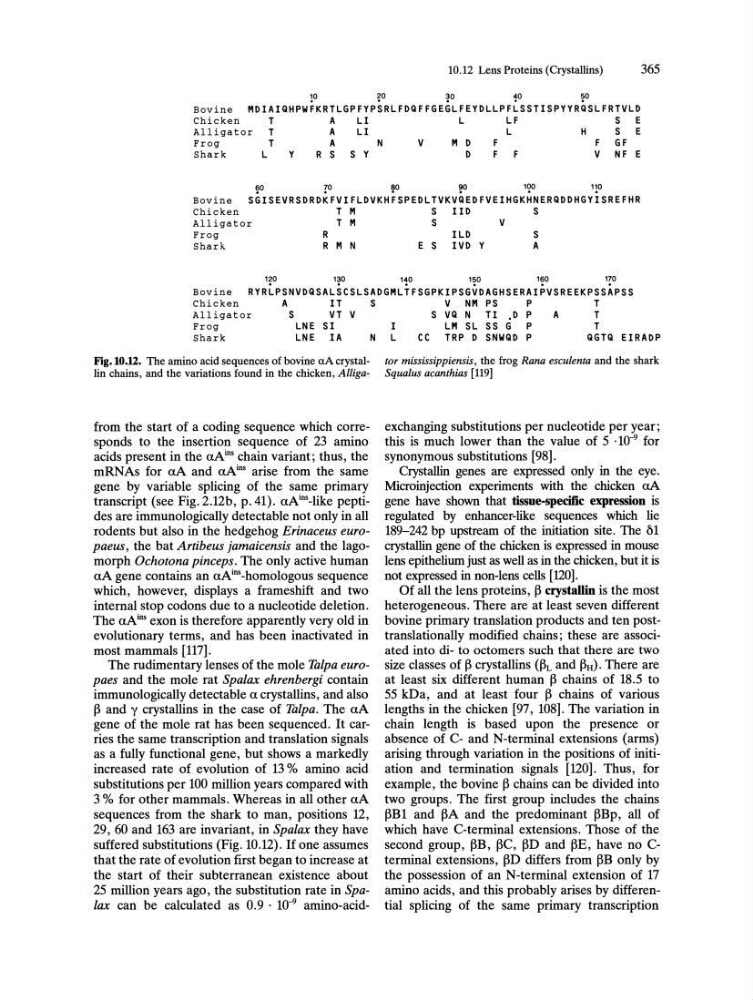
Fig.l0.12. The amino acid sequences of bovine aA crystallin chains, and the variations found in the chicken, Alligafrom the start of a coding sequence which corresponds to the insertion sequence of 23 amino
acids present in the aA ins chain variant; thus, the
mRNAs for aA and aA ins arise from the same
gene by variable splicing of the same primary
transcript (see Fig. 2.12b, p.41). aAins-like peptides are immunologically detectable not only in all
rodents but also in the hedgehog Erinaceus europaeus, the bat Artibeus jamaicensis and the lagomorph Ochotona pinceps. The only active human
aA gene contains an aAins-homologous sequence
which, however, displays a frameshift and two
internal stop codons due to a nucleotide deletion.
The aA ins exon is therefore apparently very old in
evolutionary terms, and has been inactivated in
most mammals [117].
The rudimentary lenses of the mole Talpa europaes and the mole rat Spalax ehrenbergi contain
immunologically detectable a crystallins, and also
Band y crystallins in the case of Talpa. The aA
gene of the mole rat has been sequenced. It carries the same transcription and translation signals
as a fully functional gene, but shows a markedly
increased rate of evolution of 13 % amino acid
substitutions per 100 million years compared with
3 % for other mammals. Whereas in all other aA
sequences from the shark to man, positions 12,
29, 60 and 163 are invariant, in Spalax they have
suffered substitutions (Fig. 10.12). If one assumes
that the rate of evolution first began to increase at
the start of their subterranean existence about
25 million years ago, the substitution rate in Spalax can be calculated as 0.9 . 10- 9 amino-acidtor mississippiensis, the frog Rana esculenta and the shark
Squalus acanthias [119]
exchanging substitutions per nucleotide per year;
this is much lower than the value of 5 .10- 9 for
synonymous substitutions [98].
Crystallin genes are expressed only in the eye.
Microinjection experiments with the chicken aA
gene have shown that tissue-specific expression is
regulated by enhancer-like sequences which lie
189-242 bp upstream of the initiation site. The 01
crystallin gene of the chicken is expressed in mouse
lens epithelium just as well as in the chicken, but it is
not expressed in non-lens cells [120].
Of all the lens proteins, B crystallin is the most
heterogeneous. There are at least seven different
bovine primary translation products and ten posttranslationally modified chains; these are associated into di- to octomers such that there are two
size classes of B crystallins (BL and BH)' There are
at least six different human B chains of 18.5 to
55 kDa, and at least four B chains of various
lengths in the chicken [97, 108]. The variation in
chain length is based upon the presence or
absence of C- and N-terminal extensions (arms)
arising through variation in the positions of initiation and termination signals [120]. Thus, for
example, the bovine ~ chains can be divided into
two groups. The first group includes the chains
BBl and BA and the predominant BBp, all of
which have C-terminal extensions. Those of the
second group, BB, BC, BD and BE, have no Cterminal extensions, BD differs from BB only by
the possession of an N-terminal extension of 17
amino acids, and this probably arises by differential splicing of the same primary transcription
365
~
~
~
~
~
MDIAIQHPWFKRTLGPFYPSRLFDQFFGEGLFEYDLLPFLSSTISPYYRQSLFRTVLD
Bovine
Chicken
Alligator
Frog
Shark
T A L I
L
LF
S E
T A L I
L
H
SE
T A N
V
M D
F
F GF
L
Y
R S S Y
D
F F
V NF E
100
110
00
ro
00
00
.
.
.
.
SGISEVRSDRDKFVIFLDVKHFSPEDLTVKVQEDFVEIHGKHNERQDDHGYISREFHR
Bovine
Chicken
Alligator
T M
S
lID
S
T M
S
V
Frog
Shark.
R
R M N
ILD
E S IVD Y
S
A
1~0
1~0
110
1~0
1~0
170
RYRLPSNVDQSALSCSLSADGMLTFSGPKIPSGVDAGHSERAIPVSREEKPSSAPSS
Bovine
Chicken
Alligator
A
IT
S
V NM PS
P
T
S
VT V
S VQ N TI .D P A T
Frog
Shark
LNE SI
I
LM SL SS G P
T
LNE IA
N L
CC TRP D SNWQD P
QGTQ EIRADP
Fig.l0.12. The amino acid sequences of bovine aA crystallin chains, and the variations found in the chicken, Alligafrom the start of a coding sequence which corresponds to the insertion sequence of 23 amino
acids present in the aA ins chain variant; thus, the
mRNAs for aA and aA ins arise from the same
gene by variable splicing of the same primary
transcript (see Fig. 2.12b, p.41). aAins-like peptides are immunologically detectable not only in all
rodents but also in the hedgehog Erinaceus europaeus, the bat Artibeus jamaicensis and the lagomorph Ochotona pinceps. The only active human
aA gene contains an aAins-homologous sequence
which, however, displays a frameshift and two
internal stop codons due to a nucleotide deletion.
The aA ins exon is therefore apparently very old in
evolutionary terms, and has been inactivated in
most mammals [117].
The rudimentary lenses of the mole Talpa europaes and the mole rat Spalax ehrenbergi contain
immunologically detectable a crystallins, and also
Band y crystallins in the case of Talpa. The aA
gene of the mole rat has been sequenced. It carries the same transcription and translation signals
as a fully functional gene, but shows a markedly
increased rate of evolution of 13 % amino acid
substitutions per 100 million years compared with
3 % for other mammals. Whereas in all other aA
sequences from the shark to man, positions 12,
29, 60 and 163 are invariant, in Spalax they have
suffered substitutions (Fig. 10.12). If one assumes
that the rate of evolution first began to increase at
the start of their subterranean existence about
25 million years ago, the substitution rate in Spalax can be calculated as 0.9 . 10- 9 amino-acidtor mississippiensis, the frog Rana esculenta and the shark
Squalus acanthias [119]
exchanging substitutions per nucleotide per year;
this is much lower than the value of 5 .10- 9 for
synonymous substitutions [98].
Crystallin genes are expressed only in the eye.
Microinjection experiments with the chicken aA
gene have shown that tissue-specific expression is
regulated by enhancer-like sequences which lie
189-242 bp upstream of the initiation site. The 01
crystallin gene of the chicken is expressed in mouse
lens epithelium just as well as in the chicken, but it is
not expressed in non-lens cells [120].
Of all the lens proteins, B crystallin is the most
heterogeneous. There are at least seven different
bovine primary translation products and ten posttranslationally modified chains; these are associated into di- to octomers such that there are two
size classes of B crystallins (BL and BH)' There are
at least six different human B chains of 18.5 to
55 kDa, and at least four B chains of various
lengths in the chicken [97, 108]. The variation in
chain length is based upon the presence or
absence of C- and N-terminal extensions (arms)
arising through variation in the positions of initiation and termination signals [120]. Thus, for
example, the bovine ~ chains can be divided into
two groups. The first group includes the chains
BBl and BA and the predominant BBp, all of
which have C-terminal extensions. Those of the
second group, BB, BC, BD and BE, have no Cterminal extensions, BD differs from BB only by
the possession of an N-terminal extension of 17
amino acids, and this probably arises by differential splicing of the same primary transcription