

with increasing temperature in all myosins. The
mean "melting point" , however, varies from
33°C for Arctic fish to 45 °C for frogs and 49°C
for rabbits [235].
Two classes of light chain can be distinguished;
these have different functional properties and are
solubilized from myosin molecules in different
ways. One type of LC is termed "regulatory", in
view of its involvement in calcium regulation in
the scallop [88]. The second type, known as
"essential", was initially thought to be an absolute requirement for ATPase function; in the
meantime, it has become clear that the myosin
fragment S-l can hydrolyse ATP in the absence of
an LC. The function of the essential LCs is therefore controversial [88]. In the myosin of mammalian skeletal muscle, the essential chains are
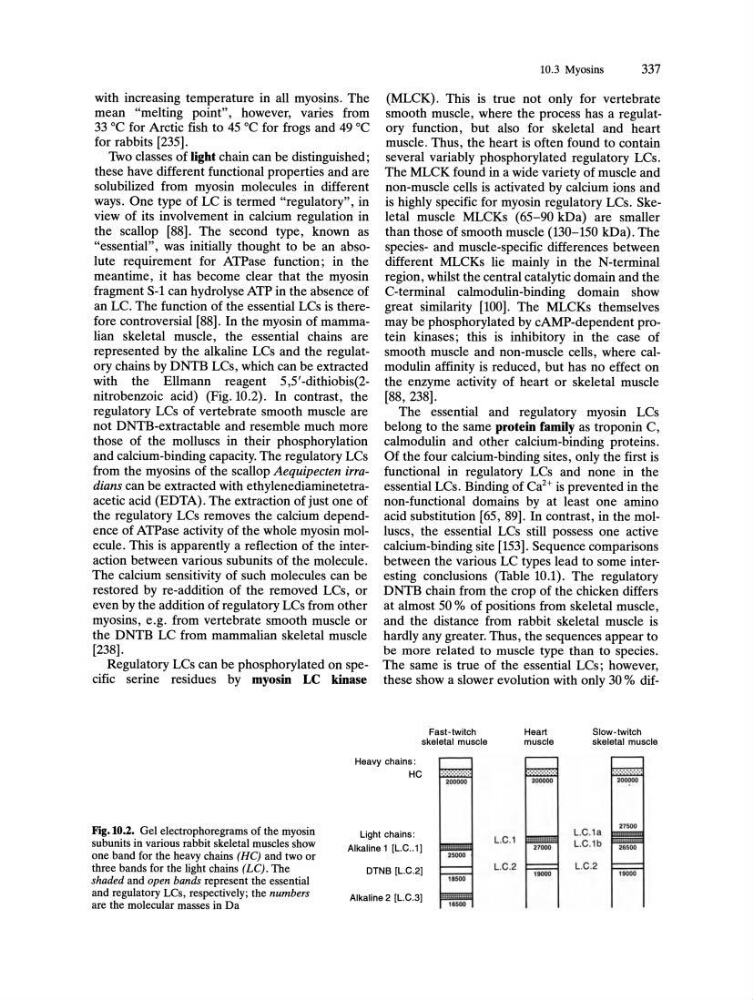
represented by the alkaline LCs and the regulatory chains by DNTB LCs, which can be extracted
with the Ellmann reagent 5,5'-dithiobis(2nitrobenzoic acid) (Fig. 10.2). In contrast, the
regulatory LCs of vertebrate smooth muscle are
not DNTB-extractable and resemble much more
those of the molluscs in their phosphorylation
and calcium-binding capacity. The regulatory LCs
from the myosins of the scallop Aequipecten irradians can be extracted with ethylenediaminetetraacetic acid (EDTA). The extraction of just one of
the regulatory LCs removes the calcium dependence of ATPase activity of the whole myosin molecule. This is apparently a reflection of the interaction between various subunits of the molecule.
The calcium sensitivity of such molecules can be
restored by re-addition of the removed LCs, or
even by the addition of regulatory LCs from other
myosins, e.g. from vertebrate smooth muscle or
the DNTB LC from mammalian skeletal muscle
[238] .
Regulatory LCs can be phosphorylated on specific serine residues by myosin LC kinase
10.3 Myosins
337
(MLCK). This is true not only for vertebrate
smooth muscle, where the process has a regulatory function, but also for skeletal and heart
muscle. Thus, the heart is often found to contain
several variably phosphorylated regulatory LCs.
The MLCK found in a wide variety of muscle and
non-muscle cells is activated by calcium ions and
is highly specific for myosin regulatory LCs. Skeletal muscle MLCKs (65-90 kDa) are smaller
than those of smooth muscle (130-150 kDa). The
species- and muscle-specific differences between
different MLCKs lie mainly in the N-terminal
region, whilst the central catalytic domain and the
C-terminal calmodulin-binding domain show
great similarity [100] . The MLCKs themselves
may be phosphorylated by cAMP-dependent protein kinases; this is inhibitory in the case of
smooth muscle and non-muscle cells, where calmodulin affinity is reduced, but has no effect on
the enzyme activity of heart or skeletal muscle
[88, 238].
The essential and regulatory myosin LCs
belong to the same protein family as troponin C,
calmodulin and other calcium-binding proteins.
Of the four calcium-binding sites, only the first is
functional in regulatory LCs and none in the
essential LCs. Binding of Ca 2 + is prevented in the
non-functional domains by at least one amino
acid substitution [65 , 89]. In contrast, in the molluscs, the essential LCs still possess one active
calcium-binding site [153]. Sequence comparisons
between the various LC types lead to some interesting conclusions (Table 10.1). The regulatory
DNTB chain from the crop of the chicken differs
at almost 50 % of positions from skeletal muscle,
and the distance from rabbit skeletal muscle is
hardly any greater. Thus, the sequences appear to
be more related to muscle type than to species.
The same is true of the essential LCs; however,
these show a slower evolution with only 30 % difFast -twitch
skeletal muscle
Heart
muscle
Slow-twitch
skeletal muscle
Heavy chains:
Fig.tO.2. Gel electrophoregrams of the myosin
subunits in various rabbit skeletal muscles show
one band for the heavy chains (HC) and two or
three bands for the light chains (LC). The
shaded and open bands represent the essential
and regulatory Les, respectively; the numbers
are the molecular masses in Da
HC
Light chains:
Alkaline 1 [L.C .. 1]
DTNB [L.C.2]
Alkaline 2 [L.C.3]
16500
L.C.1
L.C.2
19000
L.C.1a
L.C .lb
L.C .2
19000
mean "melting point" , however, varies from
33°C for Arctic fish to 45 °C for frogs and 49°C
for rabbits [235].
Two classes of light chain can be distinguished;
these have different functional properties and are
solubilized from myosin molecules in different
ways. One type of LC is termed "regulatory", in
view of its involvement in calcium regulation in
the scallop [88]. The second type, known as
"essential", was initially thought to be an absolute requirement for ATPase function; in the
meantime, it has become clear that the myosin
fragment S-l can hydrolyse ATP in the absence of
an LC. The function of the essential LCs is therefore controversial [88]. In the myosin of mammalian skeletal muscle, the essential chains are
represented by the alkaline LCs and the regulatory chains by DNTB LCs, which can be extracted
with the Ellmann reagent 5,5'-dithiobis(2nitrobenzoic acid) (Fig. 10.2). In contrast, the
regulatory LCs of vertebrate smooth muscle are
not DNTB-extractable and resemble much more
those of the molluscs in their phosphorylation
and calcium-binding capacity. The regulatory LCs
from the myosins of the scallop Aequipecten irradians can be extracted with ethylenediaminetetraacetic acid (EDTA). The extraction of just one of
the regulatory LCs removes the calcium dependence of ATPase activity of the whole myosin molecule. This is apparently a reflection of the interaction between various subunits of the molecule.
The calcium sensitivity of such molecules can be
restored by re-addition of the removed LCs, or
even by the addition of regulatory LCs from other
myosins, e.g. from vertebrate smooth muscle or
the DNTB LC from mammalian skeletal muscle
[238] .
Regulatory LCs can be phosphorylated on specific serine residues by myosin LC kinase
10.3 Myosins
337
(MLCK). This is true not only for vertebrate
smooth muscle, where the process has a regulatory function, but also for skeletal and heart
muscle. Thus, the heart is often found to contain
several variably phosphorylated regulatory LCs.
The MLCK found in a wide variety of muscle and
non-muscle cells is activated by calcium ions and
is highly specific for myosin regulatory LCs. Skeletal muscle MLCKs (65-90 kDa) are smaller
than those of smooth muscle (130-150 kDa). The
species- and muscle-specific differences between
different MLCKs lie mainly in the N-terminal
region, whilst the central catalytic domain and the
C-terminal calmodulin-binding domain show
great similarity [100] . The MLCKs themselves
may be phosphorylated by cAMP-dependent protein kinases; this is inhibitory in the case of
smooth muscle and non-muscle cells, where calmodulin affinity is reduced, but has no effect on
the enzyme activity of heart or skeletal muscle
[88, 238].
The essential and regulatory myosin LCs
belong to the same protein family as troponin C,
calmodulin and other calcium-binding proteins.
Of the four calcium-binding sites, only the first is
functional in regulatory LCs and none in the
essential LCs. Binding of Ca 2 + is prevented in the
non-functional domains by at least one amino
acid substitution [65 , 89]. In contrast, in the molluscs, the essential LCs still possess one active
calcium-binding site [153]. Sequence comparisons
between the various LC types lead to some interesting conclusions (Table 10.1). The regulatory
DNTB chain from the crop of the chicken differs
at almost 50 % of positions from skeletal muscle,
and the distance from rabbit skeletal muscle is
hardly any greater. Thus, the sequences appear to
be more related to muscle type than to species.
The same is true of the essential LCs; however,
these show a slower evolution with only 30 % difFast -twitch
skeletal muscle
Heart
muscle
Slow-twitch
skeletal muscle
Heavy chains:
Fig.tO.2. Gel electrophoregrams of the myosin
subunits in various rabbit skeletal muscles show
one band for the heavy chains (HC) and two or
three bands for the light chains (LC). The
shaded and open bands represent the essential
and regulatory Les, respectively; the numbers
are the molecular masses in Da
HC
Light chains:
Alkaline 1 [L.C .. 1]
DTNB [L.C.2]
Alkaline 2 [L.C.3]
16500
L.C.1
L.C.2
19000
L.C.1a
L.C .lb
L.C .2
19000