

9 Toxic Proteins and Peptides
9.1.
9.1.1
9.1.2
9.2
9.3
Snake Venoms
The Toxms of Snake Venoms
Enzymes and Other Protein Components
Proteotoxms of Other Vertebrates
Arthropod Venoms
Many animals produce poisonous substances
which, even at a relatively low dose, are deleterious or lethal to other organisms, including man.
They may serve on the one hand to disable or kill
prey, or on the other hand as a protection or
defence against predators. These substances are
mostly produced by special glands, and both poison reservoirs and specialized structures for delivering the secretion, e.g. stings or modified
mouthparts or fangs, are usually also present. In
accordance with the aims of this book, we will
deal with the comparative biochemistry of the animal toxins as natural products with special structures and functions; a discussion of the mechanisms
of their pharmacological effects and the highly
complicated organ structures and behavioural patterns associated with natural poisons may be
found in numerous monographs [5,20, 36,68,
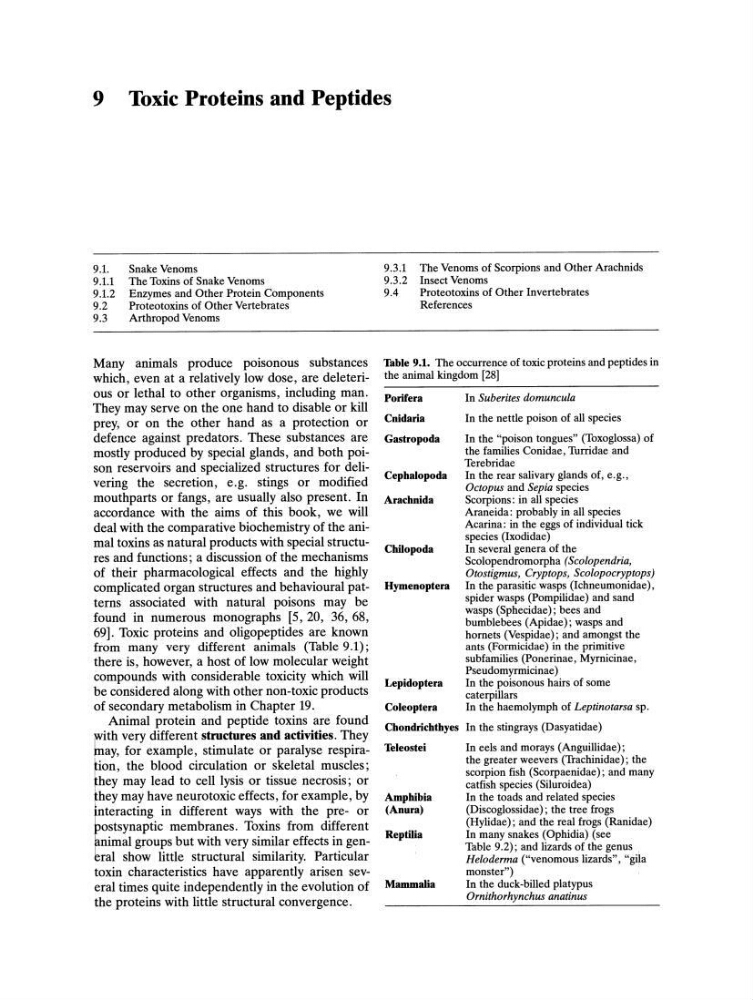
69]. Toxic proteins and oligopeptides are known
from many very different animals (Table 9.1);
there is, however, a host of low molecular weight
compounds with considerable toxicity which will
be considered along with other non-toxic products
of secondary metabolism in Chapter 19.
Animal protein and peptide toxins are found
with very different structures and activities. They
~ay, for example, stimulate or paralyse respiraion, the blood circulation or skeletal muscles;
hey may lead to cell lysis or tissue necrosis; or
hey may have neurotoxic effects, for example, by
nteracting in different ways with the pre- or
ostsynaptic membranes. Toxins from different
nimal groups but with very similar effects in genral show little structural similarity. Particular
toxin characteristics have apparently arisen several times quite independently in the evolution of
the proteins with little structural convergence.
9.3.1
9.3.2
9.4
The Venoms of Scorpions and Other Arachnids
Insect Venoms
Proteotoxins of Other Invertebrates
References
Thble 9.1. The occurrence of toxic proteins and peptides in
the animal kingdom [28]
Porifera
In Suberites domuncula
Cnidaria
In the nettle poison of all species
Gastropoda
In the "poison tongues" (Toxoglossa) of
the families Conidae, Turridae and
Terebridae
Cephalopoda
In the rear salivary glands of, e.g.,
Octopus and Sepia species
Arachnida
Scorpions: in all species
Araneida: probably in all species
Acarina: in the eggs of individual tick
species (Ixodidae)
Chilopoda
In several genera of the
Scolopendromorpha (Scolopendria,
Otostigmus, Cryptops, Scolopocryptops)
Hymenoptera In the parasitic wasps (lchneumonidae),
spider wasps (Pompilidae) and sand
wasps (Sphecidae); bees and
bumblebees (Apidae); wasps and
hornets (Vespidae); and amongst the
ants (Formicidae) in the primitive
subfamilies (Ponerinae, Mymicinae,
Pseudomyrmicinae)
Lepidoptera
In the poisonous hairs of some
caterpillars
Coleoptera
In the haemolymph of Leptinotarsa sp.
Chondrichthyes In the stingrays (Dasyatidae)
Teleostei
Amphibia
(Anura)
Reptilia
Mammalia
In eels and morays (Anguillidae);
the greater weevers ('frachinidae); the
scorpion fish (Scorpaenidae); and many
catfish species (Siluroidea)
In the toads and related species
(Discoglossidae); the tree frogs
(Hylidae); and the real frogs (Ranidae)
In many snakes (Ophidia) (see
Table 9.2); and lizards of the genus ,
Heloderma ("venomous lizards", "gi).a
monster")
In the duck-billed platypus
Omithorhynchus anatinus
9.1.
9.1.1
9.1.2
9.2
9.3
Snake Venoms
The Toxms of Snake Venoms
Enzymes and Other Protein Components
Proteotoxms of Other Vertebrates
Arthropod Venoms
Many animals produce poisonous substances
which, even at a relatively low dose, are deleterious or lethal to other organisms, including man.
They may serve on the one hand to disable or kill
prey, or on the other hand as a protection or
defence against predators. These substances are
mostly produced by special glands, and both poison reservoirs and specialized structures for delivering the secretion, e.g. stings or modified
mouthparts or fangs, are usually also present. In
accordance with the aims of this book, we will
deal with the comparative biochemistry of the animal toxins as natural products with special structures and functions; a discussion of the mechanisms
of their pharmacological effects and the highly
complicated organ structures and behavioural patterns associated with natural poisons may be
found in numerous monographs [5,20, 36,68,
69]. Toxic proteins and oligopeptides are known
from many very different animals (Table 9.1);
there is, however, a host of low molecular weight
compounds with considerable toxicity which will
be considered along with other non-toxic products
of secondary metabolism in Chapter 19.
Animal protein and peptide toxins are found
with very different structures and activities. They
~ay, for example, stimulate or paralyse respiraion, the blood circulation or skeletal muscles;
hey may lead to cell lysis or tissue necrosis; or
hey may have neurotoxic effects, for example, by
nteracting in different ways with the pre- or
ostsynaptic membranes. Toxins from different
nimal groups but with very similar effects in genral show little structural similarity. Particular
toxin characteristics have apparently arisen several times quite independently in the evolution of
the proteins with little structural convergence.
9.3.1
9.3.2
9.4
The Venoms of Scorpions and Other Arachnids
Insect Venoms
Proteotoxins of Other Invertebrates
References
Thble 9.1. The occurrence of toxic proteins and peptides in
the animal kingdom [28]
Porifera
In Suberites domuncula
Cnidaria
In the nettle poison of all species
Gastropoda
In the "poison tongues" (Toxoglossa) of
the families Conidae, Turridae and
Terebridae
Cephalopoda
In the rear salivary glands of, e.g.,
Octopus and Sepia species
Arachnida
Scorpions: in all species
Araneida: probably in all species
Acarina: in the eggs of individual tick
species (Ixodidae)
Chilopoda
In several genera of the
Scolopendromorpha (Scolopendria,
Otostigmus, Cryptops, Scolopocryptops)
Hymenoptera In the parasitic wasps (lchneumonidae),
spider wasps (Pompilidae) and sand
wasps (Sphecidae); bees and
bumblebees (Apidae); wasps and
hornets (Vespidae); and amongst the
ants (Formicidae) in the primitive
subfamilies (Ponerinae, Mymicinae,
Pseudomyrmicinae)
Lepidoptera
In the poisonous hairs of some
caterpillars
Coleoptera
In the haemolymph of Leptinotarsa sp.
Chondrichthyes In the stingrays (Dasyatidae)
Teleostei
Amphibia
(Anura)
Reptilia
Mammalia
In eels and morays (Anguillidae);
the greater weevers ('frachinidae); the
scorpion fish (Scorpaenidae); and many
catfish species (Siluroidea)
In the toads and related species
(Discoglossidae); the tree frogs
(Hylidae); and the real frogs (Ranidae)
In many snakes (Ophidia) (see
Table 9.2); and lizards of the genus ,
Heloderma ("venomous lizards", "gi).a
monster")
In the duck-billed platypus
Omithorhynchus anatinus