

27S
7 Respiratory Pigments
binding-site sequences of Cu(A) and Cu(B) of
the crustaceans (HHVTWH and HNTAH) and
the chelicerates (HHWHWH and HNWGH) are
very similar [lOS]. Comparison of the presumably
orthologous subunits Lim-IIlEury-a and Tachy-a/
Eury-e suggests a moderate rate of evolution for
the haemocyanins of 0.72-0.S5 . 10- 9 amino acid
~ubstitutions per year (see Table 4.12; p.161).
The gene duplications leading to the appearance
of multiple subunits would appear to have
occurred before the separation of the Arachnida
and the Xiphosura [126]. Surprisingly, there is significant homology between arthropod haemocyanins and several haemolymph proteins of the lepidoptera, e.g. the SP1 protein of Bombyx mori,
the arylphorin of Manduca sexta and the acidic
juvenile hormone-suppressible haemolymph protein, AJSP-1, of Trichoplusia ni [7S, 116].
The number of molecules in the different subunits in native baemocyanin molecules, their
organization and their contribution to the coherence of the molecule have been investigated in
Limulus polyphemus, Androctonus australis and
Eurypelma californicum by means of four different approaches:
1. Determination of the stoichiometry of the
individual subunits.
2. Analysis of the fragments after dissociation.
3. Reaggregation experiments with different
combinations of subunits.
4. Immuno-electron microscopy, i.e. electron
micrographic analysis of haemocyanin molecules labelled with subunit-specific antibodies or
antibody fragments [115].
The 4S-mer of Limulus dissociates under mild
conditions into 24-mers which resemble those of
Androctonus (Fig. 7.9) or Eurypelma. In the latter species, the two hexamers of the 12-mers are
a)
linked via two bc dimers, and the two 12-mers of
the 24-mer are linked via interaction between
the f subunits. This is also true for the 24-mers of
Limulus and Androctonus. The hexamers in the
12-mer of the spider Cupiennius are held together by a disulphide bridge, as are the hexamers
of the 12-mers in the crayfish Cherax destructor
and Astacus leptodactylus; in the case of Homarus american us and Cancer magister, the link
appears to be non-covalent [lOS]. The similarity
of the contacts between the subunits of chelicerates (e.g. Limulus, Androctonus and Eurypelma) is such that hybrid molecules are formed
in reaggregation experiments with subunits from
different species [115]; despite immunological
differences, the subunits of the crayfish Cherax
and Jasus can also form hybrid hexamers [lOS].
There are, however, exceptions to this scheme.
For example, the 12-mer of the stomatopod
Squilla mantis appears in electron micrographs
as two hexamers which overlap by only 60 %
[12].
The native haemocyanin of Eurypelma californicum is characterized by a low O2 affinity, high
cooperativity with n values of more than 9.0, and
a strong alkaline Bohr effect. Isolated subunits
bind O2 with a higher affinity but exhibit neither
cooperativity nor a Bohr effect. The hexamer
already has the normal O2 affinity and Bohr
effect; however, cooperativity increases stepwise
from the hexamer to the 12-mer and then to the
24-mer. This phenomenon is described as "nesting" in cooperation models: the conformation of
the multimeric molecule influences ligand binding to the subunits in a hierarchical manner with
several steps. According to this idea, the 24-mer
of Eurypelma consists of two allosteric 12-mers
whose properties are dependent upon the conformation of the 24-mer. The nesting model can
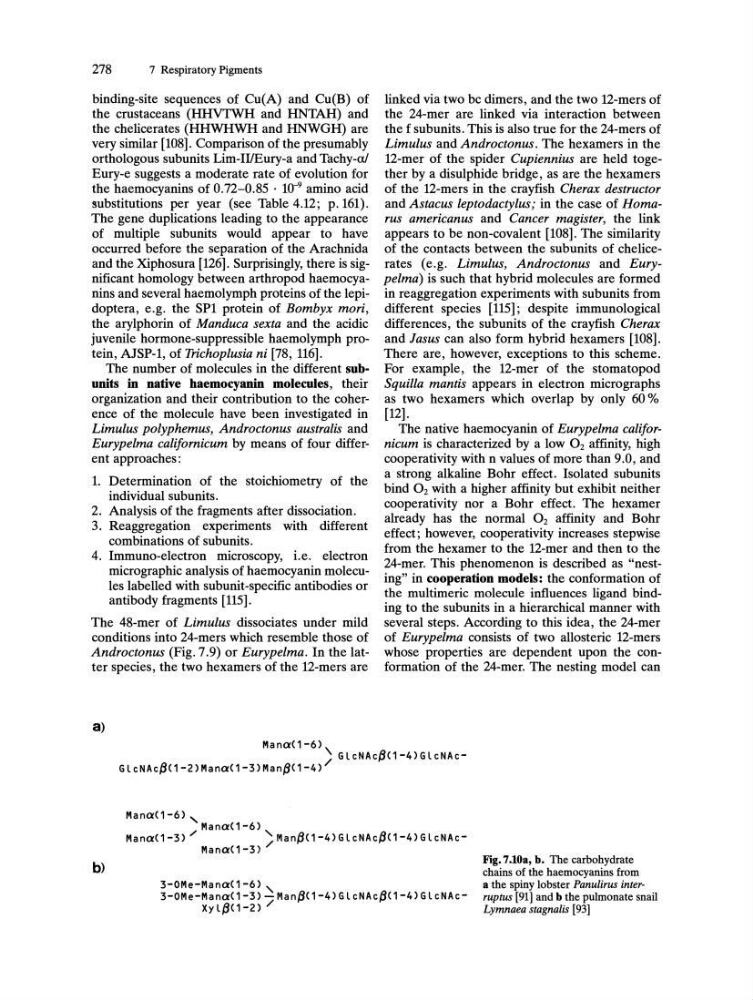
Mana(1-6)
) GLcNAc~(1-4)GLcNAcGLcNAc~(1-2)Mana(1-3)Man~(1-4)
b)
Mana(1-6) "
Mana(1-6)
Mana(1-3) /
;Man~(1-4)GLCNAc~(1-4)GLCNACMana(1-3)
3-0Me-Mana(1-6) "
3-0Me-Mana( 1-3) - Man~(1-4) G L cNAc~(1-4) G L cNAcXyL~(1-2) /
Fig.7.10a, b. The carbohydrate
chains of the haemocyanins from
a the spiny lobster Panulirus interruptus [91] and b the pulmonate snail
Lymnaea stagnalis [93]
7 Respiratory Pigments
binding-site sequences of Cu(A) and Cu(B) of
the crustaceans (HHVTWH and HNTAH) and
the chelicerates (HHWHWH and HNWGH) are
very similar [lOS]. Comparison of the presumably
orthologous subunits Lim-IIlEury-a and Tachy-a/
Eury-e suggests a moderate rate of evolution for
the haemocyanins of 0.72-0.S5 . 10- 9 amino acid
~ubstitutions per year (see Table 4.12; p.161).
The gene duplications leading to the appearance
of multiple subunits would appear to have
occurred before the separation of the Arachnida
and the Xiphosura [126]. Surprisingly, there is significant homology between arthropod haemocyanins and several haemolymph proteins of the lepidoptera, e.g. the SP1 protein of Bombyx mori,
the arylphorin of Manduca sexta and the acidic
juvenile hormone-suppressible haemolymph protein, AJSP-1, of Trichoplusia ni [7S, 116].
The number of molecules in the different subunits in native baemocyanin molecules, their
organization and their contribution to the coherence of the molecule have been investigated in
Limulus polyphemus, Androctonus australis and
Eurypelma californicum by means of four different approaches:
1. Determination of the stoichiometry of the
individual subunits.
2. Analysis of the fragments after dissociation.
3. Reaggregation experiments with different
combinations of subunits.
4. Immuno-electron microscopy, i.e. electron
micrographic analysis of haemocyanin molecules labelled with subunit-specific antibodies or
antibody fragments [115].
The 4S-mer of Limulus dissociates under mild
conditions into 24-mers which resemble those of
Androctonus (Fig. 7.9) or Eurypelma. In the latter species, the two hexamers of the 12-mers are
a)
linked via two bc dimers, and the two 12-mers of
the 24-mer are linked via interaction between
the f subunits. This is also true for the 24-mers of
Limulus and Androctonus. The hexamers in the
12-mer of the spider Cupiennius are held together by a disulphide bridge, as are the hexamers
of the 12-mers in the crayfish Cherax destructor
and Astacus leptodactylus; in the case of Homarus american us and Cancer magister, the link
appears to be non-covalent [lOS]. The similarity
of the contacts between the subunits of chelicerates (e.g. Limulus, Androctonus and Eurypelma) is such that hybrid molecules are formed
in reaggregation experiments with subunits from
different species [115]; despite immunological
differences, the subunits of the crayfish Cherax
and Jasus can also form hybrid hexamers [lOS].
There are, however, exceptions to this scheme.
For example, the 12-mer of the stomatopod
Squilla mantis appears in electron micrographs
as two hexamers which overlap by only 60 %
[12].
The native haemocyanin of Eurypelma californicum is characterized by a low O2 affinity, high
cooperativity with n values of more than 9.0, and
a strong alkaline Bohr effect. Isolated subunits
bind O2 with a higher affinity but exhibit neither
cooperativity nor a Bohr effect. The hexamer
already has the normal O2 affinity and Bohr
effect; however, cooperativity increases stepwise
from the hexamer to the 12-mer and then to the
24-mer. This phenomenon is described as "nesting" in cooperation models: the conformation of
the multimeric molecule influences ligand binding to the subunits in a hierarchical manner with
several steps. According to this idea, the 24-mer
of Eurypelma consists of two allosteric 12-mers
whose properties are dependent upon the conformation of the 24-mer. The nesting model can
Mana(1-6)
) GLcNAc~(1-4)GLcNAcGLcNAc~(1-2)Mana(1-3)Man~(1-4)
b)
Mana(1-6) "
Mana(1-6)
Mana(1-3) /
;Man~(1-4)GLCNAc~(1-4)GLCNACMana(1-3)
3-0Me-Mana(1-6) "
3-0Me-Mana( 1-3) - Man~(1-4) G L cNAc~(1-4) G L cNAcXyL~(1-2) /
Fig.7.10a, b. The carbohydrate
chains of the haemocyanins from
a the spiny lobster Panulirus interruptus [91] and b the pulmonate snail
Lymnaea stagnalis [93]