

7.1.3 HeterotropicInteractions
257
18ble 7.3. The amino acids responsible for heterotropic interactions in various vertebrates [131]. The latest results showing no Root effect in Xenopus haemoglobin [26] are taken into account
Hum
FIV
FI
Xen
R.ad
R.la
Lep
II Chain
NA2
His
Asp
GIu
Gly
His
His
EF6
Lys
Lys
Leu
Lys
Lys
Lys
Lys
F6
Glu
Val
Glu
Lys
GIu
Glu
His
F9
Cys
Ser
Ala
Ser
Ser
Ala
Ser
FGl
Asp
Glu
Asn
Glu
Gly
Asn
Glu
H21
His
Arg
Ser
Lys
Lys
His
Arg
HC1
Lys
Gin
Arg
Gly
Gly
Ser
GIu
HC3
His
His
Phe
His
His
His
His
a Chain
NA1
Val
aSer
aSer
Leu
?
aSer
mArg
C3
Thr
Gin
Gin
Lys
?
Gin
Gly
Bohr effect
Norm
High
None
Norm
?
Inv
Norm
Root effect
None
Pres
None
None
None
None
None
Hum, human; FIV and Fl, rainbow trout Salmo irideus (S. gairdneri) Hb IV and HB I, respectively; Xen, Xenopus laevis
(adult), R.ad and R.la, frog Rana catesbeiana adult and larval, respectively; Lep, lungfish Lepidosiren paradoxus; aSer,
N-acetyl-serine; mArg, methylarginine; Norm, normal; Inv, inverse; Pres, present
the tuna fish Thunnus thynnus [21, 131]. The stability of the T state at low pH makes Root-effect
haemoglobins extremely interesting for studies of
the R-T transition [64]. The biological importance of the Root effect was initially thought to lie
in the achievement of higher gas pressure in the
swim bladder by counter-current multiplication in
the rete mirabile of the gas gland, a mechanism
described in all fish physiology textbooks. However, Root-effect haemoglobins are also found in
fish lacking a functional gas gland. In this case,
they are involved in the O2 supply to the eye by a
multiplication effect in the network of blood vessels in the choroid (rete chorioidale) [21, 38,
131].
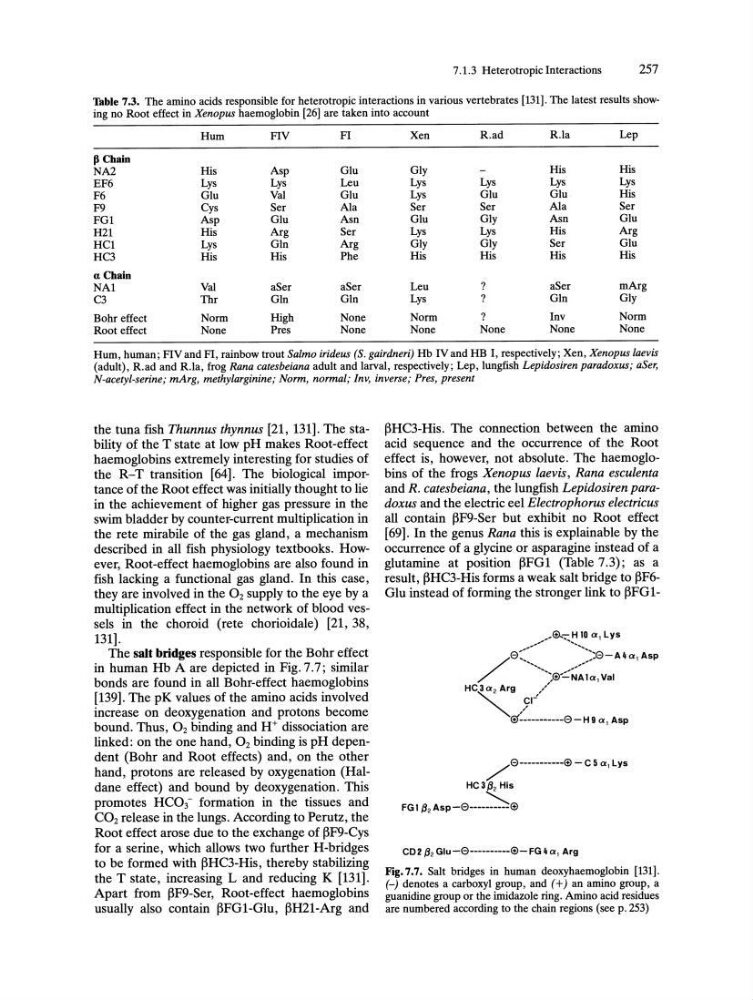
The salt bridges responsible for the Bohr effect
in human Hb A are depicted in Fig. 7.7; similar
bonds are found in all Bohr-effect haemoglobins
[139]. The pK values of the amino acids involved
increase on deoxygenation and protons become
bound. Thus, O2 binding and H+ dissociation are
linked: on the one hand, O2 binding is pH dependent (Bohr and Root effects) and, on the other
hand, protons are released by oxygenation (Haldane effect) and bound by deoxygenation. This
promotes HC03- formation in the tissues and
CO2 release in the lungs. According to Perutz, the
Root effect arose due to the exchange of ~F9-Cys
for a serine, which allows two further H-bridges
to be formed with ~HC3-His, thereby stabilizing
the T state, increasing L and reducing K [131].
Apart from ~F9-Ser, Root-effect haemoglobins
usually also contain ~FG1-Glu, ~H21-Arg and
~HC3-His. The connection between the amino
acid sequence and the occurrence of the Root
effect is, however, not absolute. The haemoglobins of the frogs Xenopus laevis, Rana esculenta
and R. catesbeiana, the lungfish Lepidosiren paradoxus and the electric eel Electrophorus electricus
all contain ~F9-Ser but exhibit no Root effect
[69]. In the genus Rana this is explainable by the
occurrence of a glycine or asparagine instead of a
glutamine at position ~FG1 (Table 7.3); as a
result, ~HC3-His forms a weak salt bridge to ~F6Glu instead of forming the stronger link to ~FG 1/6-----------® - C 5
"' "
FG 1 ~2 Asp -6----------®
CD 2 ~2 Glu -6----------®- FG 4
(-) denotes a carboxyl group, and (+) an amino group, a
guanidine group or the imidazole ring. Amino acid residues
are numbered according to the chain regions (see p. 253)
257
18ble 7.3. The amino acids responsible for heterotropic interactions in various vertebrates [131]. The latest results showing no Root effect in Xenopus haemoglobin [26] are taken into account
Hum
FIV
FI
Xen
R.ad
R.la
Lep
II Chain
NA2
His
Asp
GIu
Gly
His
His
EF6
Lys
Lys
Leu
Lys
Lys
Lys
Lys
F6
Glu
Val
Glu
Lys
GIu
Glu
His
F9
Cys
Ser
Ala
Ser
Ser
Ala
Ser
FGl
Asp
Glu
Asn
Glu
Gly
Asn
Glu
H21
His
Arg
Ser
Lys
Lys
His
Arg
HC1
Lys
Gin
Arg
Gly
Gly
Ser
GIu
HC3
His
His
Phe
His
His
His
His
a Chain
NA1
Val
aSer
aSer
Leu
?
aSer
mArg
C3
Thr
Gin
Gin
Lys
?
Gin
Gly
Bohr effect
Norm
High
None
Norm
?
Inv
Norm
Root effect
None
Pres
None
None
None
None
None
Hum, human; FIV and Fl, rainbow trout Salmo irideus (S. gairdneri) Hb IV and HB I, respectively; Xen, Xenopus laevis
(adult), R.ad and R.la, frog Rana catesbeiana adult and larval, respectively; Lep, lungfish Lepidosiren paradoxus; aSer,
N-acetyl-serine; mArg, methylarginine; Norm, normal; Inv, inverse; Pres, present
the tuna fish Thunnus thynnus [21, 131]. The stability of the T state at low pH makes Root-effect
haemoglobins extremely interesting for studies of
the R-T transition [64]. The biological importance of the Root effect was initially thought to lie
in the achievement of higher gas pressure in the
swim bladder by counter-current multiplication in
the rete mirabile of the gas gland, a mechanism
described in all fish physiology textbooks. However, Root-effect haemoglobins are also found in
fish lacking a functional gas gland. In this case,
they are involved in the O2 supply to the eye by a
multiplication effect in the network of blood vessels in the choroid (rete chorioidale) [21, 38,
131].
The salt bridges responsible for the Bohr effect
in human Hb A are depicted in Fig. 7.7; similar
bonds are found in all Bohr-effect haemoglobins
[139]. The pK values of the amino acids involved
increase on deoxygenation and protons become
bound. Thus, O2 binding and H+ dissociation are
linked: on the one hand, O2 binding is pH dependent (Bohr and Root effects) and, on the other
hand, protons are released by oxygenation (Haldane effect) and bound by deoxygenation. This
promotes HC03- formation in the tissues and
CO2 release in the lungs. According to Perutz, the
Root effect arose due to the exchange of ~F9-Cys
for a serine, which allows two further H-bridges
to be formed with ~HC3-His, thereby stabilizing
the T state, increasing L and reducing K [131].
Apart from ~F9-Ser, Root-effect haemoglobins
usually also contain ~FG1-Glu, ~H21-Arg and
~HC3-His. The connection between the amino
acid sequence and the occurrence of the Root
effect is, however, not absolute. The haemoglobins of the frogs Xenopus laevis, Rana esculenta
and R. catesbeiana, the lungfish Lepidosiren paradoxus and the electric eel Electrophorus electricus
all contain ~F9-Ser but exhibit no Root effect
[69]. In the genus Rana this is explainable by the
occurrence of a glycine or asparagine instead of a
glutamine at position ~FG1 (Table 7.3); as a
result, ~HC3-His forms a weak salt bridge to ~F6Glu instead of forming the stronger link to ~FG 1/6-----------® - C 5
"' "
FG 1 ~2 Asp -6----------®
CD 2 ~2 Glu -6----------®- FG 4
(-) denotes a carboxyl group, and (+) an amino group, a
guanidine group or the imidazole ring. Amino acid residues
are numbered according to the chain regions (see p. 253)