

256
7 Respiratory Pigments
-c-_ _ - - - - - - - - - - = 5 2 - - - - a Man
15/ .......... 14 ............ 9'
28
a Chicken
/
-
107
42
a Alligator
/
' 1 8
a Vipera
14
...........
60
a Xenopus
0 /
123_ a Salamander
/ \
42
51
~ Manj
43 1~14 -====
115
4 9 _ n Chickenr
0:
=
a Carp
34
134
75
aD Chicken
0/
a Shark
\2
f3 Shark
1 9
123
f3 Tadpole
'0
81
-
f3 Carp
'25
93
f3 Xenopus
~122
/
' \
=99- f3 Bull frog
20
32
96 - - - - - - - f3 Alligator
20_0~23- p Chicken9 ---==::.::;; 2 - f3 Chicken
6 -
f3 Ostrich
21
11
5 _
f3 Man
~
0<":'4
,0-9
- f3 Clawed ape
/ 2 5
- / j
Man
~
1B-f3 Cow
10
12 ..... J; <29_ y" C A
31~ j /
"'-:25_"f3 L~~a
7
36
f3 Platypus
/
_____ y (~hO) Mouse -/A
o
43
"'"
~
3 2 - - Y (~3) Rabbit
6 ,
1 / 4~
1 ....... Y Chimpanzee A
......... 0 /
25_ 2' 1_ Ay Man A
" 4
O{o, G y Man A
450
300
150
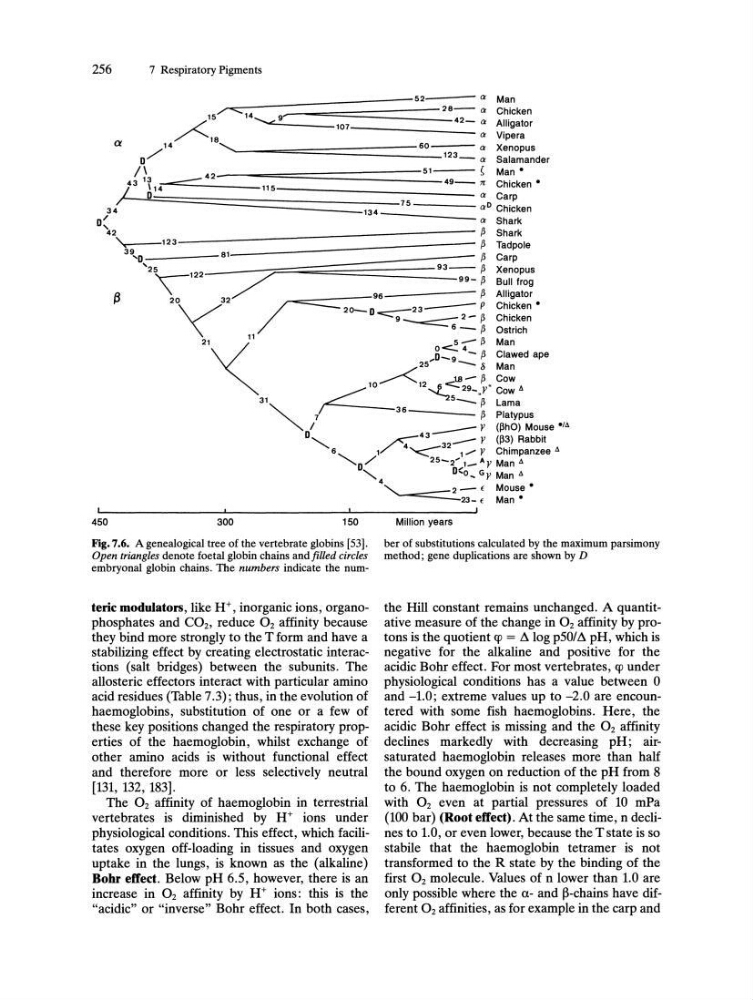
Fig. 7.6. A genealogical tree of the vertebrate globins [53].
Open triangles denote foetal globin chains and filled circles
embryonal globin chains. The numbers indicate the numteric modulators, like H+, inorganic ions, organophosphates and CO2, reduce O2 affinity because
they bind more strongly to the T form and have a
stabilizing effect by creating electrostatic interactions (salt bridges) between the subunits. The
allosteric effectors interact with particular amino
acid residues (Table 7.3); thus, in the evolution of
haemoglobins, substitution of one or a few of
these key positions changed the respiratory properties of the haemoglobin, whilst exchange of
other amino acids is without functional effect
and therefore more or less selectively neutral
[131, 132, 183].
The O2 affinity of haemoglobin in terrestrial
vertebrates is diminished by H+ ions under
physiological conditions. This effect, which facilitates oxygen off-loading in tissues and oxygen
uptake in the lungs, is known as the (alkaline)
Bohr eft'ect. Below pH 6.5, however, there is an
increase in O2 affinity by H+ ions: this is the
"acidic" or "inverse" Bohr effect. In both cases,
" -
- 2 -
f
Mouse-23- f
ManMillion years
ber of substitutions calculated by the maximum parsimony
method; gene duplications are shown by D
the Hill constant remains unchanged. A quantitative measure of the change in O2 affinity by protons is the quotient cp = ~ log p50/ ~ pH, which is
negative for the alkaline and positive for the
acidic Bohr effect. For most vertebrates, cp under
physiological conditions has a value between 0
and -1.0; extreme values up to -2.0 are encountered with some fish haemoglobins. Here, the
acidic Bohr effect is missing and the O2 affinity
declines markedly with decreasing pH; airsaturated haemoglobin releases more than half
the bound oxygen on reduction of the pH from 8
to 6. The haemoglobin is not completely loaded
with O2 even at partial pressures of 10 mPa
(100 bar) (Root eft'ect). At the same time, n declines to 1.0, or even lower, because the T state is so
stabile that the haemoglobin tetramer is not
transformed to the R state by the binding of the
first O2 molecule. Values of n lower than 1.0 are
only possible where the a- and ~-chains have different O2 affinities, as for example in the carp and
7 Respiratory Pigments
-c-_ _ - - - - - - - - - - = 5 2 - - - - a Man
15/ .......... 14 ............ 9'
28
a Chicken
/
-
107
42
a Alligator
/
' 1 8
a Vipera
14
...........
60
a Xenopus
0 /
123_ a Salamander
/ \
42
51
~ Manj
43 1~14 -====
115
4 9 _ n Chickenr
0:
=
a Carp
34
134
75
aD Chicken
0/
a Shark
\2
f3 Shark
1 9
123
f3 Tadpole
'0
81
-
f3 Carp
'25
93
f3 Xenopus
~122
/
' \
=99- f3 Bull frog
20
32
96 - - - - - - - f3 Alligator
20_0~23- p Chicken9 ---==::.::;; 2 - f3 Chicken
6 -
f3 Ostrich
21
11
5 _
f3 Man
~
0<":'4
,0-9
- f3 Clawed ape
/ 2 5
- / j
Man
~
1B-f3 Cow
10
12 ..... J; <29_ y" C A
31~ j /
"'-:25_"f3 L~~a
7
36
f3 Platypus
/
_____ y (~hO) Mouse -/A
o
43
"'"
~
3 2 - - Y (~3) Rabbit
6 ,
1 / 4~
1 ....... Y Chimpanzee A
......... 0 /
25_ 2' 1_ Ay Man A
" 4
O{o, G y Man A
450
300
150
Fig. 7.6. A genealogical tree of the vertebrate globins [53].
Open triangles denote foetal globin chains and filled circles
embryonal globin chains. The numbers indicate the numteric modulators, like H+, inorganic ions, organophosphates and CO2, reduce O2 affinity because
they bind more strongly to the T form and have a
stabilizing effect by creating electrostatic interactions (salt bridges) between the subunits. The
allosteric effectors interact with particular amino
acid residues (Table 7.3); thus, in the evolution of
haemoglobins, substitution of one or a few of
these key positions changed the respiratory properties of the haemoglobin, whilst exchange of
other amino acids is without functional effect
and therefore more or less selectively neutral
[131, 132, 183].
The O2 affinity of haemoglobin in terrestrial
vertebrates is diminished by H+ ions under
physiological conditions. This effect, which facilitates oxygen off-loading in tissues and oxygen
uptake in the lungs, is known as the (alkaline)
Bohr eft'ect. Below pH 6.5, however, there is an
increase in O2 affinity by H+ ions: this is the
"acidic" or "inverse" Bohr effect. In both cases,
" -
- 2 -
f
Mouse-23- f
ManMillion years
ber of substitutions calculated by the maximum parsimony
method; gene duplications are shown by D
the Hill constant remains unchanged. A quantitative measure of the change in O2 affinity by protons is the quotient cp = ~ log p50/ ~ pH, which is
negative for the alkaline and positive for the
acidic Bohr effect. For most vertebrates, cp under
physiological conditions has a value between 0
and -1.0; extreme values up to -2.0 are encountered with some fish haemoglobins. Here, the
acidic Bohr effect is missing and the O2 affinity
declines markedly with decreasing pH; airsaturated haemoglobin releases more than half
the bound oxygen on reduction of the pH from 8
to 6. The haemoglobin is not completely loaded
with O2 even at partial pressures of 10 mPa
(100 bar) (Root eft'ect). At the same time, n declines to 1.0, or even lower, because the T state is so
stabile that the haemoglobin tetramer is not
transformed to the R state by the binding of the
first O2 molecule. Values of n lower than 1.0 are
only possible where the a- and ~-chains have different O2 affinities, as for example in the carp and