

234
6 Immunoproteins
sugar-binding site, and it can, therefore, link cells
together (agglutination) or precipitate glycoconjugates. The detection of lectins is usually based
upon the agglutination of vertebrate erythrocytes. Many lectins require Ca 2 + for the binding
reaction. Specificity is defined by examining
which free or bound sugar competitively inhibits
haemagglutination. The specificity is most frequently for L-fucose, N-acetyl-D-galactose, Dgalactose, N-acetyl-D-glucose, D-mannose or Nacetyl-D-neuraminic acid (sialic acid). Neuraminic acid-specific lectins are also found in animal groups which contain no sialic acid, and in
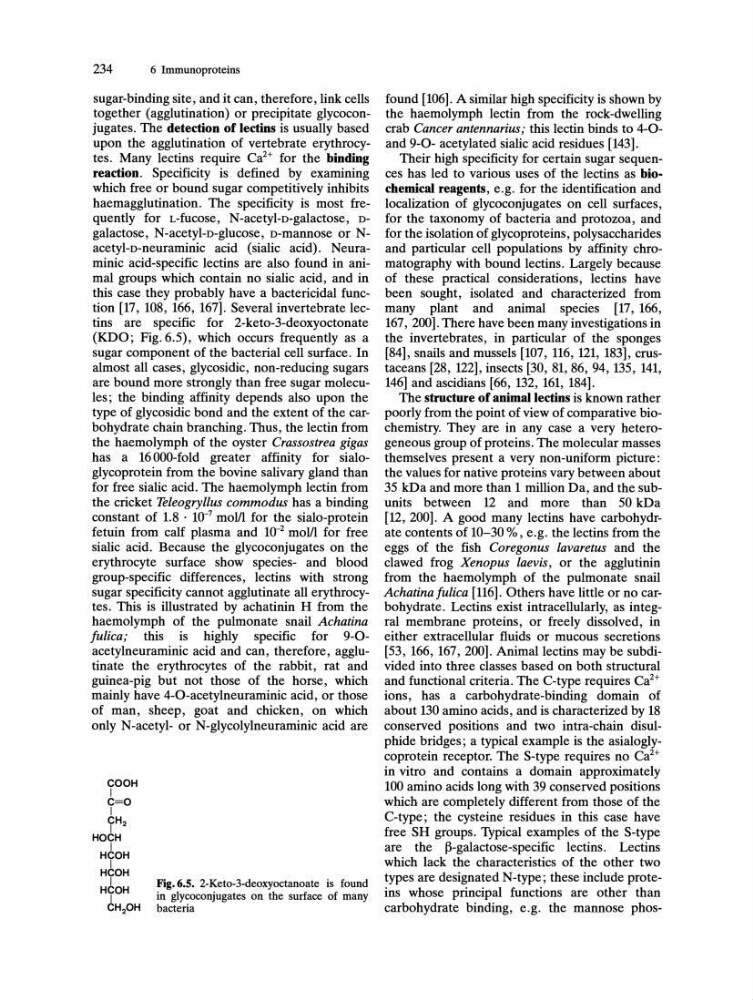
this case they probably have a bactericidal function [17, 108, 166, 167]. Several invertebrate lectins are specific for 2-keto-3-deoxyoctonate
(KDO; Fig. 6.5), which occurs frequently as a
sugar component of the bacterial cell surface. In
almost all cases, glycosidic, non-reducing sugars
are bound more strongly than free sugar molecules; the binding affinity depends also upon the
type of glycosidic bond and the extent of the carbohydrate chain branching. Thus, the lectin from
the haemolymph of the oyster Crassostrea gigas
has a 16 ODD-fold greater affinity for sialoglycoprotein from the bovine salivary gland than
for free sialic acid. The haemolymph lectin from
the cricket Teleogryllus commodus has a binding
constant of 1.8 . 10- 7 molll for the sialo-protein
fetuin from calf plasma and 10- 2 molll for free
sialic acid. Because the glycoconjugates on the
erythrocyte surface show species- and blood
group-specific differences, lectins with strong
sugar specificity cannot agglutinate all erythrocytes. This is illustrated by achatinin H from the
haemolymph of the pulmonate snail Achatina
fulica; this is highly specific for 9-0acetylneuraminic acid and can, therefore, agglutinate the erythrocytes of the rabbit, rat and
guinea-pig but not those of the horse, which
mainly have 4-0-acetylneuraminic acid, or those
of man, sheep, goat and chicken, on which
only N-acetyl- or N-glycolylneuraminic acid are
COOH
I
c=o
I
CH2
I
HOCH
I
HCOH
I
HCOH
I
HCOH
I
CH 2 0H
Fig.6.S. 2-Keto-3-deoxyoctanoate is found
in glycoconjugates on the surface of many
bacteria
found [106]. A similar high specificity is shown by
the haemolymph lectin from the rock-dwelling
crab Cancer antennarius; this lectin binds to 4-0and 9-0- acetylated sialic acid residues [143].
Their high specificity for certain sugar sequences has led to various uses of the lectins as biochemical reagents, e.g. for the identification and
localization of glycoconjugates on cell surfaces,
for the taxonomy of bacteria and protozoa, and
for the isolation of glycoproteins, polysaccharides
and particular cell populations by affinity chromatography with bound lectins. Largely because
of these practical considerations, lectins have
been sought, isolated and characterized from
many plant and animal species [17, 166,
167, 200]. There have been many investigations in
the invertebrates, in particular of the sponges
[84], snails and mussels [107, 116, 121, 183], crustaceans [28, 122], insects [30, 81,86, 94, 135, 141,
146] and ascidians [66, 132, 161, 184].
The structure of animallectins is known rather
poorly from the point of view of comparative biochemistry. They are in any case a very heterogeneous group of proteins. The molecular masses
themselves present a very non-uniform picture:
the values for native proteins vary between about
35 kDa and more than 1 million Da, and the subunits between 12 and more than 50 kDa
[12, 200]. A good many lectins have carbohydrate contents of 10-30 %, e.g. the lectins from the
eggs of the fish Coregonus lavaretus and the
clawed frog Xenopus laevis, or the agglutinin
from the haemolymph of the pulmonate snail
Achatina fulica [116]. Others have little or no carbohydrate. Lectins exist intracellularly, as integral membrane proteins, or freely dissolved, in
either extracellular fluids or mucous secretions
[53, 166, 167,200]. Animallectins may be subdivided into three classes based on both structural
and functional criteria. The C-type requires Ca 2 +
ions, has a carbohydrate-binding domain of
about 130 amino acids, and is characterized by 18
conserved positions and two intra-chain disulphide bridges; a typical example is the asialoglycoprotein receptor. The S-type requires no Ca 2 +
in vitro and contains a domain approximately
100 amino acids long with 39 conserved positions
which are completely different from those of the
C-type; the cysteine residues in this case have
free SH groups. Typical examples of the S-type
are the ~-galactose-specific lectins. Lectins
which lack the characteristics of the other two
types are designated N-type; these include proteins whose principal functions are other than
carbohydrate binding, e.g. the mannose phos-
6 Immunoproteins
sugar-binding site, and it can, therefore, link cells
together (agglutination) or precipitate glycoconjugates. The detection of lectins is usually based
upon the agglutination of vertebrate erythrocytes. Many lectins require Ca 2 + for the binding
reaction. Specificity is defined by examining
which free or bound sugar competitively inhibits
haemagglutination. The specificity is most frequently for L-fucose, N-acetyl-D-galactose, Dgalactose, N-acetyl-D-glucose, D-mannose or Nacetyl-D-neuraminic acid (sialic acid). Neuraminic acid-specific lectins are also found in animal groups which contain no sialic acid, and in
this case they probably have a bactericidal function [17, 108, 166, 167]. Several invertebrate lectins are specific for 2-keto-3-deoxyoctonate
(KDO; Fig. 6.5), which occurs frequently as a
sugar component of the bacterial cell surface. In
almost all cases, glycosidic, non-reducing sugars
are bound more strongly than free sugar molecules; the binding affinity depends also upon the
type of glycosidic bond and the extent of the carbohydrate chain branching. Thus, the lectin from
the haemolymph of the oyster Crassostrea gigas
has a 16 ODD-fold greater affinity for sialoglycoprotein from the bovine salivary gland than
for free sialic acid. The haemolymph lectin from
the cricket Teleogryllus commodus has a binding
constant of 1.8 . 10- 7 molll for the sialo-protein
fetuin from calf plasma and 10- 2 molll for free
sialic acid. Because the glycoconjugates on the
erythrocyte surface show species- and blood
group-specific differences, lectins with strong
sugar specificity cannot agglutinate all erythrocytes. This is illustrated by achatinin H from the
haemolymph of the pulmonate snail Achatina
fulica; this is highly specific for 9-0acetylneuraminic acid and can, therefore, agglutinate the erythrocytes of the rabbit, rat and
guinea-pig but not those of the horse, which
mainly have 4-0-acetylneuraminic acid, or those
of man, sheep, goat and chicken, on which
only N-acetyl- or N-glycolylneuraminic acid are
COOH
I
c=o
I
CH2
I
HOCH
I
HCOH
I
HCOH
I
HCOH
I
CH 2 0H
Fig.6.S. 2-Keto-3-deoxyoctanoate is found
in glycoconjugates on the surface of many
bacteria
found [106]. A similar high specificity is shown by
the haemolymph lectin from the rock-dwelling
crab Cancer antennarius; this lectin binds to 4-0and 9-0- acetylated sialic acid residues [143].
Their high specificity for certain sugar sequences has led to various uses of the lectins as biochemical reagents, e.g. for the identification and
localization of glycoconjugates on cell surfaces,
for the taxonomy of bacteria and protozoa, and
for the isolation of glycoproteins, polysaccharides
and particular cell populations by affinity chromatography with bound lectins. Largely because
of these practical considerations, lectins have
been sought, isolated and characterized from
many plant and animal species [17, 166,
167, 200]. There have been many investigations in
the invertebrates, in particular of the sponges
[84], snails and mussels [107, 116, 121, 183], crustaceans [28, 122], insects [30, 81,86, 94, 135, 141,
146] and ascidians [66, 132, 161, 184].
The structure of animallectins is known rather
poorly from the point of view of comparative biochemistry. They are in any case a very heterogeneous group of proteins. The molecular masses
themselves present a very non-uniform picture:
the values for native proteins vary between about
35 kDa and more than 1 million Da, and the subunits between 12 and more than 50 kDa
[12, 200]. A good many lectins have carbohydrate contents of 10-30 %, e.g. the lectins from the
eggs of the fish Coregonus lavaretus and the
clawed frog Xenopus laevis, or the agglutinin
from the haemolymph of the pulmonate snail
Achatina fulica [116]. Others have little or no carbohydrate. Lectins exist intracellularly, as integral membrane proteins, or freely dissolved, in
either extracellular fluids or mucous secretions
[53, 166, 167,200]. Animallectins may be subdivided into three classes based on both structural
and functional criteria. The C-type requires Ca 2 +
ions, has a carbohydrate-binding domain of
about 130 amino acids, and is characterized by 18
conserved positions and two intra-chain disulphide bridges; a typical example is the asialoglycoprotein receptor. The S-type requires no Ca 2 +
in vitro and contains a domain approximately
100 amino acids long with 39 conserved positions
which are completely different from those of the
C-type; the cysteine residues in this case have
free SH groups. Typical examples of the S-type
are the ~-galactose-specific lectins. Lectins
which lack the characteristics of the other two
types are designated N-type; these include proteins whose principal functions are other than
carbohydrate binding, e.g. the mannose phos-