

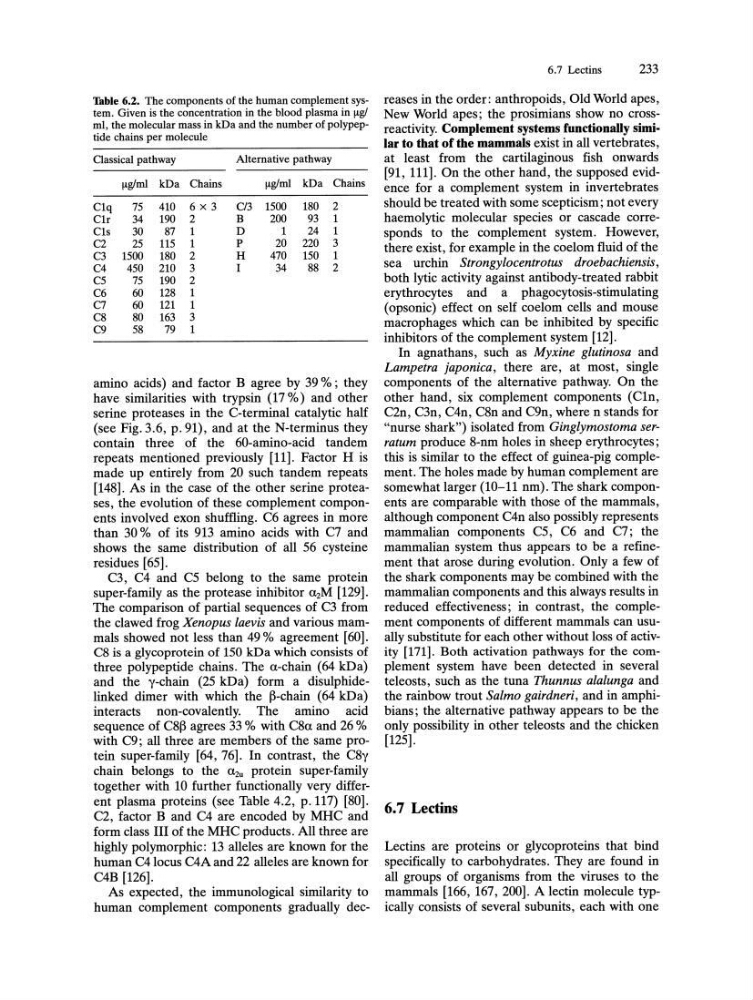
18ble 6.2. The components of the human complement system. Given is the concentration in the blood plasma in Ilg/
mI, the molecular mass in kDa and the number of polypeptide chains per molecule
Classical pathway
Alternative pathway
llg/mI kDa Chains
llg/mI kDa Chains
Clq
75 410 6 x 3
C/3 1500 180 2
Clr
34 190 2
B
200
93 1
CIs
30
87 1
D
1
24 1
C2
25 115 1
P
20 220 3
C3 1500 180 2
H
470 150 1
C4
450 210 3
I
34
88 2
C5
75 190 2
C6
60 128 1
C7
60 121 1
C8
80 163 3
C9
58
79 1
amino acids) and factor B agree by 39 %; they
have similarities with trypsin (17 %) and other
serine proteases in the C-terminal catalytic half
(see Fig. 3.6, p.91), and at the N-terminus they
contain three of the 60-amino-acid tandem
repeats mentioned previously [11]. Factor H is
made up entirely from 20 such tandem repeats
[14S]. As in the case of the other serine proteases, the evolution of these complement components involved exon shuffling. C6 agrees in more
than 30 % of its 913 amino acids with C7 and
shows the same distribution of all 56 cysteine
residues [65].
C3, C4 and C5 belong to the same protein
super-family as the protease inhibitor a2M [129].
The comparison of partial sequences of C3 from
the clawed frog Xenopus laevis and various mammals showed not less than 49 % agreement [60].
C8 is a glycoprotein of 150 kDa which consists of
three polypeptide chains. The a-chain (64 kDa)
and the y-chain (25 kDa) form a disulphidelinked dimer with which the ~-chain (64 kDa)
interacts non-covalently. The amino acid
sequence of CS~ agrees 33 % with CSa and 26 %
with C9; all three are members of the same protein super-family [64, 76]. In contrast, the CSy
chain belongs to the a2u protein super-family
together with 10 further functionally very different plasma proteins (see Table 4.2, p.117) [SO].
C2, factor Band C4 are encoded by MHC and
form class III of the MHC products. All three are
highly polymorphic: 13 alleles are known for the
human C4locus C4A and 22 alleles are known for
C4B [126].
As expected, the immunological similarity to
human complement components gradually dec6.7 Lectins
233
reases in the order: anthropoids, Old World apes,
New World apes; the prosimians show no crossreactivity. Complement systems functionally similar to that of the mammals exist in all vertebrates,
at least from the cartilaginous fish onwards
[91, 111]. On the other hand, the supposed evidence for a complement system in invertebrates
should be treated with some scepticism; not every
haemolytic molecular species or cascade corresponds to the complement system. However,
there exist, for example in the coelom fluid of the
sea urchin Strongylocentrotus droebachiensis,
both lytic activity against antibody-treated rabbit
erythrocytes and a phagocytosis-stimulating
( opsonic) effect on self coelom cells and mouse
macrophages which can be inhibited by specific
inhibitors of the complement system [12].
In agnathans, such as Myxine glutinosa and
Lampetra japonica, there are, at most, single
components of the alternative pathway. On the
other hand, six complement components (Cln,
C2n, C3n, C4n, CSn and C9n, where n stands for
"nurse shark") isolated from Ginglymostoma serratum produce S-nm holes in sheep erythrocytes;
this is similar to the effect of guinea-pig complement. The holes made by human complement are
somewhat larger (10-11 nm). The shark components are comparable with those of the mammals,
although component C4n also possibly represents
mammalian components C5, C6 and C7; the
mammalian system thus appears to be a refinement that arose during evolution. Only a few of
the shark components may be combined with the
mammalian components and this always results in
reduced effectiveness; in contrast, the complement components of different mammals can usually substitute for each other without loss of activity [171]. Both activation pathways for the complement system have been detected in several
teleosts, such as the tuna Thunnus alalunga and
the rainbow trout Salmo gairdneri, and in amphibians; the alternative pathway appears to be the
only possibility in other teleosts and the chicken
[125].
6.7 Lectins
Lectins are proteins or glycoproteins that bind
specifically to carbohydrates. They are found in
all groups of organisms from the viruses to the
mammals [166, 167, 200]. A lectin molecule typically consists of several subunits, each with one
mI, the molecular mass in kDa and the number of polypeptide chains per molecule
Classical pathway
Alternative pathway
llg/mI kDa Chains
llg/mI kDa Chains
Clq
75 410 6 x 3
C/3 1500 180 2
Clr
34 190 2
B
200
93 1
CIs
30
87 1
D
1
24 1
C2
25 115 1
P
20 220 3
C3 1500 180 2
H
470 150 1
C4
450 210 3
I
34
88 2
C5
75 190 2
C6
60 128 1
C7
60 121 1
C8
80 163 3
C9
58
79 1
amino acids) and factor B agree by 39 %; they
have similarities with trypsin (17 %) and other
serine proteases in the C-terminal catalytic half
(see Fig. 3.6, p.91), and at the N-terminus they
contain three of the 60-amino-acid tandem
repeats mentioned previously [11]. Factor H is
made up entirely from 20 such tandem repeats
[14S]. As in the case of the other serine proteases, the evolution of these complement components involved exon shuffling. C6 agrees in more
than 30 % of its 913 amino acids with C7 and
shows the same distribution of all 56 cysteine
residues [65].
C3, C4 and C5 belong to the same protein
super-family as the protease inhibitor a2M [129].
The comparison of partial sequences of C3 from
the clawed frog Xenopus laevis and various mammals showed not less than 49 % agreement [60].
C8 is a glycoprotein of 150 kDa which consists of
three polypeptide chains. The a-chain (64 kDa)
and the y-chain (25 kDa) form a disulphidelinked dimer with which the ~-chain (64 kDa)
interacts non-covalently. The amino acid
sequence of CS~ agrees 33 % with CSa and 26 %
with C9; all three are members of the same protein super-family [64, 76]. In contrast, the CSy
chain belongs to the a2u protein super-family
together with 10 further functionally very different plasma proteins (see Table 4.2, p.117) [SO].
C2, factor Band C4 are encoded by MHC and
form class III of the MHC products. All three are
highly polymorphic: 13 alleles are known for the
human C4locus C4A and 22 alleles are known for
C4B [126].
As expected, the immunological similarity to
human complement components gradually dec6.7 Lectins
233
reases in the order: anthropoids, Old World apes,
New World apes; the prosimians show no crossreactivity. Complement systems functionally similar to that of the mammals exist in all vertebrates,
at least from the cartilaginous fish onwards
[91, 111]. On the other hand, the supposed evidence for a complement system in invertebrates
should be treated with some scepticism; not every
haemolytic molecular species or cascade corresponds to the complement system. However,
there exist, for example in the coelom fluid of the
sea urchin Strongylocentrotus droebachiensis,
both lytic activity against antibody-treated rabbit
erythrocytes and a phagocytosis-stimulating
( opsonic) effect on self coelom cells and mouse
macrophages which can be inhibited by specific
inhibitors of the complement system [12].
In agnathans, such as Myxine glutinosa and
Lampetra japonica, there are, at most, single
components of the alternative pathway. On the
other hand, six complement components (Cln,
C2n, C3n, C4n, CSn and C9n, where n stands for
"nurse shark") isolated from Ginglymostoma serratum produce S-nm holes in sheep erythrocytes;
this is similar to the effect of guinea-pig complement. The holes made by human complement are
somewhat larger (10-11 nm). The shark components are comparable with those of the mammals,
although component C4n also possibly represents
mammalian components C5, C6 and C7; the
mammalian system thus appears to be a refinement that arose during evolution. Only a few of
the shark components may be combined with the
mammalian components and this always results in
reduced effectiveness; in contrast, the complement components of different mammals can usually substitute for each other without loss of activity [171]. Both activation pathways for the complement system have been detected in several
teleosts, such as the tuna Thunnus alalunga and
the rainbow trout Salmo gairdneri, and in amphibians; the alternative pathway appears to be the
only possibility in other teleosts and the chicken
[125].
6.7 Lectins
Lectins are proteins or glycoproteins that bind
specifically to carbohydrates. They are found in
all groups of organisms from the viruses to the
mammals [166, 167, 200]. A lectin molecule typically consists of several subunits, each with one