

body. The restriction of antigen recognition by
cytotoxic T cells and T helper cells via ~HC ~s a
specific task of the T cell receptors; the ~1~log~cal
role of this process lies in the safer d1stmctlOn
between self and non-self.
Only recently has it become clear that th~
immunoglobulins, T cell receptors, MHC antigens, cell-adhesion molecules (CAM) and several
other proteins are all members of one and the
same super-family which, besides its involvement
in the immune system, has apparently played a
central role in the evolution of cell-cell recognition in vertebrates. In addition to the immunoglobulins, further plasma proteins involved in the
immune response are the components of the complement system, the lymphokines and other
immuno-modulator proteins, the antiviral interferons, acute-phase proteins and, especially in
lower vertebrates, lectins, agglutinins and lysins
with low specificity.
Compared with the defence mechanisms of the
vertebrates, those of the invertebrates are far less
complex. In the latter, phagocytosis by specialized blood cells is widely found as a cellular
mechanism. In addition, the extracellular fluids
of many invertebrates and lower vertebrates contain relatively unspecific defence proteins (lectins, agglutinins, lysins), the concentrations of
which may, in some cases, be increased in
response to infection. Finally, many of th~ low
molecular weight defence substances of the mvertebrates (which will be dealt with in Chap. 19 as
products of secondary metabolism) have primarily bactericidal or fungicidal functions.
The molecular structure of the cell surface,
which is responsible for the external identification of the cell and its contact interactions with
other cells, has mainly been investigated in the
vertebrates. However, in some special instances
attention has been drawn to the corresponding
membrane proteins of invertebrates. For example, the surface proteins of the sponges have ~een
studied in some detail because of the umque
property of these most primitive, multicellular
animals to reaggregate spontaneously a complete,
viable organism from isolated single cells. The
surface proteins of the parasitic trypanosomes
and malarial agents are of medical interest
because as antigens they are responsible for the
immune response of their hosts; at the same time
they have attracted the attention of molecular
biologists.
6.1 The Immunoglobulin Super-Family
221
6.1 The Immunoglobulin Super-Family
The characteristic structural element of this
super-family is the antibody fold or Ig homol~gy
unit, a polypeptide chain of about 100 ~mmo
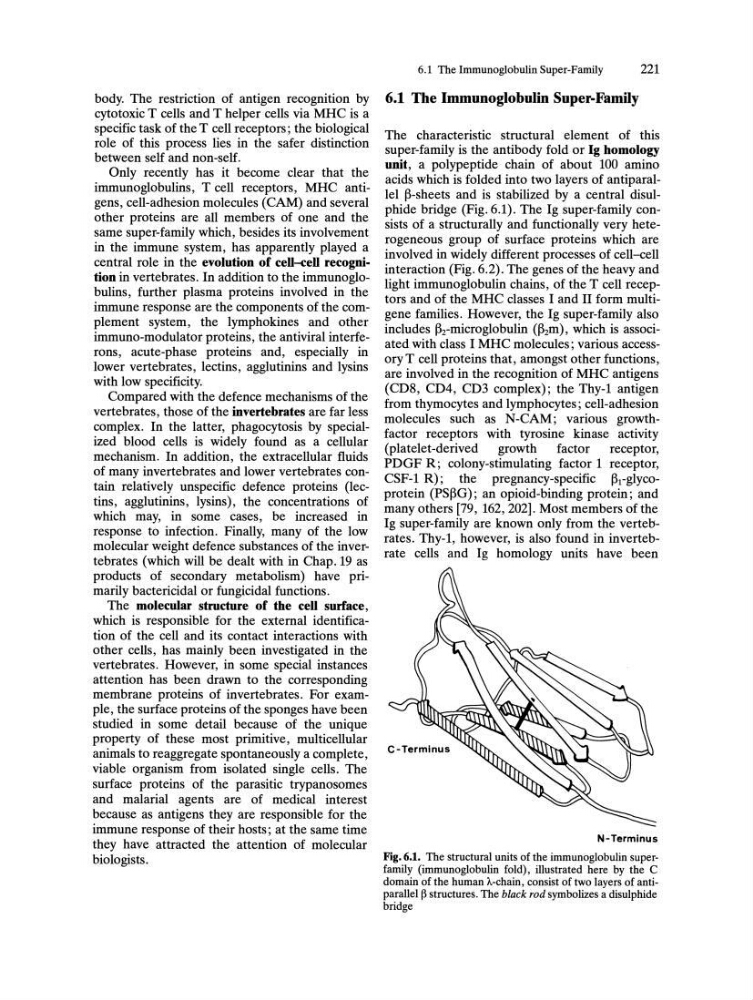
acids which is folded into two layers of antiparalleI ~-sheets and is stabilized by a central disulphide bridge (Fig. 6.1). The Ig.super-family consists of a structurally and functlOnally very heterogeneous group of surface proteins which are
involved in widely different processes of cell-cell
interaction (Fig. 6.2). The genes of the heavy and
light immunoglobulin chains, of the T cell receptors and of the MHC classes I and II form multigene families. However, the Ig supe~-faI?ily als?
includes ~2-microglobulin (~2m), wh1ch 1S aSSOC1ated with class I MHC molecules; various accessoryT cell proteins that, amongst other functions,
are involved in the recognition of MHC antigens
(CD8, CD4, CD3 complex); the Thy-1 anti~en
from thymocytes and lymphocytes; cell-adheslOn
molecules such as N-CAM; various growthfactor receptors with tyrosine kinase activity
(platelet-derived
growth
factor
receptor,
PDGF R; colony-stimulating factor 1 receptor,
CSF-1 R); the pregnancy-specific ~l-glycoprotein (PS~G); an opioid-binding protein; and
many others [79, 162, 202]. Most members of the
Ig super-family are known only from the vertebrates. Thy-1, however, is also found in invertebrate cells and Ig homology units have been
C-Terminus
N-Terminus
Fig.6.1. The structural units of the immunoglobulin superfamily (immunoglobulin fold), illustrated here by the domain of the human A-chain, consist of two layers of antlparallel ~ structures. The black rod symbolizes a disulphide
bridge
cytotoxic T cells and T helper cells via ~HC ~s a
specific task of the T cell receptors; the ~1~log~cal
role of this process lies in the safer d1stmctlOn
between self and non-self.
Only recently has it become clear that th~
immunoglobulins, T cell receptors, MHC antigens, cell-adhesion molecules (CAM) and several
other proteins are all members of one and the
same super-family which, besides its involvement
in the immune system, has apparently played a
central role in the evolution of cell-cell recognition in vertebrates. In addition to the immunoglobulins, further plasma proteins involved in the
immune response are the components of the complement system, the lymphokines and other
immuno-modulator proteins, the antiviral interferons, acute-phase proteins and, especially in
lower vertebrates, lectins, agglutinins and lysins
with low specificity.
Compared with the defence mechanisms of the
vertebrates, those of the invertebrates are far less
complex. In the latter, phagocytosis by specialized blood cells is widely found as a cellular
mechanism. In addition, the extracellular fluids
of many invertebrates and lower vertebrates contain relatively unspecific defence proteins (lectins, agglutinins, lysins), the concentrations of
which may, in some cases, be increased in
response to infection. Finally, many of th~ low
molecular weight defence substances of the mvertebrates (which will be dealt with in Chap. 19 as
products of secondary metabolism) have primarily bactericidal or fungicidal functions.
The molecular structure of the cell surface,
which is responsible for the external identification of the cell and its contact interactions with
other cells, has mainly been investigated in the
vertebrates. However, in some special instances
attention has been drawn to the corresponding
membrane proteins of invertebrates. For example, the surface proteins of the sponges have ~een
studied in some detail because of the umque
property of these most primitive, multicellular
animals to reaggregate spontaneously a complete,
viable organism from isolated single cells. The
surface proteins of the parasitic trypanosomes
and malarial agents are of medical interest
because as antigens they are responsible for the
immune response of their hosts; at the same time
they have attracted the attention of molecular
biologists.
6.1 The Immunoglobulin Super-Family
221
6.1 The Immunoglobulin Super-Family
The characteristic structural element of this
super-family is the antibody fold or Ig homol~gy
unit, a polypeptide chain of about 100 ~mmo
acids which is folded into two layers of antiparalleI ~-sheets and is stabilized by a central disulphide bridge (Fig. 6.1). The Ig.super-family consists of a structurally and functlOnally very heterogeneous group of surface proteins which are
involved in widely different processes of cell-cell
interaction (Fig. 6.2). The genes of the heavy and
light immunoglobulin chains, of the T cell receptors and of the MHC classes I and II form multigene families. However, the Ig supe~-faI?ily als?
includes ~2-microglobulin (~2m), wh1ch 1S aSSOC1ated with class I MHC molecules; various accessoryT cell proteins that, amongst other functions,
are involved in the recognition of MHC antigens
(CD8, CD4, CD3 complex); the Thy-1 anti~en
from thymocytes and lymphocytes; cell-adheslOn
molecules such as N-CAM; various growthfactor receptors with tyrosine kinase activity
(platelet-derived
growth
factor
receptor,
PDGF R; colony-stimulating factor 1 receptor,
CSF-1 R); the pregnancy-specific ~l-glycoprotein (PS~G); an opioid-binding protein; and
many others [79, 162, 202]. Most members of the
Ig super-family are known only from the vertebrates. Thy-1, however, is also found in invertebrate cells and Ig homology units have been
C-Terminus
N-Terminus
Fig.6.1. The structural units of the immunoglobulin superfamily (immunoglobulin fold), illustrated here by the domain of the human A-chain, consist of two layers of antlparallel ~ structures. The black rod symbolizes a disulphide
bridge