

dilution of the blood plasma, and the globulins,
which are insoluble under these conditions. The
first electrophoretic investigations carried out in
the 1940s produced the well-known separation at
pH 8.6 of the fastest, anodic albumin fraction and
the slower globulin fractions ab az, ~ and y. Fifteen years later, 20 components could be distinguished by gel electrophoresis and as many as 30-35
by immunoelectrophoresis. Today, detailed knowledge is available on more than 100 different proteins from 14 super-families in human blood
plasma (Table 5.2), not including either the protein hormones or the enzymes originating in body
cells, and without taking into account the genetic
variability of the immunoglobulins and other
plasma proteins. More than 95 % of the total
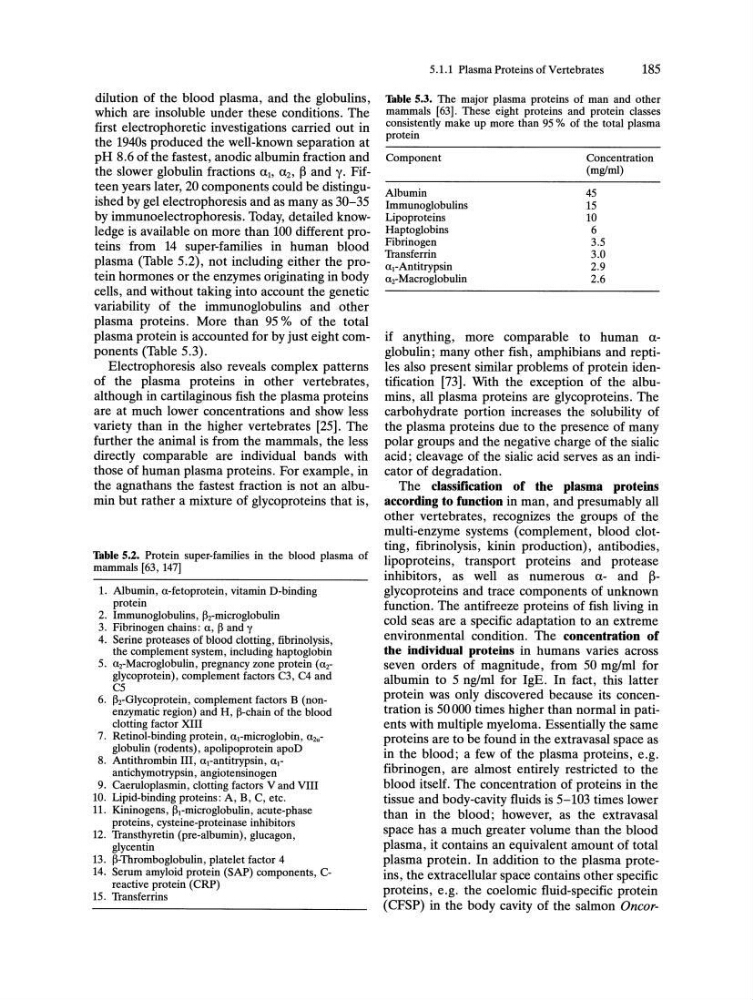
plasma protein is accounted for by just eight components (Table 5.3).
Electrophoresis also reveals complex patterns
of the plasma proteins in other vertebrates,
although in cartilaginous fish the plasma proteins
are at much lower concentrations and show less
variety than in the higher vertebrates [25]. The
further the animal is from the mammals, the less
directly comparable are individual bands with
those of human plasma proteins. For example, in
the agnathans the fastest fraction is not an albumin but rather a mixture of glycoproteins that is,
Table 5.2. Protein super-families in the blood plasma of
mammals [63, 147]
1. Albumin, a-fetoprotein, vitamin D-binding
protein
2. Immunoglobulins, ~z-microglobulin
3. Fibrinogen chains: a, ~ and y
4. Serine proteases of blood clotting, fibrinolysis,
the complement system, including haptoglobin
5. az-Macroglobulin, pregnancy zone protein (azglycoprotein), complement factors C3, C4 and
C5
6. ~z-Glycoprotein, complement factors B (nonenzymatic region) and H, ~-chain of the blood
clotting factor XIII
7. Retinol-binding protein, armicroglobin, a2uglobulin (rodents), apolipoprotein apoD
8. Antithrombin III, aI-antitrypsin, alantichymotrypsin, angiotensinogen
9. Caeruloplasmin, clotting factors V and VIII
10. Lipid-binding proteins: A, B, C, etc.
11. Kininogens, ~rmicroglobulin, acute-phase
proteins, cysteine-proteinase inhibitors
12. Transthyretin (pre-albumin), glucagon,
glycentin
13. ~-Thromboglobulin, platelet factor 4
14. Serum amyloid protein (SAP) components, Creactive protein (CRP)
15. Transferrins
5.1.1 Plasma Proteins of Vertebrates
185
Table 5.3. The major plasma proteins of man and other
mammals [63]. These eight proteins and protein classes
consistently make up more than 95 % of the total plasma
protein
Component
Albumin
Immunoglobulins
Lipoproteins
Haptoglobins
Fibrinogen
Transferrin
aI-Antitrypsin
az-Macroglobulin
Concentration
(mg/ml)
45
15
10
6
3.5
3.0
2.9
2.6
if anything, more comparable to human aglobulin; many other fish, amphibians and reptiles also present similar problems of protein identification [73]. With the exception of the albumins, all plasma proteins are glycoproteins. The
carbohydrate portion increases the solubility of
the plasma proteins due to the presence of many
polar groups and the negative charge of the sialic
acid; cleavage of the sialic acid serves as an indicator of degradation.
The classification of the plasma proteins
according to function in man, and presumably all
other vertebrates, recognizes the groups of the
multi-enzyme systems (complement, blood clotting, fibrinolysis, kinin production), antibodies,
lipoproteins, transport proteins and protease
inhibitors, as well as numerous a- and ~glycoproteins and trace components of unknown
function. The antifreeze proteins of fish living in
cold seas are a specific adaptation to an extreme
environmental condition. The concentration of
the individual proteins in humans varies across
seven orders of magnitude, from 50 mg/ml for
albumin to 5 ng/ml for IgE. In fact, this latter
protein was only discovered because its concentration is 50000 times higher than normal in patients with multiple myeloma. Essentially the same
proteins are to be found in the extravasal space as
in the blood; a few of the plasma proteins, e.g.
fibrinogen, are almost entirely restricted to the
blood itself. The concentration of proteins in the
tissue and body-cavity fluids is 5-103 times lower
than in the blood; however, as the extravasal
space has a much greater volume than the blood
plasma, it contains an equivalent amount of total
plasma protein. In addition to the plasma proteins, the extracellular space contains other specific
proteins, e.g. the coelomic fluid-specific protein
(CFSP) in the body cavity of the salmon Oncor-
which are insoluble under these conditions. The
first electrophoretic investigations carried out in
the 1940s produced the well-known separation at
pH 8.6 of the fastest, anodic albumin fraction and
the slower globulin fractions ab az, ~ and y. Fifteen years later, 20 components could be distinguished by gel electrophoresis and as many as 30-35
by immunoelectrophoresis. Today, detailed knowledge is available on more than 100 different proteins from 14 super-families in human blood
plasma (Table 5.2), not including either the protein hormones or the enzymes originating in body
cells, and without taking into account the genetic
variability of the immunoglobulins and other
plasma proteins. More than 95 % of the total
plasma protein is accounted for by just eight components (Table 5.3).
Electrophoresis also reveals complex patterns
of the plasma proteins in other vertebrates,
although in cartilaginous fish the plasma proteins
are at much lower concentrations and show less
variety than in the higher vertebrates [25]. The
further the animal is from the mammals, the less
directly comparable are individual bands with
those of human plasma proteins. For example, in
the agnathans the fastest fraction is not an albumin but rather a mixture of glycoproteins that is,
Table 5.2. Protein super-families in the blood plasma of
mammals [63, 147]
1. Albumin, a-fetoprotein, vitamin D-binding
protein
2. Immunoglobulins, ~z-microglobulin
3. Fibrinogen chains: a, ~ and y
4. Serine proteases of blood clotting, fibrinolysis,
the complement system, including haptoglobin
5. az-Macroglobulin, pregnancy zone protein (azglycoprotein), complement factors C3, C4 and
C5
6. ~z-Glycoprotein, complement factors B (nonenzymatic region) and H, ~-chain of the blood
clotting factor XIII
7. Retinol-binding protein, armicroglobin, a2uglobulin (rodents), apolipoprotein apoD
8. Antithrombin III, aI-antitrypsin, alantichymotrypsin, angiotensinogen
9. Caeruloplasmin, clotting factors V and VIII
10. Lipid-binding proteins: A, B, C, etc.
11. Kininogens, ~rmicroglobulin, acute-phase
proteins, cysteine-proteinase inhibitors
12. Transthyretin (pre-albumin), glucagon,
glycentin
13. ~-Thromboglobulin, platelet factor 4
14. Serum amyloid protein (SAP) components, Creactive protein (CRP)
15. Transferrins
5.1.1 Plasma Proteins of Vertebrates
185
Table 5.3. The major plasma proteins of man and other
mammals [63]. These eight proteins and protein classes
consistently make up more than 95 % of the total plasma
protein
Component
Albumin
Immunoglobulins
Lipoproteins
Haptoglobins
Fibrinogen
Transferrin
aI-Antitrypsin
az-Macroglobulin
Concentration
(mg/ml)
45
15
10
6
3.5
3.0
2.9
2.6
if anything, more comparable to human aglobulin; many other fish, amphibians and reptiles also present similar problems of protein identification [73]. With the exception of the albumins, all plasma proteins are glycoproteins. The
carbohydrate portion increases the solubility of
the plasma proteins due to the presence of many
polar groups and the negative charge of the sialic
acid; cleavage of the sialic acid serves as an indicator of degradation.
The classification of the plasma proteins
according to function in man, and presumably all
other vertebrates, recognizes the groups of the
multi-enzyme systems (complement, blood clotting, fibrinolysis, kinin production), antibodies,
lipoproteins, transport proteins and protease
inhibitors, as well as numerous a- and ~glycoproteins and trace components of unknown
function. The antifreeze proteins of fish living in
cold seas are a specific adaptation to an extreme
environmental condition. The concentration of
the individual proteins in humans varies across
seven orders of magnitude, from 50 mg/ml for
albumin to 5 ng/ml for IgE. In fact, this latter
protein was only discovered because its concentration is 50000 times higher than normal in patients with multiple myeloma. Essentially the same
proteins are to be found in the extravasal space as
in the blood; a few of the plasma proteins, e.g.
fibrinogen, are almost entirely restricted to the
blood itself. The concentration of proteins in the
tissue and body-cavity fluids is 5-103 times lower
than in the blood; however, as the extravasal
space has a much greater volume than the blood
plasma, it contains an equivalent amount of total
plasma protein. In addition to the plasma proteins, the extracellular space contains other specific
proteins, e.g. the coelomic fluid-specific protein
(CFSP) in the body cavity of the salmon Oncor-