

5 Plasma Proteins, Yolk Proteins
and Metal-Binding Proteins
5.1
5.1.1
5.1.2
5.2
5.3
5.3.1
5.3.2
5.3.3
5.4
5.5
5.6
5.6.1
The Variety of Plasma Proteins
Plasma Proteins of Vertebrates
Plasma Proteins of Invertebrates
Serum Albumin and a-Fetoprotein
Plasma Proteins with Special Binding
and Transport Functions
Transferrin
Haptoglobin and Haemopexin
Caeruloplasmin and Pre-Albumins
Acute-Phase Proteins
Larval Haemolymph Proteins of Insects
Plasma Lipoproteins
Plasma Lipoproteins of Vertebrates
5.1 The Variety of Plasma Proteins
The extracellular fluid of the metazoans is not
only a transport vehicle but also, for the majority
of the body's cells, their growth environment.
Proteins play an important role here, providing
colloid-osmotic pressure and acting as buffers.
The most important parameter in this respect is
their concentration which, depending upon the
species, the developmental stage and the physiological conditions, can vary from less than 1 to
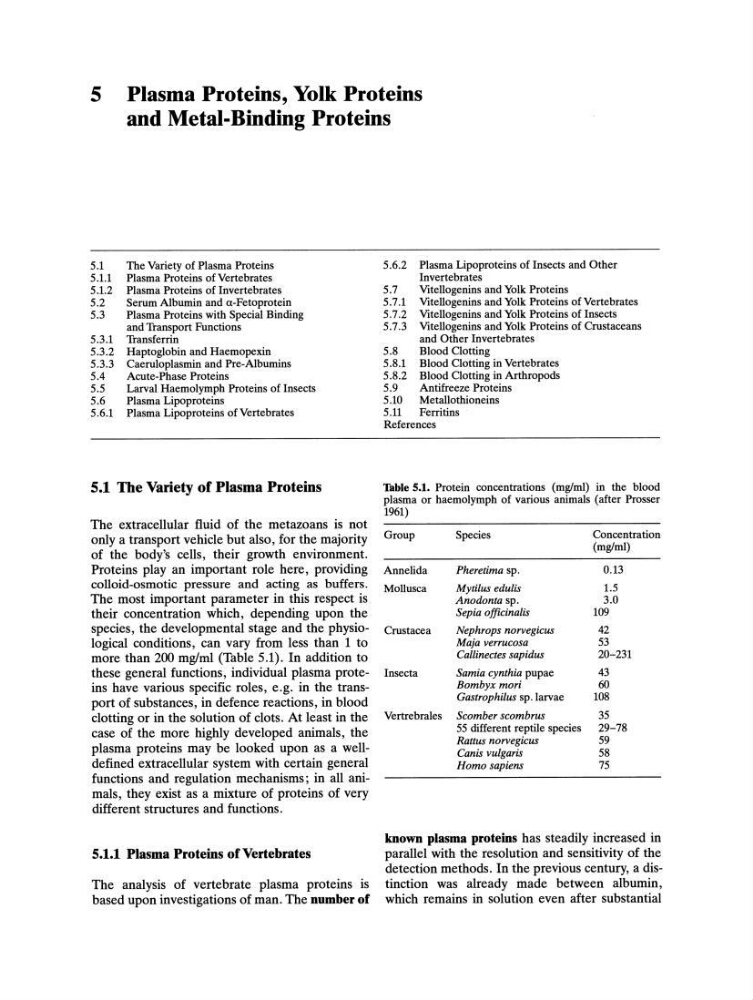
more than 200 mg/ml (Table 5.1). In addition to
these general functions, individual plasma proteins have various specific roles, e.g. in the transport of substances, in defence reactions, in blood
clotting or in the solution of clots. At least in the
case of the more highly developed animals, the
plasma proteins may be looked upon as a welldefined extracellular system with certain general
functions and regulation mechanisms; in all animals, they exist as a mixture of proteins of very
different structures and functions.
5.1.1 Plasma Proteins of Vertebrates
The analysis of vertebrate plasma proteins is
based upon investigations of man. The number of
5.6.2
5.7
5.7.1
5.7.2
5.7.3
5.8
5.8.1
5.8.2
5.9
5.10
5.11
Plasma Lipoproteins of Insects and Other
Invertebrates
Vitellogenins and Yolk Proteins
Vitellogenins and Yolk Proteins of Vertebrates
Vitellogenins and Yolk Proteins of Insects
Vitellogenins and Yolk Proteins of Crustaceans
and Other Invertebrates
Blood Clotting
Blood Clotting in Vertebrates
Blood Clotting in Arthropods
Antifreeze Proteins
Metallothioneins
Ferritins
References
Table 5.1. Protein concentrations (mg/ml) in the blood
plasma or haemolymph of various animals (after Prosser
1961)
Group
Species
Concentration
(mg/ml)
Annelida
Pheretima sp.
0.13
Mollusca
Mytilus edulis
1.5
Anodonta sp.
3.0
Sepia officinalis
109
Crustacea
Nephrops norvegicus
42
Maja verrucosa
53
Callinectes sapidus
20-231
Insecta
Samia cynthia pupae
43
Bombyx mori
60
Gastrophilus sp.larvae
108
Vertrebrales Scomberscombrus
35
55 different reptile species 29-78
Rattus norvegicus
59
Canis vulgaris
58
Homo sapiens
75
known plasma proteins has steadily increased in
parallel with the resolution and sensitivity of the
detection methods. In the previous century, a distinction was already made between albumin,
which remains in solution even after substantial
and Metal-Binding Proteins
5.1
5.1.1
5.1.2
5.2
5.3
5.3.1
5.3.2
5.3.3
5.4
5.5
5.6
5.6.1
The Variety of Plasma Proteins
Plasma Proteins of Vertebrates
Plasma Proteins of Invertebrates
Serum Albumin and a-Fetoprotein
Plasma Proteins with Special Binding
and Transport Functions
Transferrin
Haptoglobin and Haemopexin
Caeruloplasmin and Pre-Albumins
Acute-Phase Proteins
Larval Haemolymph Proteins of Insects
Plasma Lipoproteins
Plasma Lipoproteins of Vertebrates
5.1 The Variety of Plasma Proteins
The extracellular fluid of the metazoans is not
only a transport vehicle but also, for the majority
of the body's cells, their growth environment.
Proteins play an important role here, providing
colloid-osmotic pressure and acting as buffers.
The most important parameter in this respect is
their concentration which, depending upon the
species, the developmental stage and the physiological conditions, can vary from less than 1 to
more than 200 mg/ml (Table 5.1). In addition to
these general functions, individual plasma proteins have various specific roles, e.g. in the transport of substances, in defence reactions, in blood
clotting or in the solution of clots. At least in the
case of the more highly developed animals, the
plasma proteins may be looked upon as a welldefined extracellular system with certain general
functions and regulation mechanisms; in all animals, they exist as a mixture of proteins of very
different structures and functions.
5.1.1 Plasma Proteins of Vertebrates
The analysis of vertebrate plasma proteins is
based upon investigations of man. The number of
5.6.2
5.7
5.7.1
5.7.2
5.7.3
5.8
5.8.1
5.8.2
5.9
5.10
5.11
Plasma Lipoproteins of Insects and Other
Invertebrates
Vitellogenins and Yolk Proteins
Vitellogenins and Yolk Proteins of Vertebrates
Vitellogenins and Yolk Proteins of Insects
Vitellogenins and Yolk Proteins of Crustaceans
and Other Invertebrates
Blood Clotting
Blood Clotting in Vertebrates
Blood Clotting in Arthropods
Antifreeze Proteins
Metallothioneins
Ferritins
References
Table 5.1. Protein concentrations (mg/ml) in the blood
plasma or haemolymph of various animals (after Prosser
1961)
Group
Species
Concentration
(mg/ml)
Annelida
Pheretima sp.
0.13
Mollusca
Mytilus edulis
1.5
Anodonta sp.
3.0
Sepia officinalis
109
Crustacea
Nephrops norvegicus
42
Maja verrucosa
53
Callinectes sapidus
20-231
Insecta
Samia cynthia pupae
43
Bombyx mori
60
Gastrophilus sp.larvae
108
Vertrebrales Scomberscombrus
35
55 different reptile species 29-78
Rattus norvegicus
59
Canis vulgaris
58
Homo sapiens
75
known plasma proteins has steadily increased in
parallel with the resolution and sensitivity of the
detection methods. In the previous century, a distinction was already made between albumin,
which remains in solution even after substantial