

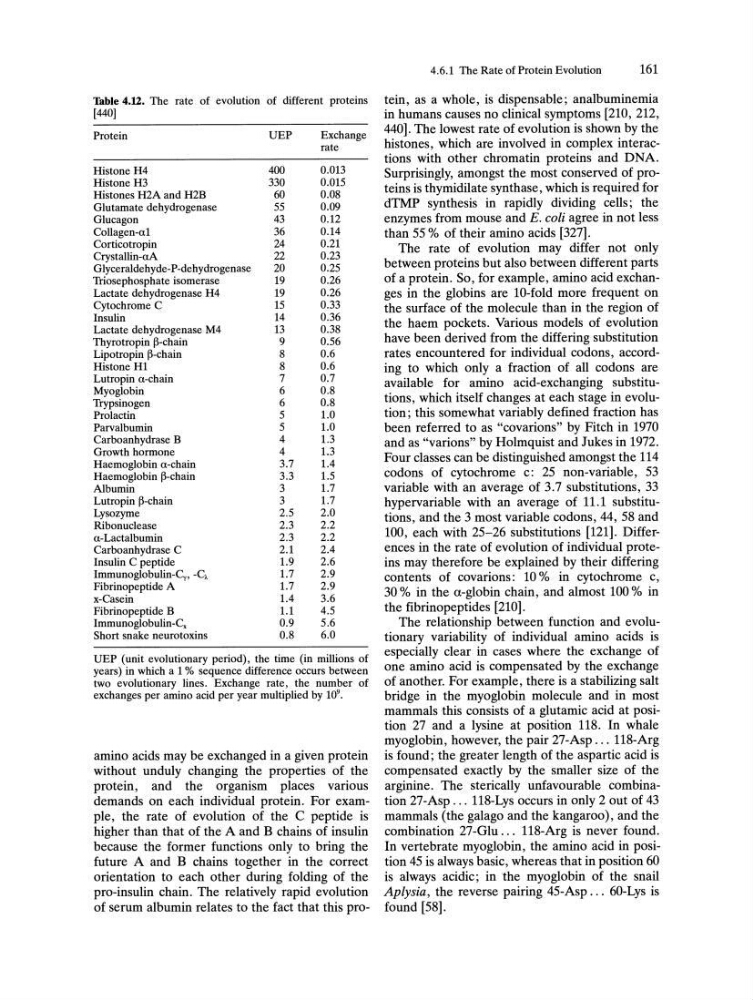
Table 4.12. The rate of evolution of different proteins
[440]
Protein
Histone H4
Histone H3
Histones H2A and H2B
Glutamate dehydrogenase
Glucagon
Collagen-a1
Corticotropin
Crystallin-aA
Glyceraldehyde-P-dehydrogenase
Triosephosphate isomerase
Lactate dehydrogenase H4
Cytochrome C
Insulin
Lactate dehydrogenase M4
Thyrotropin p-chain
Lipotropin p-chain
Histone H1
Lutropin a-chain
Myoglobin
Trypsinogen
Prolactin
Parvalbumin
Carboanhydrase B
Growth hormone
Haemoglobin a-chain
Haemoglobin p-chain
Albumin
Lutropin p-chain
Lysozyme
Ribonuclease
a-Lactalbumin
Carbo anhydrase C
Insulin C peptide
Immunoglobulin-Cy , -CA
Fibrinopeptide A
x-Casein
Fibrinopeptide B
Immunoglobulin-Cx
Short snake neurotoxins
UEP
400
330
60
55
43
36
24
22
20
19
19
15
14
13
9
8
8
7
6
6
5
5
4
4
3.7
3.3
3
3
2.5
2.3
2.3
2.1
1.9
1.7
1.7
1.4
1.1
0.9
0.8
Exchange
rate
0.013
0.015
0.08
0.09
0.12
0.14
0.21
0.23
0.25
0.26
0.26
0.33
0.36
0.38
0.56
0.6
0.6
0.7
0.8
0.8
1.0
1.0
1.3
1.3
1.4
1.5
1.7
1.7
2.0
2.2
2.2
2.4
2.6
2.9
2.9
3.6
4.5
5.6
6.0
UEP (unit evolutionary period), the time (in millions of
years) in which a 1 % sequence difference occurs between
two evolutionary lines. Exchange rate, the number of
exchanges per amino acid per year multiplied by 10 9 •
amino acids may be exchanged in a given protein
without unduly changing the properties of the
protein, and the organism places various
demands on each individual protein. For example, the rate of evolution of the C peptide is
higher than that of the A and B chains of insulin
because the former functions only to bring the
future A and B chains together in the correct
orientation to each other during folding of the
pro-insulin chain. The relatively rapid evolution
of serum albumin relates to the fact that this pro4.6.1 The Rate of Protein Evolution
161
tein, as a whole, is dispensable; analbuminemia
in humans causes no clinical symptoms [210, 212,
440]. The lowest rate of evolution is shown by the
histones, which are involved in complex interactions with other chromatin proteins and DNA.
Surprisingly, amongst the most conserved of proteins is thymidilate synthase, which is required for
dTMP synthesis in rapidly dividing cells; the
enzymes from mouse and E. coli agree in not less
than 55 % of their amino acids [327].
The rate of evolution may differ not only
between proteins but also between different parts
of a protein. So, for example, amino acid exchanges in the globins are lO-fold more frequent on
the surface of the molecule than in the region of
the haem pockets. Various models of evolution
have been derived from the differing substitution
rates encountered for individual codons, according to which only a fraction of all co dons are
available for amino acid-exchanging substitutions, which itself changes at each stage in evolution; this somewhat variably defined fraction has
been referred to as "covarions" by Fitch in 1970
and as "varions" by Holmquist and Jukes in 1972.
Four classes can be distinguished amongst the 114
co dons of cytochrome c: 25 non-variable, 53
variable with an average of 3.7 substitutions, 33
hypervariable with an average of 11.1 substitutions, and the 3 most variable codons, 44, 58 and
100, each with 25-26 substitutions [121]. Differences in the rate of evolution of individual proteins may therefore be explained by their differing
contents of covarions: 10 % in cytochrome c,
30 % in the a-globin chain, and almost 100 % in
the fibrinopeptides [210].
The relationship between function and evolutionary variability of individual amino acids is
especially clear in cases where the exchange of
one amino acid is compensated by the exchange
of another. For example, there is a stabilizing salt
bridge in the myoglobin molecule and in most
mammals this consists of a glutamic acid at position 27 and a lysine at position 118. In whale
myoglobin, however, the pair 27-Asp ... 118-Arg
is found; the greater length of the aspartic acid is
compensated exactly by the smaller size of the
arginine. The sterically unfavourable combination 27-Asp ... 118-Lys occurs in only 2 out of 43
mammals (the galago and the kangaroo), and the
combination 27-Glu ... 118-Arg is never found.
In vertebrate myoglobin, the amino acid in position 45 is always basic, whereas that in position 60
is always acidic; in the myoglobin of the snail
Aplysia, the reverse pairing 45-Asp ... 60-Lys is
found [58].
[440]
Protein
Histone H4
Histone H3
Histones H2A and H2B
Glutamate dehydrogenase
Glucagon
Collagen-a1
Corticotropin
Crystallin-aA
Glyceraldehyde-P-dehydrogenase
Triosephosphate isomerase
Lactate dehydrogenase H4
Cytochrome C
Insulin
Lactate dehydrogenase M4
Thyrotropin p-chain
Lipotropin p-chain
Histone H1
Lutropin a-chain
Myoglobin
Trypsinogen
Prolactin
Parvalbumin
Carboanhydrase B
Growth hormone
Haemoglobin a-chain
Haemoglobin p-chain
Albumin
Lutropin p-chain
Lysozyme
Ribonuclease
a-Lactalbumin
Carbo anhydrase C
Insulin C peptide
Immunoglobulin-Cy , -CA
Fibrinopeptide A
x-Casein
Fibrinopeptide B
Immunoglobulin-Cx
Short snake neurotoxins
UEP
400
330
60
55
43
36
24
22
20
19
19
15
14
13
9
8
8
7
6
6
5
5
4
4
3.7
3.3
3
3
2.5
2.3
2.3
2.1
1.9
1.7
1.7
1.4
1.1
0.9
0.8
Exchange
rate
0.013
0.015
0.08
0.09
0.12
0.14
0.21
0.23
0.25
0.26
0.26
0.33
0.36
0.38
0.56
0.6
0.6
0.7
0.8
0.8
1.0
1.0
1.3
1.3
1.4
1.5
1.7
1.7
2.0
2.2
2.2
2.4
2.6
2.9
2.9
3.6
4.5
5.6
6.0
UEP (unit evolutionary period), the time (in millions of
years) in which a 1 % sequence difference occurs between
two evolutionary lines. Exchange rate, the number of
exchanges per amino acid per year multiplied by 10 9 •
amino acids may be exchanged in a given protein
without unduly changing the properties of the
protein, and the organism places various
demands on each individual protein. For example, the rate of evolution of the C peptide is
higher than that of the A and B chains of insulin
because the former functions only to bring the
future A and B chains together in the correct
orientation to each other during folding of the
pro-insulin chain. The relatively rapid evolution
of serum albumin relates to the fact that this pro4.6.1 The Rate of Protein Evolution
161
tein, as a whole, is dispensable; analbuminemia
in humans causes no clinical symptoms [210, 212,
440]. The lowest rate of evolution is shown by the
histones, which are involved in complex interactions with other chromatin proteins and DNA.
Surprisingly, amongst the most conserved of proteins is thymidilate synthase, which is required for
dTMP synthesis in rapidly dividing cells; the
enzymes from mouse and E. coli agree in not less
than 55 % of their amino acids [327].
The rate of evolution may differ not only
between proteins but also between different parts
of a protein. So, for example, amino acid exchanges in the globins are lO-fold more frequent on
the surface of the molecule than in the region of
the haem pockets. Various models of evolution
have been derived from the differing substitution
rates encountered for individual codons, according to which only a fraction of all co dons are
available for amino acid-exchanging substitutions, which itself changes at each stage in evolution; this somewhat variably defined fraction has
been referred to as "covarions" by Fitch in 1970
and as "varions" by Holmquist and Jukes in 1972.
Four classes can be distinguished amongst the 114
co dons of cytochrome c: 25 non-variable, 53
variable with an average of 3.7 substitutions, 33
hypervariable with an average of 11.1 substitutions, and the 3 most variable codons, 44, 58 and
100, each with 25-26 substitutions [121]. Differences in the rate of evolution of individual proteins may therefore be explained by their differing
contents of covarions: 10 % in cytochrome c,
30 % in the a-globin chain, and almost 100 % in
the fibrinopeptides [210].
The relationship between function and evolutionary variability of individual amino acids is
especially clear in cases where the exchange of
one amino acid is compensated by the exchange
of another. For example, there is a stabilizing salt
bridge in the myoglobin molecule and in most
mammals this consists of a glutamic acid at position 27 and a lysine at position 118. In whale
myoglobin, however, the pair 27-Asp ... 118-Arg
is found; the greater length of the aspartic acid is
compensated exactly by the smaller size of the
arginine. The sterically unfavourable combination 27-Asp ... 118-Lys occurs in only 2 out of 43
mammals (the galago and the kangaroo), and the
combination 27-Glu ... 118-Arg is never found.
In vertebrate myoglobin, the amino acid in position 45 is always basic, whereas that in position 60
is always acidic; in the myoglobin of the snail
Aplysia, the reverse pairing 45-Asp ... 60-Lys is
found [58].