

140
4 Molecular Evolution
age sequence difference of about 0.6 %, found by
use of this method, agrees with the value
obtained by sequence comparison [221, 363].
Restriction analysis gave a value of 0.24 % for the
variability of the heat -shock locus 87 A 7 of Drosophila [40}.
4.4 The Causes of Genetic Polymorphism
It was mainly as an explanation of the unexpectedly high protein polymorphism of natural
populations that in 1968-1969, Kimura and also
King and Jukes independently developed the theories of molecular evolution that became known as
the "neutral theories" or "non-Darwinian evolution" [208, 213]. At the heart of these theories is
the thesis that a large part of the nucleotide substitutions and resulting amino acid exchanges that
occur during evolution are selectively neutral and
become fixed in populations by random processes
(drift). In opposition to these revolutionary ideas,
various attempts were made to explain protein
polymorphism as the result of some selection process. Controversy ensued between "neutralism"
and selectionism"; at one time this took on an
almost ideological dimension and the argument
continues to this day [210, 212, 294, 297].
The arguments sometimes led to misunderstandings. Quite obviously, the proponents of the
neutral theories did not claim that all mutation
was selectively neutral. They did not deny the
effects of selection, but held more to the idea
that, under constant internal and external conditions, selection worked mainly to stabilize in that
it eliminated variants deviating greatly from the
norm. At the same time, the random fixation of
neutral mutations brought about a high level of
variability within a population and this actually
then made possible adaptation to changing conditions. If the phenotypic optimum is shifted, as the
result of a change in the environment, then some
4 Ne
l/Vo
. . ....
<>
t:¢ <> <>
11111,. ~ <>
<>
otherwise neutral variant may become advantageous; this spreads through the population because
of positive selection and becomes "fixed" .
According to this concept, it is not necessary to
assign special importance to specific "adaptive"
mutations, although some may arise [210, 212].
4.4.1 Neutral Theories
of Molecular Evolution
A significant advantage of the "neutral mutation
- random drift" theory, proposed by Kimura in
1968, is the possibility to make quantitative statements about the relationship between the neutral
mutation rate Vo and the effective population size
Ne, on the one hand, and the rate of evolution
and the extent of polymorphism on the other
hand [210,212]. The effective population Ne
refers to an ideal population with random mating;
for various reasons Ne in real populations is usually considerably smaller than the total number of
available individuals. In addition, it is assumed
that the population size will significantly change
several times during the period required for the
development of the polymorphism. Ne is, therefore, considered to have an abstract size in
population genetics models, and the real value
can be only roughly estimated [294]. A population of Ne individuals with a neutral mutation rate
of Vo will accumulate 2Nevo neutral mutations per
generation, and will have a fixation probability of
1/2Ne. Thus, the fixation rate of neutral mutations
is given by
k = 2Nevj2Ne = Vo
(4.7)
This is therefore independent of the population
size and identical to the neutral mutation rate: a
neutral mutation will become fixed in the population every l/vo generations. Definite fixation
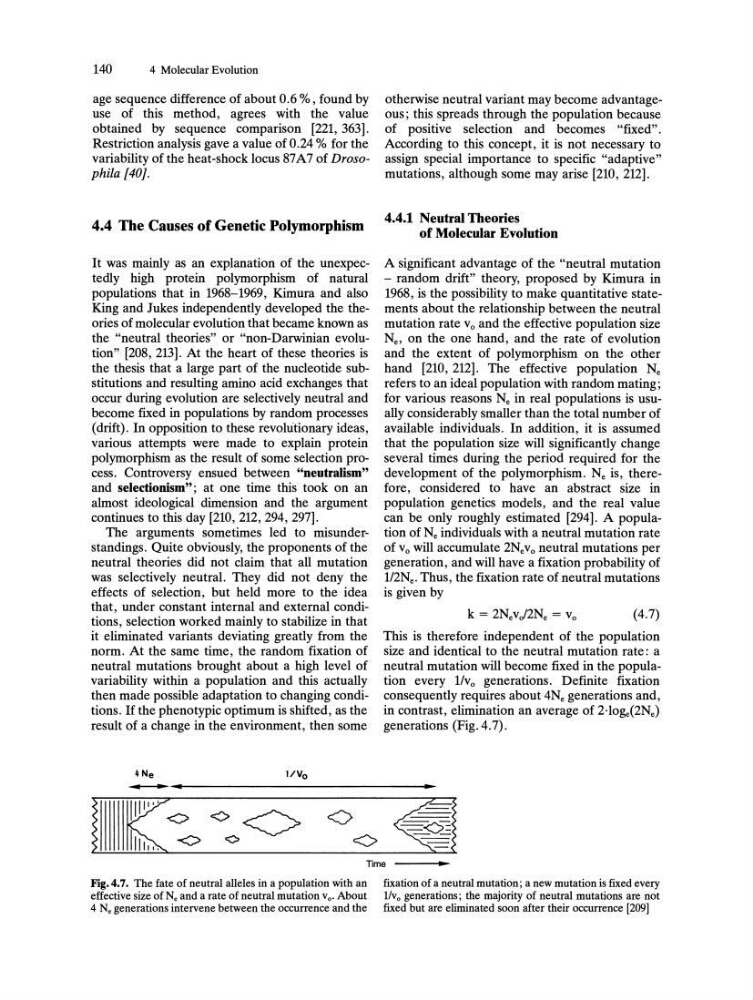
consequently requires about 4Ne generations and,
in contrast, elimination an average of 2·loge(2Ne)
generations (Fig. 4.7).
..
Time
..
Fig.4.7. The fate of neutral alleles in a population with an
effective size of Ne and a rate of neutral mutation Vo' About
4 Ne generations intervene between the occurrence and the
fixation of a neutral mutation; a new mutation is fixed every
ltvo generations; the majority of neutral mutations are not
fixed but are eliminated soon after their occurrence [209]
4 Molecular Evolution
age sequence difference of about 0.6 %, found by
use of this method, agrees with the value
obtained by sequence comparison [221, 363].
Restriction analysis gave a value of 0.24 % for the
variability of the heat -shock locus 87 A 7 of Drosophila [40}.
4.4 The Causes of Genetic Polymorphism
It was mainly as an explanation of the unexpectedly high protein polymorphism of natural
populations that in 1968-1969, Kimura and also
King and Jukes independently developed the theories of molecular evolution that became known as
the "neutral theories" or "non-Darwinian evolution" [208, 213]. At the heart of these theories is
the thesis that a large part of the nucleotide substitutions and resulting amino acid exchanges that
occur during evolution are selectively neutral and
become fixed in populations by random processes
(drift). In opposition to these revolutionary ideas,
various attempts were made to explain protein
polymorphism as the result of some selection process. Controversy ensued between "neutralism"
and selectionism"; at one time this took on an
almost ideological dimension and the argument
continues to this day [210, 212, 294, 297].
The arguments sometimes led to misunderstandings. Quite obviously, the proponents of the
neutral theories did not claim that all mutation
was selectively neutral. They did not deny the
effects of selection, but held more to the idea
that, under constant internal and external conditions, selection worked mainly to stabilize in that
it eliminated variants deviating greatly from the
norm. At the same time, the random fixation of
neutral mutations brought about a high level of
variability within a population and this actually
then made possible adaptation to changing conditions. If the phenotypic optimum is shifted, as the
result of a change in the environment, then some
4 Ne
l/Vo
. . ....
<>
t:¢ <> <>
11111,. ~ <>
<>
otherwise neutral variant may become advantageous; this spreads through the population because
of positive selection and becomes "fixed" .
According to this concept, it is not necessary to
assign special importance to specific "adaptive"
mutations, although some may arise [210, 212].
4.4.1 Neutral Theories
of Molecular Evolution
A significant advantage of the "neutral mutation
- random drift" theory, proposed by Kimura in
1968, is the possibility to make quantitative statements about the relationship between the neutral
mutation rate Vo and the effective population size
Ne, on the one hand, and the rate of evolution
and the extent of polymorphism on the other
hand [210,212]. The effective population Ne
refers to an ideal population with random mating;
for various reasons Ne in real populations is usually considerably smaller than the total number of
available individuals. In addition, it is assumed
that the population size will significantly change
several times during the period required for the
development of the polymorphism. Ne is, therefore, considered to have an abstract size in
population genetics models, and the real value
can be only roughly estimated [294]. A population of Ne individuals with a neutral mutation rate
of Vo will accumulate 2Nevo neutral mutations per
generation, and will have a fixation probability of
1/2Ne. Thus, the fixation rate of neutral mutations
is given by
k = 2Nevj2Ne = Vo
(4.7)
This is therefore independent of the population
size and identical to the neutral mutation rate: a
neutral mutation will become fixed in the population every l/vo generations. Definite fixation
consequently requires about 4Ne generations and,
in contrast, elimination an average of 2·loge(2Ne)
generations (Fig. 4.7).
..
Time
..
Fig.4.7. The fate of neutral alleles in a population with an
effective size of Ne and a rate of neutral mutation Vo' About
4 Ne generations intervene between the occurrence and the
fixation of a neutral mutation; a new mutation is fixed every
ltvo generations; the majority of neutral mutations are not
fixed but are eliminated soon after their occurrence [209]