

4.3.4 Differences in Protein Polymorphism Between Different Animal Groups and Habitats
135
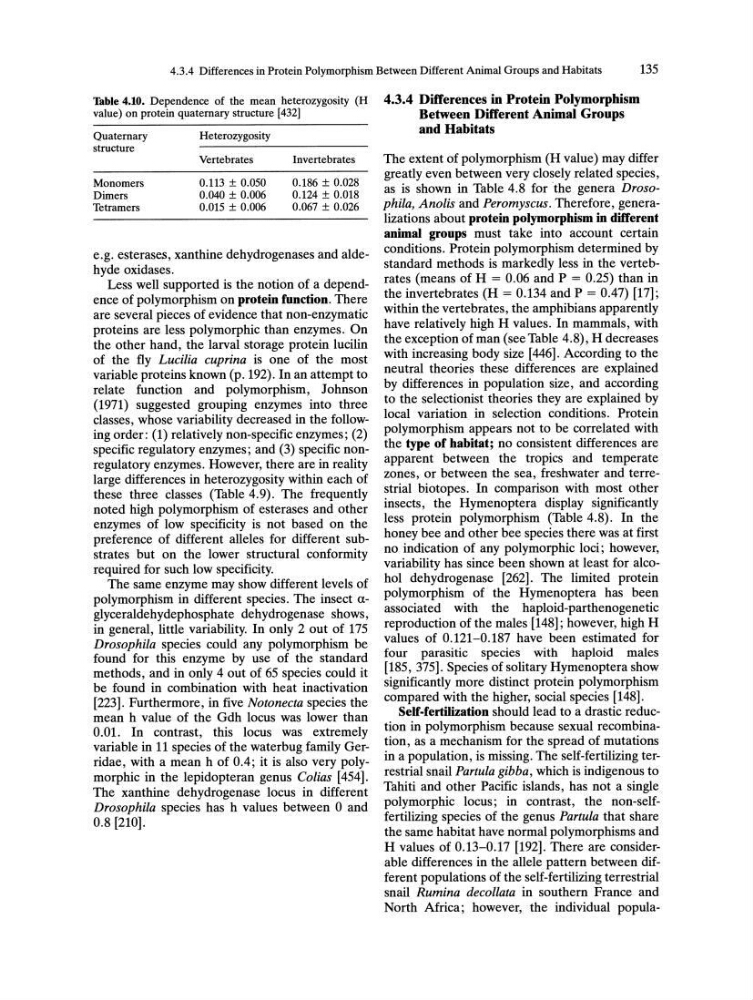
Table 4.10. Dependence of the mean heterozygosity (H
value) on protein quaternary structure [432]
Quaternary
structure
Monomers
Dimers
Tetramers
Heterozygosity
Vertebrates
0.113 ± 0.050
0.040 ± 0.006
0.Q15 ± 0.006
Invertebrates
0.186 ± 0.Q28
0.124 ± 0.018
0.067 ± 0.026
e.g. esterases, xanthine dehydrogenases and aldehyde oxidases.
Less well supported is the notion of a dependence of polymorphism on protein function. There
are several pieces of evidence that non-enzymatic
proteins are less polymorphic than enzymes. On
the other hand, the larval storage protein lucilin
of the fly Lucilia cuprina is one of the most
variable proteins known (p.192). In an attempt to
relate function and polymorphism, Johnson
(1971) suggested grouping enzymes into three
classes, whose variability decreased in the following order: (1) relatively non-specific enzymes; (2)
specific regulatory enzymes; and (3) specific nonregulatory enzymes. However, there are in reality
large differences in heterozygosity within each of
these three classes (Table 4.9). The frequently
noted high polymorphism of esterases and other
enzymes of low specificity is not based on the
preference of different alleles for different substrates but on the lower structural conformity
required for such low specificity.
The same enzyme may show different levels of
polymorphism in different species. The insect a?lyceraldehydephosphate dehydrogenase shows,
III general, little variability. In only 2 out of 175
Drosophila species could any polymorphism be
found for this enzyme by use of the standard
methods, and in only 4 out of 65 species could it
be found in combination with heat inactivation
[223]. Furthermore, in five Notonecta species the
mean h value of the Gdh locus was lower than
0.01. In contrast, this locus was extremely
variable in 11 species of the waterbug family Gerridae, with a mean h of 0.4; it is also very polymorphic in the lepidopteran genus Colias [454].
The xanthine dehydrogenase locus in different
Drosophila species has h values between 0 and
0.8 [210].
4.3.4 Differences in Protein Polymorphism
Between Different Animal Groups
and Habitats
The extent of polymorphism (H value) may differ
greatly even between very closely related species,
as is shown in Table 4.8 for the genera Drosophila, Anolis and Peromyscus. Therefore, generalizations about protein polymorphism in different
animal groups must take into account certain
conditions. Protein polymorphism determined by
standard methods is markedly less in the vertebrates (means of H = 0.06 and P = 0.25) than in
the invertebrates (H = 0.134 and P = 0.47) [17);
within the vertebrates, the amphibians apparently
have relatively high H values. In mammals, with
the exception of man (see Table 4.8), H decreases
with increasing body size [446]. According to the
neutral theories these differences are explained
by differences in population size, and according
to the selectionist theories they are explained by
local variation in selection conditions. Protein
polymorphism appears not to be correlated with
the type of habitat; no consistent differences are
apparent between the tropics and temperate
zones, or between the sea, freshwater and terrestrial biotopes. In comparison with most other
insects, the Hymenoptera display significantly
less protein polymorphism (Table 4.8). In the
honey bee and other bee species there was at first
no indication of any polymorphic loci; however,
variability has since been shown at least for alcohol dehydrogenase [262]. The limited protein
polymorphism of the Hymenoptera has been
associated with the haploid-parthenogenetic
reproduction of the males [148]; however, high H
values of 0.121-0.187 have been estimated for
four parasitic species with haploid males
[185, 375]. Species of solitary Hymenoptera show
significantly more distinct protein polymorphism
compared with the higher, social species [148).
Self-fertilization should lead to a drastic reduction in polymorphism because sexual recombination, as a mechanism for the spread of mutations
in a population, is missing. The self-fertilizing terrestrial snail Partula gibba, which is indigenous to
Tahiti and other Pacific islands, has not a single
polymorphic locus; in contrast, the non-selffertilizing species of the genus Partula that share
the same habitat have normal polymorphisms and
H values of 0.13-0.17 [192]. There are considerable differences in the allele pattern between different populations of the self-fertilizing terrestrial
snail Rumina decol/ata in southern France and
North Africa; however, the individual popula-
135
Table 4.10. Dependence of the mean heterozygosity (H
value) on protein quaternary structure [432]
Quaternary
structure
Monomers
Dimers
Tetramers
Heterozygosity
Vertebrates
0.113 ± 0.050
0.040 ± 0.006
0.Q15 ± 0.006
Invertebrates
0.186 ± 0.Q28
0.124 ± 0.018
0.067 ± 0.026
e.g. esterases, xanthine dehydrogenases and aldehyde oxidases.
Less well supported is the notion of a dependence of polymorphism on protein function. There
are several pieces of evidence that non-enzymatic
proteins are less polymorphic than enzymes. On
the other hand, the larval storage protein lucilin
of the fly Lucilia cuprina is one of the most
variable proteins known (p.192). In an attempt to
relate function and polymorphism, Johnson
(1971) suggested grouping enzymes into three
classes, whose variability decreased in the following order: (1) relatively non-specific enzymes; (2)
specific regulatory enzymes; and (3) specific nonregulatory enzymes. However, there are in reality
large differences in heterozygosity within each of
these three classes (Table 4.9). The frequently
noted high polymorphism of esterases and other
enzymes of low specificity is not based on the
preference of different alleles for different substrates but on the lower structural conformity
required for such low specificity.
The same enzyme may show different levels of
polymorphism in different species. The insect a?lyceraldehydephosphate dehydrogenase shows,
III general, little variability. In only 2 out of 175
Drosophila species could any polymorphism be
found for this enzyme by use of the standard
methods, and in only 4 out of 65 species could it
be found in combination with heat inactivation
[223]. Furthermore, in five Notonecta species the
mean h value of the Gdh locus was lower than
0.01. In contrast, this locus was extremely
variable in 11 species of the waterbug family Gerridae, with a mean h of 0.4; it is also very polymorphic in the lepidopteran genus Colias [454].
The xanthine dehydrogenase locus in different
Drosophila species has h values between 0 and
0.8 [210].
4.3.4 Differences in Protein Polymorphism
Between Different Animal Groups
and Habitats
The extent of polymorphism (H value) may differ
greatly even between very closely related species,
as is shown in Table 4.8 for the genera Drosophila, Anolis and Peromyscus. Therefore, generalizations about protein polymorphism in different
animal groups must take into account certain
conditions. Protein polymorphism determined by
standard methods is markedly less in the vertebrates (means of H = 0.06 and P = 0.25) than in
the invertebrates (H = 0.134 and P = 0.47) [17);
within the vertebrates, the amphibians apparently
have relatively high H values. In mammals, with
the exception of man (see Table 4.8), H decreases
with increasing body size [446]. According to the
neutral theories these differences are explained
by differences in population size, and according
to the selectionist theories they are explained by
local variation in selection conditions. Protein
polymorphism appears not to be correlated with
the type of habitat; no consistent differences are
apparent between the tropics and temperate
zones, or between the sea, freshwater and terrestrial biotopes. In comparison with most other
insects, the Hymenoptera display significantly
less protein polymorphism (Table 4.8). In the
honey bee and other bee species there was at first
no indication of any polymorphic loci; however,
variability has since been shown at least for alcohol dehydrogenase [262]. The limited protein
polymorphism of the Hymenoptera has been
associated with the haploid-parthenogenetic
reproduction of the males [148]; however, high H
values of 0.121-0.187 have been estimated for
four parasitic species with haploid males
[185, 375]. Species of solitary Hymenoptera show
significantly more distinct protein polymorphism
compared with the higher, social species [148).
Self-fertilization should lead to a drastic reduction in polymorphism because sexual recombination, as a mechanism for the spread of mutations
in a population, is missing. The self-fertilizing terrestrial snail Partula gibba, which is indigenous to
Tahiti and other Pacific islands, has not a single
polymorphic locus; in contrast, the non-selffertilizing species of the genus Partula that share
the same habitat have normal polymorphisms and
H values of 0.13-0.17 [192]. There are considerable differences in the allele pattern between different populations of the self-fertilizing terrestrial
snail Rumina decol/ata in southern France and
North Africa; however, the individual popula-