

PTl
CTl
SCI-III
HpTl
Vr
Va
Nn
CheL
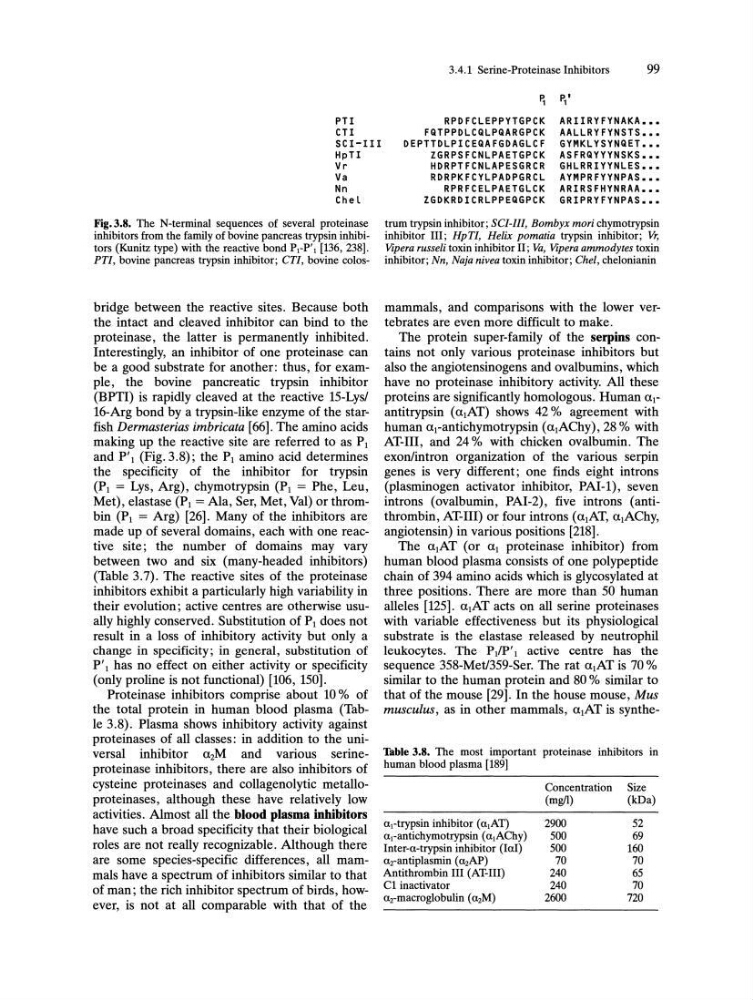
Fig.3.8. The N-terminal sequences of several proteinase
inhibitors from the family of bovine pancreas trypsin inhibitors (Kunitz type) with the reactive bond PI-P"~ [136, 238].
PT!, bovine pancreas trypsin inhibitor; CT!, bovine colosbridge between the reactive sites. Because both
the intact and cleaved inhibitor can bind to the
proteinase, the latter is permanently inhibited.
Interestingly, an inhibitor of one proteinase can
be a good substrate for another: thus, for example, the bovine pancreatic trypsin inhibitor
(BPTI) is rapidly cleaved at the reactive 15-Lys/
16-Arg bond by a trypsin-like enzyme of the starfish Dermasterias imbricata [66]. The amino acids
making up the reactive site are referred to as P 1
and p
l l (Fig. 3.8); the PI amino acid determines
the specificity of the inhibitor for trypsin
(PI = Lys, Arg), chymotrypsin (PI = Phe, Leu,
Met), elastase (PI = Ala, Ser, Met, Val) or thrombin (PI = Arg) [26]. Many of the inhibitors are
made up of several domains, each with one reactive site; the number of domains may vary
between two and six (many-headed inhibitors)
(Table 3.7). The reactive sites of the proteinase
inhibitors exhibit a particularly high variability in
their evolution; active centres are otherwise usually highly conserved. Substitution of PI does not
result in a loss of inhibitory activity but only a
change in specificity; in general, substitution of
p
l
l has no effect on either activity or specificity
(only proline is not functional) [106, 150].
Proteinase inhibitors comprise about 10 % of
the total protein in human blood plasma (Table 3.8). Plasma shows inhibitory activity against
proteinases of all classes: in addition to the universal inhibitor uzM and various serineproteinase inhibitors, there are also inhibitors of
cysteine proteinases and collagenolytic metalloproteinases, although these have relatively low
activities. Almost all the blood plasma inhibitors
have such a broad specificity that their biological
roles are not really recognizable. Although there
are some species-specific differences, all mammals have a spectrum of inhibitors similar to that
of man; the rich inhibitor spectrum of birds, however, is not at all comparable with that of the
3.4.1 Serine-Proteinase Inhibitors
99
RPDFCLEPPYTGPCK
FQTPPDLCQLPQARGPCK
AR II RY FYNAKA •••
AALLRYFYNSTS •••
GYMKLYSYNQET •••
ASFRQYYYNSKS •••
GHLRR IYYNLES •••
AYMPRFYYNPAS •••
ARIRSFHYNRAA •••
GRIPRYFYNPAS •••
DEPTTDLPICEQAFGDAGLCF
ZGRPSFCNLPAETGPCK
HDRPTFCNLAPESGRCR
RDRPKFCYLPADPGRCL
RPRFCELPAETGLCK
ZGDKRDICRLPPEQGPCK
trum trypsin inhibitor; SCI-III, Bombyx mori chymotrypsin
inhibitor III; HpT!, Helix pomatia trypsin inhibitor; Vi;
Vipera russeli toxin inhibitor II; Va, Vipera ammodytes toxin
inhibitor; Nn, Naja nivea toxin inhibitor; Chel, chelonianin
mammals, and comparisons with the lower vertebrates are even more difficult to make.
The protein super-family of the serpins contains not only various proteinase inhibitors but
also the angiotensinogens and ovalbumins, which
have no proteinase inhibitory activity. All these
proteins are significantly homologous. Human Ur
antitrypsin (uIAT) shows 42 % agreement with
human ul-antichymotrypsin (ulAChy), 28 % with
AT-III, and 24 % with chicken ovalbumin. The
exonlintron organization of the various serpin
genes is very different; one finds eight introns
(plasminogen activator inhibitor, PAl-I), seven
introns (ovalbumin, PAI-2), five introns (antithrombin, AT-III) or four introns (uIAT, ulAChy,
angiotensin) in various positions [218].
The ulAT (or UI proteinase inhibitor) from
human blood plasma consists of one polypeptide
chain of 394 amino acids which is glycosylated at
three positions. There are more than 50 human
alleles [125]. ulAT acts on all serine proteinases
with variable effectiveness but its physiological
substrate is the elastase released by neutrophil
leukocytes. The P/P' I active centre has the
sequence 358-Met/359-Ser. The rat ulAT is 70 %
similar to the human protein and 80 % similar to
that of the mouse [29]. In the house mouse, Mus
musculus, as in other mammals, ulAT is syntheTable 3.8. The most important proteinase inhibitors in
human blood plasma [189]
u,-trypsin inhibitor (u,AT)
u,-antichymotrypsin (u,AChy)
Inter-u-trypsin inhibitor (luI)
u2-antiplasmin (u2AP)
Antithrombin III (AT-III)
C1 inactivator
uz-macroglobulin (u2M)
Concentration Size
(mgll)
(kDa)
2900
500
500
70
240
240
2600
52
69
160
70
65
70
720
CTl
SCI-III
HpTl
Vr
Va
Nn
CheL
Fig.3.8. The N-terminal sequences of several proteinase
inhibitors from the family of bovine pancreas trypsin inhibitors (Kunitz type) with the reactive bond PI-P"~ [136, 238].
PT!, bovine pancreas trypsin inhibitor; CT!, bovine colosbridge between the reactive sites. Because both
the intact and cleaved inhibitor can bind to the
proteinase, the latter is permanently inhibited.
Interestingly, an inhibitor of one proteinase can
be a good substrate for another: thus, for example, the bovine pancreatic trypsin inhibitor
(BPTI) is rapidly cleaved at the reactive 15-Lys/
16-Arg bond by a trypsin-like enzyme of the starfish Dermasterias imbricata [66]. The amino acids
making up the reactive site are referred to as P 1
and p
l l (Fig. 3.8); the PI amino acid determines
the specificity of the inhibitor for trypsin
(PI = Lys, Arg), chymotrypsin (PI = Phe, Leu,
Met), elastase (PI = Ala, Ser, Met, Val) or thrombin (PI = Arg) [26]. Many of the inhibitors are
made up of several domains, each with one reactive site; the number of domains may vary
between two and six (many-headed inhibitors)
(Table 3.7). The reactive sites of the proteinase
inhibitors exhibit a particularly high variability in
their evolution; active centres are otherwise usually highly conserved. Substitution of PI does not
result in a loss of inhibitory activity but only a
change in specificity; in general, substitution of
p
l
l has no effect on either activity or specificity
(only proline is not functional) [106, 150].
Proteinase inhibitors comprise about 10 % of
the total protein in human blood plasma (Table 3.8). Plasma shows inhibitory activity against
proteinases of all classes: in addition to the universal inhibitor uzM and various serineproteinase inhibitors, there are also inhibitors of
cysteine proteinases and collagenolytic metalloproteinases, although these have relatively low
activities. Almost all the blood plasma inhibitors
have such a broad specificity that their biological
roles are not really recognizable. Although there
are some species-specific differences, all mammals have a spectrum of inhibitors similar to that
of man; the rich inhibitor spectrum of birds, however, is not at all comparable with that of the
3.4.1 Serine-Proteinase Inhibitors
99
RPDFCLEPPYTGPCK
FQTPPDLCQLPQARGPCK
AR II RY FYNAKA •••
AALLRYFYNSTS •••
GYMKLYSYNQET •••
ASFRQYYYNSKS •••
GHLRR IYYNLES •••
AYMPRFYYNPAS •••
ARIRSFHYNRAA •••
GRIPRYFYNPAS •••
DEPTTDLPICEQAFGDAGLCF
ZGRPSFCNLPAETGPCK
HDRPTFCNLAPESGRCR
RDRPKFCYLPADPGRCL
RPRFCELPAETGLCK
ZGDKRDICRLPPEQGPCK
trum trypsin inhibitor; SCI-III, Bombyx mori chymotrypsin
inhibitor III; HpT!, Helix pomatia trypsin inhibitor; Vi;
Vipera russeli toxin inhibitor II; Va, Vipera ammodytes toxin
inhibitor; Nn, Naja nivea toxin inhibitor; Chel, chelonianin
mammals, and comparisons with the lower vertebrates are even more difficult to make.
The protein super-family of the serpins contains not only various proteinase inhibitors but
also the angiotensinogens and ovalbumins, which
have no proteinase inhibitory activity. All these
proteins are significantly homologous. Human Ur
antitrypsin (uIAT) shows 42 % agreement with
human ul-antichymotrypsin (ulAChy), 28 % with
AT-III, and 24 % with chicken ovalbumin. The
exonlintron organization of the various serpin
genes is very different; one finds eight introns
(plasminogen activator inhibitor, PAl-I), seven
introns (ovalbumin, PAI-2), five introns (antithrombin, AT-III) or four introns (uIAT, ulAChy,
angiotensin) in various positions [218].
The ulAT (or UI proteinase inhibitor) from
human blood plasma consists of one polypeptide
chain of 394 amino acids which is glycosylated at
three positions. There are more than 50 human
alleles [125]. ulAT acts on all serine proteinases
with variable effectiveness but its physiological
substrate is the elastase released by neutrophil
leukocytes. The P/P' I active centre has the
sequence 358-Met/359-Ser. The rat ulAT is 70 %
similar to the human protein and 80 % similar to
that of the mouse [29]. In the house mouse, Mus
musculus, as in other mammals, ulAT is syntheTable 3.8. The most important proteinase inhibitors in
human blood plasma [189]
u,-trypsin inhibitor (u,AT)
u,-antichymotrypsin (u,AChy)
Inter-u-trypsin inhibitor (luI)
u2-antiplasmin (u2AP)
Antithrombin III (AT-III)
C1 inactivator
uz-macroglobulin (u2M)
Concentration Size
(mgll)
(kDa)
2900
500
500
70
240
240
2600
52
69
160
70
65
70
720