

3.2.3 Transport of Newly Synthesized Proteins to Their Correct Destinations in the Cell
85
Insulin (Myxine)
(Lophius)
-1 +1
MALSPFLAAVIPLVLLLSRAPPSADT RTTGH .. .
MAALWLQSFSLLVLLVVSWPGSQA VAPAQ .. .
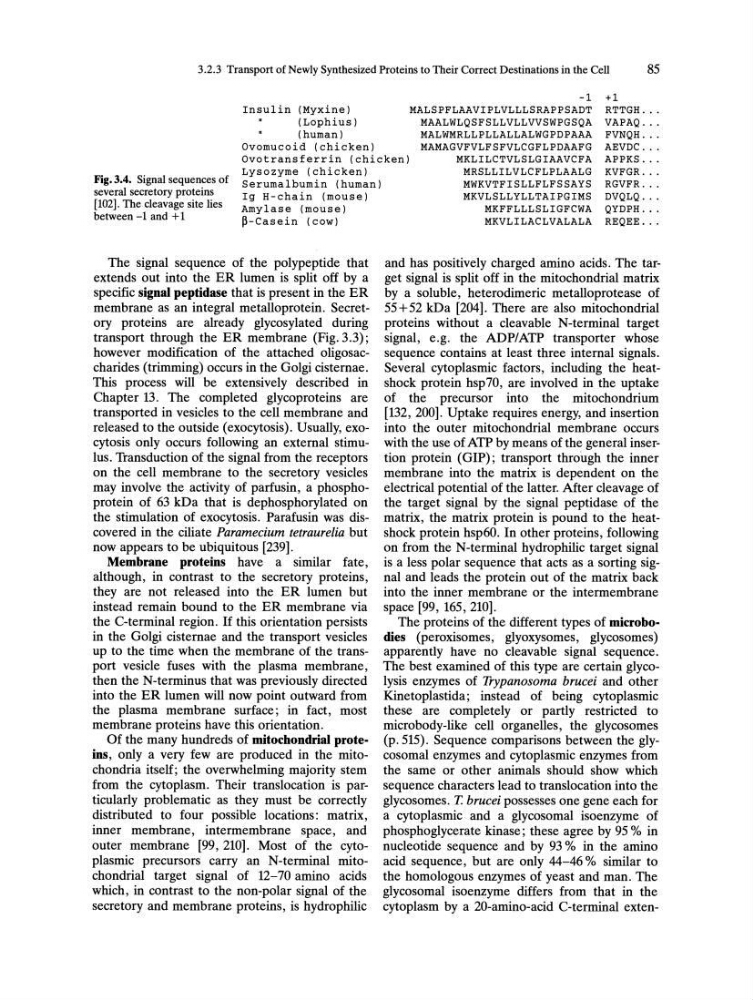
Fig. 3.4. Signal sequences of
several secretory proteins
[102]. The cleavage site lies
between -1 and + 1
(human)
Ovomucoid (chicken)
Ovotransferrin (chicken)
Lysozyme (chicken)
Serumalbumin (human)
MALWMRLLPLLALLALWGPDPAAA FVNQH .. .
MAMAGVFVLFSFVLCGFLPDAAFG AEVDC .. .
MKLILCTVLSLGIAAVCFA APPKS .. .
MRSLLILVLCFLPLAALG KVFGR .. .
MWKVTFISLLFLFSSAYS RGVFR .. .
Ig H-chain (mouse)
Amylase (mouse)
~-Casein (cow)
The signal sequence of the polypeptide that
extends out into the ER lumen is split off by a
specific signal peptidase that is present in the ER
membrane as an integral metalloprotein. Secretory proteins are already glycosylated during
transport through the ER membrane (Fig. 3.3);
however modification of the attached oligosaccharides (trimming) occurs in the Golgi cisternae.
This process will be extensively described in
Chapter 13. The completed glycoproteins are
transported in vesicles to the cell membrane and
released to the outside (exocytosis). Usually, exocytosis only occurs following an external stimulus. Transduction of the signal from the receptors
on the cell membrane to the secretory vesicles
may involve the activity of parfusin, a phosphoprotein of 63 kDa that is dephosphorylated on
the stimulation of exocytosis. Parafusin was discovered in the ciliate Paramecium tetraurelia but
now appears to be ubiquitous [239].
Membrane proteins have a similar fate,
although, in contrast to the secretory proteins,
they are not released into the ER lumen but
instead remain bound to the ER membrane via
the C-terminal region. If this orientation persists
in the Golgi cisternae and the transport vesicles
up to the time when the membrane of the transport vesicle fuses with the plasma membrane,
then the N-terminus that was previously directed
into the ER lumen will now point outward from
the plasma membrane surface; in fact, most
membrane proteins have this orientation.
Of the many hundreds of mitochondrial proteins, only a very few are produced in the mitochondria itself; the overwhelming majority stem
from the cytoplasm. Their translocation is particularly problematic as they must be correctly
distributed to four possible locations: matrix,
inner membrane, intermembrane space, and
outer membrane [99,210]. Most of the cytoplasmic precursors carry an N-terminal mitochondrial target signal of 12-70 amino acids
which, in contrast to the non-polar signal of the
secretory and membrane proteins, is hydrophilic
MKVLSLLYLLTAIPGIMS DVQLQ .. .
MKFFLLLSLIGFCWA QYDPH .. .
MKVLILACLVALALA REQEE .. .
and has positively charged amino acids. The target signal is split off in the mitochondrial matrix
by a soluble, heterodimeric metalloprotease of
55 + 52 kDa [204]. There are also mitochondrial
proteins without a cleavable N-terminal target
signal, e.g. the ADP/ATP transporter whose
sequence contains at least three internal signals.
Several cytoplasmic factors, including the heatshock protein hsp70, are involved in the uptake
of the precursor into the mitochondrium
[132, 200]. Uptake requires energy, and insertion
into the outer mitochondrial membrane occurs
with the use of ATP by means of the general insertion protein (GIP); transport through the inner
membrane into the matrix is dependent on the
electrical potential of the latter. After cleavage of
the target signal by the signal peptidase of the
matrix, the matrix protein is pound to the heatshock protein hsp60. In other proteins, following
on from the N-terminal hydrophilic target signal
is a less polar sequence that acts as a sorting signal and leads the protein out of the matrix back
into the inner membrane or the intermembrane
space [99, 165, 210].
The proteins of the different types of microbodies (peroxisomes, glyoxysomes, glycosomes)
apparently have no cleavable signal sequence.
The best examined of this type are certain glycolysis enzymes of Trypanosoma brucei and other
Kinetoplastida; instead of being cytoplasmic
these are completely or partly restricted to
microbody-like cell organelles, the glycosomes
(p. 515). Sequence comparisons between the glycosomal enzymes and cytoplasmic enzymes from
the same or other animals should show which
sequence characters lead to translocation into the
glycosomes. T. brucei possesses one gene each for
a cytoplasmic and a glycosomal isoenzyme of
phosphoglycerate kinase; these agree by 95 % in
nucleotide sequence and by 93 % in the amino
acid sequence, but are only 44-46 % similar to
the homologous enzymes of yeast and man. The
glycosomal isoenzyme differs from that in the
cytoplasm by a 20-amino-acid C-terminal exten-
85
Insulin (Myxine)
(Lophius)
-1 +1
MALSPFLAAVIPLVLLLSRAPPSADT RTTGH .. .
MAALWLQSFSLLVLLVVSWPGSQA VAPAQ .. .
Fig. 3.4. Signal sequences of
several secretory proteins
[102]. The cleavage site lies
between -1 and + 1
(human)
Ovomucoid (chicken)
Ovotransferrin (chicken)
Lysozyme (chicken)
Serumalbumin (human)
MALWMRLLPLLALLALWGPDPAAA FVNQH .. .
MAMAGVFVLFSFVLCGFLPDAAFG AEVDC .. .
MKLILCTVLSLGIAAVCFA APPKS .. .
MRSLLILVLCFLPLAALG KVFGR .. .
MWKVTFISLLFLFSSAYS RGVFR .. .
Ig H-chain (mouse)
Amylase (mouse)
~-Casein (cow)
The signal sequence of the polypeptide that
extends out into the ER lumen is split off by a
specific signal peptidase that is present in the ER
membrane as an integral metalloprotein. Secretory proteins are already glycosylated during
transport through the ER membrane (Fig. 3.3);
however modification of the attached oligosaccharides (trimming) occurs in the Golgi cisternae.
This process will be extensively described in
Chapter 13. The completed glycoproteins are
transported in vesicles to the cell membrane and
released to the outside (exocytosis). Usually, exocytosis only occurs following an external stimulus. Transduction of the signal from the receptors
on the cell membrane to the secretory vesicles
may involve the activity of parfusin, a phosphoprotein of 63 kDa that is dephosphorylated on
the stimulation of exocytosis. Parafusin was discovered in the ciliate Paramecium tetraurelia but
now appears to be ubiquitous [239].
Membrane proteins have a similar fate,
although, in contrast to the secretory proteins,
they are not released into the ER lumen but
instead remain bound to the ER membrane via
the C-terminal region. If this orientation persists
in the Golgi cisternae and the transport vesicles
up to the time when the membrane of the transport vesicle fuses with the plasma membrane,
then the N-terminus that was previously directed
into the ER lumen will now point outward from
the plasma membrane surface; in fact, most
membrane proteins have this orientation.
Of the many hundreds of mitochondrial proteins, only a very few are produced in the mitochondria itself; the overwhelming majority stem
from the cytoplasm. Their translocation is particularly problematic as they must be correctly
distributed to four possible locations: matrix,
inner membrane, intermembrane space, and
outer membrane [99,210]. Most of the cytoplasmic precursors carry an N-terminal mitochondrial target signal of 12-70 amino acids
which, in contrast to the non-polar signal of the
secretory and membrane proteins, is hydrophilic
MKVLSLLYLLTAIPGIMS DVQLQ .. .
MKFFLLLSLIGFCWA QYDPH .. .
MKVLILACLVALALA REQEE .. .
and has positively charged amino acids. The target signal is split off in the mitochondrial matrix
by a soluble, heterodimeric metalloprotease of
55 + 52 kDa [204]. There are also mitochondrial
proteins without a cleavable N-terminal target
signal, e.g. the ADP/ATP transporter whose
sequence contains at least three internal signals.
Several cytoplasmic factors, including the heatshock protein hsp70, are involved in the uptake
of the precursor into the mitochondrium
[132, 200]. Uptake requires energy, and insertion
into the outer mitochondrial membrane occurs
with the use of ATP by means of the general insertion protein (GIP); transport through the inner
membrane into the matrix is dependent on the
electrical potential of the latter. After cleavage of
the target signal by the signal peptidase of the
matrix, the matrix protein is pound to the heatshock protein hsp60. In other proteins, following
on from the N-terminal hydrophilic target signal
is a less polar sequence that acts as a sorting signal and leads the protein out of the matrix back
into the inner membrane or the intermembrane
space [99, 165, 210].
The proteins of the different types of microbodies (peroxisomes, glyoxysomes, glycosomes)
apparently have no cleavable signal sequence.
The best examined of this type are certain glycolysis enzymes of Trypanosoma brucei and other
Kinetoplastida; instead of being cytoplasmic
these are completely or partly restricted to
microbody-like cell organelles, the glycosomes
(p. 515). Sequence comparisons between the glycosomal enzymes and cytoplasmic enzymes from
the same or other animals should show which
sequence characters lead to translocation into the
glycosomes. T. brucei possesses one gene each for
a cytoplasmic and a glycosomal isoenzyme of
phosphoglycerate kinase; these agree by 95 % in
nucleotide sequence and by 93 % in the amino
acid sequence, but are only 44-46 % similar to
the homologous enzymes of yeast and man. The
glycosomal isoenzyme differs from that in the
cytoplasm by a 20-amino-acid C-terminal exten-