

280
S. Gobert et al.
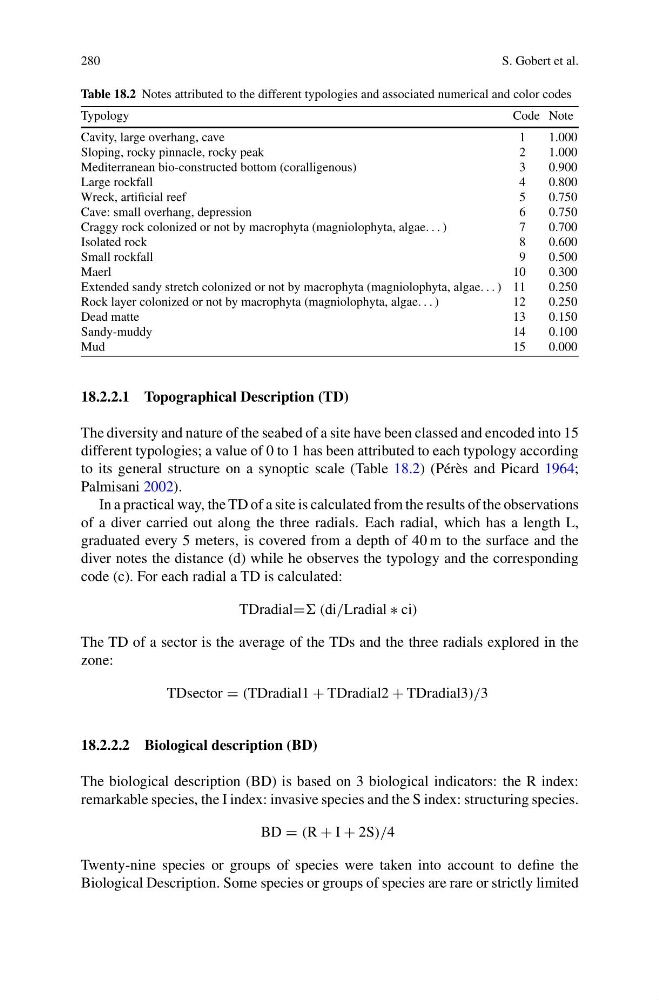
Table 18.2 Notes attributed to the different typologies and associated numerical and color codes
Typology
Code Note
Cavity, large overhang, cave
1
1.000
Sloping, rocky pinnacle, rocky peak
2
1.000
Mediterranean bio-constructed bottom (coralligenous)
3
0.900
Large rockfall
4
0.800
Wreck, artificial reef
5
0.750
Cave: small overhang, depression
6
0.750
Craggy rock colonized or not by macrophyta (magniolophyta, algae. . . )
7
0.700
Isolated rock
8
0.600
Small rockfall
9
0.500
Maerl
10
0.300
Extended sandy stretch colonized or not by macrophyta (magniolophyta, algae. . . ) 11
0.250
Rock layer colonized or not by macrophyta (magniolophyta, algae. . . )
12
0.250
Dead matte
13
0.150
Sandy-muddy
14
0.100
Mud
15
0.000
18.2.2.1 Topographical Description (TD)
The diversity and nature of the seabed of a site have been classed and encoded into 15
different typologies; a value of 0 to 1 has been attributed to each typology according
to its general structure on a synoptic scale (Table 18.2) (Pérès and Picard 1964;
Palmisani 2002).
In a practical way, the TD of a site is calculated from the results of the observations
of a diver carried out along the three radials. Each radial, which has a length L,
graduated every 5 meters, is covered from a depth of 40 m to the surface and the
diver notes the distance (d) while he observes the typology and the corresponding
code (c). For each radial a TD is calculated:
TDradial= (di/Lradial ∗ ci)
The TD of a sector is the average of the TDs and the three radials explored in the
zone:
TDsector = (TDradial1 + TDradial2 + TDradial3)/3
18.2.2.2 Biological description (BD)
The biological description (BD) is based on 3 biological indicators: the R index:
remarkable species, the I index: invasive species and the S index: structuring species.
BD = (R + I + 2S)/4
Twenty-nine species or groups of species were taken into account to define the
Biological Description. Some species or groups of species are rare or strictly limited
S. Gobert et al.
Table 18.2 Notes attributed to the different typologies and associated numerical and color codes
Typology
Code Note
Cavity, large overhang, cave
1
1.000
Sloping, rocky pinnacle, rocky peak
2
1.000
Mediterranean bio-constructed bottom (coralligenous)
3
0.900
Large rockfall
4
0.800
Wreck, artificial reef
5
0.750
Cave: small overhang, depression
6
0.750
Craggy rock colonized or not by macrophyta (magniolophyta, algae. . . )
7
0.700
Isolated rock
8
0.600
Small rockfall
9
0.500
Maerl
10
0.300
Extended sandy stretch colonized or not by macrophyta (magniolophyta, algae. . . ) 11
0.250
Rock layer colonized or not by macrophyta (magniolophyta, algae. . . )
12
0.250
Dead matte
13
0.150
Sandy-muddy
14
0.100
Mud
15
0.000
18.2.2.1 Topographical Description (TD)
The diversity and nature of the seabed of a site have been classed and encoded into 15
different typologies; a value of 0 to 1 has been attributed to each typology according
to its general structure on a synoptic scale (Table 18.2) (Pérès and Picard 1964;
Palmisani 2002).
In a practical way, the TD of a site is calculated from the results of the observations
of a diver carried out along the three radials. Each radial, which has a length L,
graduated every 5 meters, is covered from a depth of 40 m to the surface and the
diver notes the distance (d) while he observes the typology and the corresponding
code (c). For each radial a TD is calculated:
TDradial= (di/Lradial ∗ ci)
The TD of a sector is the average of the TDs and the three radials explored in the
zone:
TDsector = (TDradial1 + TDradial2 + TDradial3)/3
18.2.2.2 Biological description (BD)
The biological description (BD) is based on 3 biological indicators: the R index:
remarkable species, the I index: invasive species and the S index: structuring species.
BD = (R + I + 2S)/4
Twenty-nine species or groups of species were taken into account to define the
Biological Description. Some species or groups of species are rare or strictly limited