

1 Introduction: Towards a Shared Language: Semantic Exchanges . . .
13
Terminology
Surfaces
DescripƟon
Component
n x 1 m
Abioc, bioc or anthropic element covering a small
surface area
LocaƟon
n x 10 m
Limited area with a parcular use or percepon
Site
n x 100 m
Special areas, oen around an emblemac feature
Landscape structure
n x 100 m
Characterisc organisaon of a unit, consisng of
components
Type of landscape
n x 1km
Homogeneous area in terms of relief, plant coverage,
occupaon (sequence)
Landscape unit
n x 10 km
Has a certain homogeneity compared to neighbouring
units but a varying degree of internal complexity (mosaic,
gradient)
Landscape group
n x 100 km
Grouping of units, regional overviews
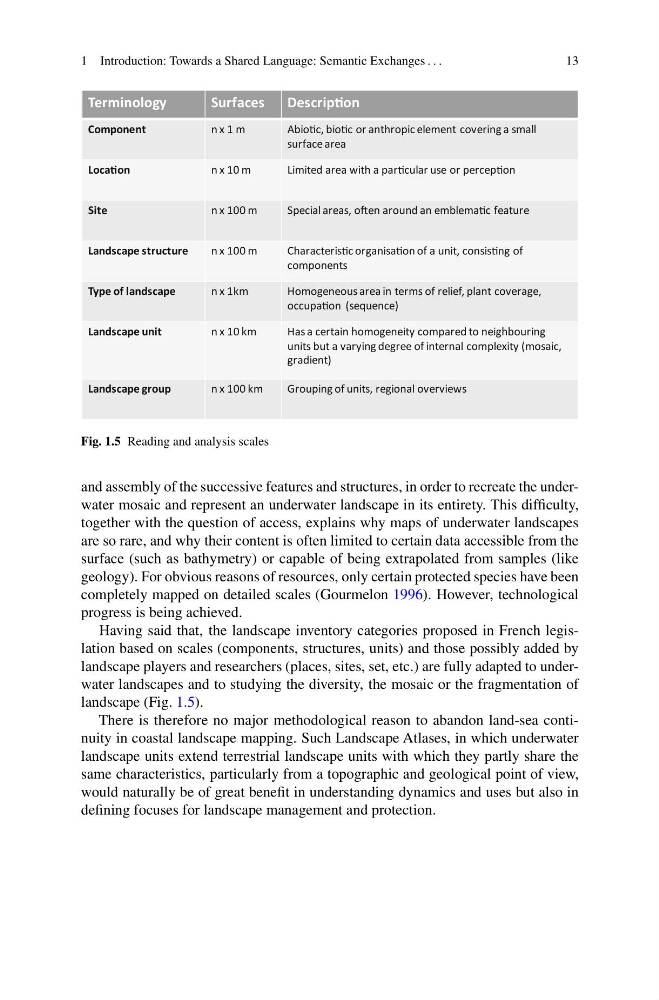
Fig. 1.5 Reading and analysis scales
and assembly of the successive features and structures, in order to recreate the underwater mosaic and represent an underwater landscape in its entirety. This difficulty,
together with the question of access, explains why maps of underwater landscapes
are so rare, and why their content is often limited to certain data accessible from the
surface (such as bathymetry) or capable of being extrapolated from samples (like
geology). For obvious reasons of resources, only certain protected species have been
completely mapped on detailed scales (Gourmelon 1996). However, technological
progress is being achieved.
Having said that, the landscape inventory categories proposed in French legislation based on scales (components, structures, units) and those possibly added by
landscape players and researchers (places, sites, set, etc.) are fully adapted to underwater landscapes and to studying the diversity, the mosaic or the fragmentation of
landscape (Fig. 1.5).
There is therefore no major methodological reason to abandon land-sea continuity in coastal landscape mapping. Such Landscape Atlases, in which underwater
landscape units extend terrestrial landscape units with which they partly share the
same characteristics, particularly from a topographic and geological point of view,
would naturally be of great benefit in understanding dynamics and uses but also in
defining focuses for landscape management and protection.
13
Terminology
Surfaces
DescripƟon
Component
n x 1 m
Abioc, bioc or anthropic element covering a small
surface area
LocaƟon
n x 10 m
Limited area with a parcular use or percepon
Site
n x 100 m
Special areas, oen around an emblemac feature
Landscape structure
n x 100 m
Characterisc organisaon of a unit, consisng of
components
Type of landscape
n x 1km
Homogeneous area in terms of relief, plant coverage,
occupaon (sequence)
Landscape unit
n x 10 km
Has a certain homogeneity compared to neighbouring
units but a varying degree of internal complexity (mosaic,
gradient)
Landscape group
n x 100 km
Grouping of units, regional overviews
Fig. 1.5 Reading and analysis scales
and assembly of the successive features and structures, in order to recreate the underwater mosaic and represent an underwater landscape in its entirety. This difficulty,
together with the question of access, explains why maps of underwater landscapes
are so rare, and why their content is often limited to certain data accessible from the
surface (such as bathymetry) or capable of being extrapolated from samples (like
geology). For obvious reasons of resources, only certain protected species have been
completely mapped on detailed scales (Gourmelon 1996). However, technological
progress is being achieved.
Having said that, the landscape inventory categories proposed in French legislation based on scales (components, structures, units) and those possibly added by
landscape players and researchers (places, sites, set, etc.) are fully adapted to underwater landscapes and to studying the diversity, the mosaic or the fragmentation of
landscape (Fig. 1.5).
There is therefore no major methodological reason to abandon land-sea continuity in coastal landscape mapping. Such Landscape Atlases, in which underwater
landscape units extend terrestrial landscape units with which they partly share the
same characteristics, particularly from a topographic and geological point of view,
would naturally be of great benefit in understanding dynamics and uses but also in
defining focuses for landscape management and protection.